



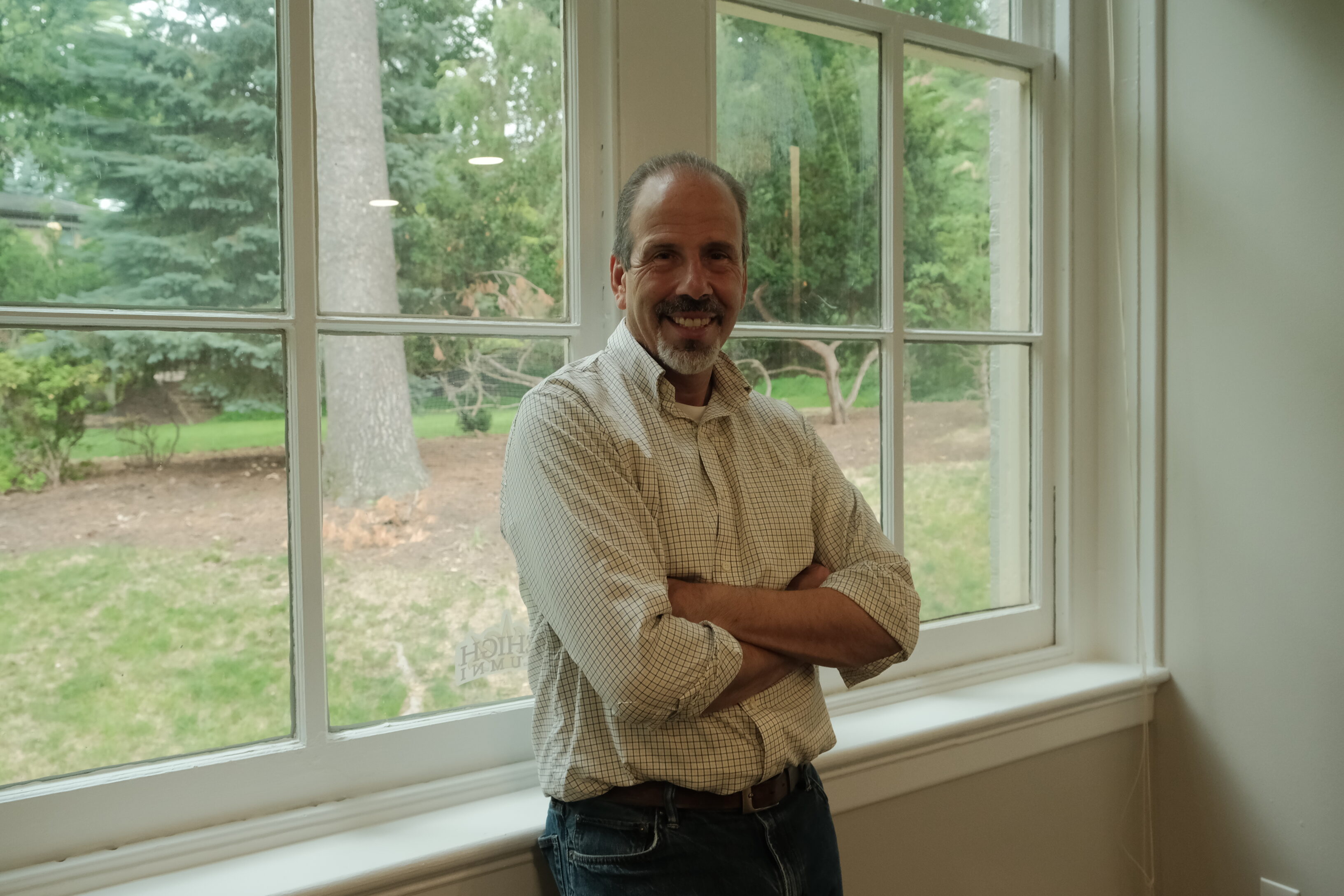
For Christopher Borick, relocating to Lehigh is more than a change in workplace. It’s an opportunity to bring together decades of teaching, political research and public opinion analysis to a university that has long been part of his professional and personal life.
In July, Borick joined Lehigh full-time after spending much of his career at Muhlenberg College.
However, his connection to Lehigh began years before the move. Borick previously taught at the university as an adjunct professor in the Political Science Department. This semester, he is teaching an undergraduate course called American Political Systems and a graduate course called Research in Politics and Public Policy.
“I saw the direction of where the university has been heading in many exciting ways, and this time frame seemed like a really amazing opportunity to come aboard on a full-time basis,” he said.
Borick brings experience that exceeds the traditional role of a professor. Throughout his career, he has balanced teaching with research and analysis.
Borick’s political analysis has brought him to national and international media outlets, giving him opportunities to discuss elections, polling and political trends. His interest in these subjects began early. Growing up, Borick was exposed to political conversations within his family, sparking a curiosity that followed him into college.
As an undergraduate at Penn State studying American studies, he continued exploring politics before turning his attention towards policy in graduate school.
Over time, his research became increasingly focused on a question that continues to shape his work: What do people think about political issues and why? This interest led Borick to study public opinion on topics ranging from health to environmental policy.
At Lehigh, Borick has plans to expand that work through the establishment of the Lehigh University Opinion Observatory, a space dedicated to studying and measuring public opinion.
“I want to tie this all together,” he said. “I want the work of the observatory to be intertwined with my teaching, our class offerings and the student experience,” Borick said.
The observatory will serve as more than a place to conduct polls. Borick sees it as an opportunity to connect researchers and students from different disciplines to discuss questions that cross traditional academic boundaries.
Borick said conversations have already begun about potential collaborations with other research centers at Lehigh, including those working on electrification and artificial intelligence.
The observatory, located next to the Alumni Memorial Building, is currently being renovated, with graduate students involved in its early stages.
“The building was designed as an observatory to look at the heavens, and in my mind, looking at the thoughts and opinions of people is equally exciting and diverse, just like the heavens,” he said.
Even as his media presence has grown, teaching has remained a foundation of his career. Borick has been cited in the New York Times, Wall Street Journal and Axios. He is also co-writing a book about Pennsylvania being a swing state.
At his previous institution, Borick incorporated students into research projects, allowing them to gain experience beyond what they could learn from a textbook. He hopes to create similar opportunities at Lehigh for undergraduate and doctoral students.
Aria Sangha, ‘26, ‘27G, experienced Borick’s teaching approach firsthand.
She first took Borick’s political psychology course last fall and has since taken two additional courses with him.
Sangha said Borick is one of the best professors she’s had at Lehigh. In a subject where discussions can quickly become contentious, she said Borick creates an environment where students feel comfortable contributing while still challenging them to examine their beliefs.
“He really took the time for all of us to get to know him and then also to get to know each other, which I think is super important,” Sangha said.
She also said Borick’s courses have helped connect her interests in psychology and political science because he brings his experience as a pollster into classroom discussions.
Emily Collins, a media relations specialist in Lehigh’s University Communications and Public Affairs Department, said Borick’s ability to explain complicated political topics is also valuable outside the classroom.
She said Borick stands out for his ability to turn complicated political issues and data into information understandable to a broad audience.
“He’s so informed, really eager to participate and a really amazing representation of Lehigh and the type of expertise and faculty that we have here,” Collins said.
Comment Policy
Comments posted to The Brown and White website are reviewed by a moderator before being approved. Incendiary speech or harassing language, including comments targeted at individuals, may be deemed unacceptable and not published. Spam and other soliciting will also be declined.
The Brown and White also reserves the right to refuse the publication of entirely anonymous comments.