



Lehigh made significant changes to non-medical benefits for faculty and staff effective Jan. 1, 2027, with many of the changes applying to employees hired on, or after, that date.
The changes reduce retirement contributions for new employees, phase out the university’s annual $5,000 dependent tuition cash grant and change dependent tuition remission.
It will eliminate dependent undergraduate tuition remission during the first five years of new hires’ employment. This tuition remission provided eligible dependent children of full benefits eligible faculty and staff and their domestic partners a waiver for tuition.
They also ended coverage of summer and winter undergraduate courses, introduced new requirements for employee graduate tuition remission and ended tuition remission eligibility for the Flex MBA program.
Most current employees will retain several existing benefits under grandfathering provisions.
Lehigh joined the Tuition Exchange, a network of more than 710 colleges and universities, as an alternative to its tuition cash grant.
Retirement contributions
Lehigh contributes a percentage of an employee’s salary to the university’s retirement plan.
For employees hired Jan. 1, 2027 or later, the base contribution will drop to 3% for the first three years, 5% during years three to five and remain 8% after five years.
Employees hired before Jan. 1, 2027 will not be affected by this change and will continue to receive 4% in the first three years, 5% in the years three to five and 8% after five years.
Dependent tuition benefits
Lehigh is phasing out the $5,000 annual cash grant toward a dependent’s college tuition and replacing it with access to the Tuition Exchange program.
Employees hired before Jan. 1, 2027 can continue receiving the cash grant if their dependent begins receiving it before Jan. 1, 2029, until the dependent reaches the four-year maximum.
Employees hired on or after Jan. 1, 2027 will not be eligible for their dependent to receive the cash grant.
Employees hired on or after Jan. 1, 2027 will also no longer receive 50% tuition remission for dependents during their first five years of employment.
After five years of continuous benefits-eligible employment, dependents remain eligible for 100% tuition remission, subject to their admission to Lehigh.
Employees hired before Jan. 1, 2027 retain the existing 50% benefit during their first five years.
Summer and winter undergraduate courses will no longer be covered after the 2026-27 winter term.
The maximum age of enrollment for undergraduate study by dependents will decrease from 30 to 24, and the maximum age of enrollment for graduate study will decrease from 35 to 30.
Employee education benefits
Employees who begin graduate programs after Jan. 1, 2027 will be expected to remain at Lehigh for at least two years after completing their degree or certificate.
Employees who voluntarily leave or are terminated during those two years may have to repay part of their graduate tuition benefit.
The Flex MBA will no longer be eligible for tuition remission.
Employees, dependents and spouses already enrolled before Jan. 1, 2027 will not be affected, with transition provisions for those admitted and registered for the spring 2027 semester before Jan. 1, 2027.
Benefits Review Working Group
These changes follow a broader review of Lehigh’s non-medical benefits that began last academic year.
Jenna Lay, chair of the Faculty Senate, said the senate was informed that the university hadn’t conducted a comprehensive review of its non-medical benefits in over a decade and the administration was working to identify cost-saving measures.
Provost Nathan Urban said the university formed a committee of faculty and staff to review the non-medical portion of the benefits.
Urban said the committee spent months analyzing the benefits and working with employees who evaluate and adjust Lehigh’s benefits.
Christine Cook, senior vice president for finance and administration, approached Lay and the former faculty senate chair about creating the Benefits Review Working Group.
“We felt it was very important to include faculty in this work, so the faculty had a voice in this conversation,” Lay said. “It is good for that working group report to come to the Faculty Senate and for the Faculty Senate to respond and make recommendations.”
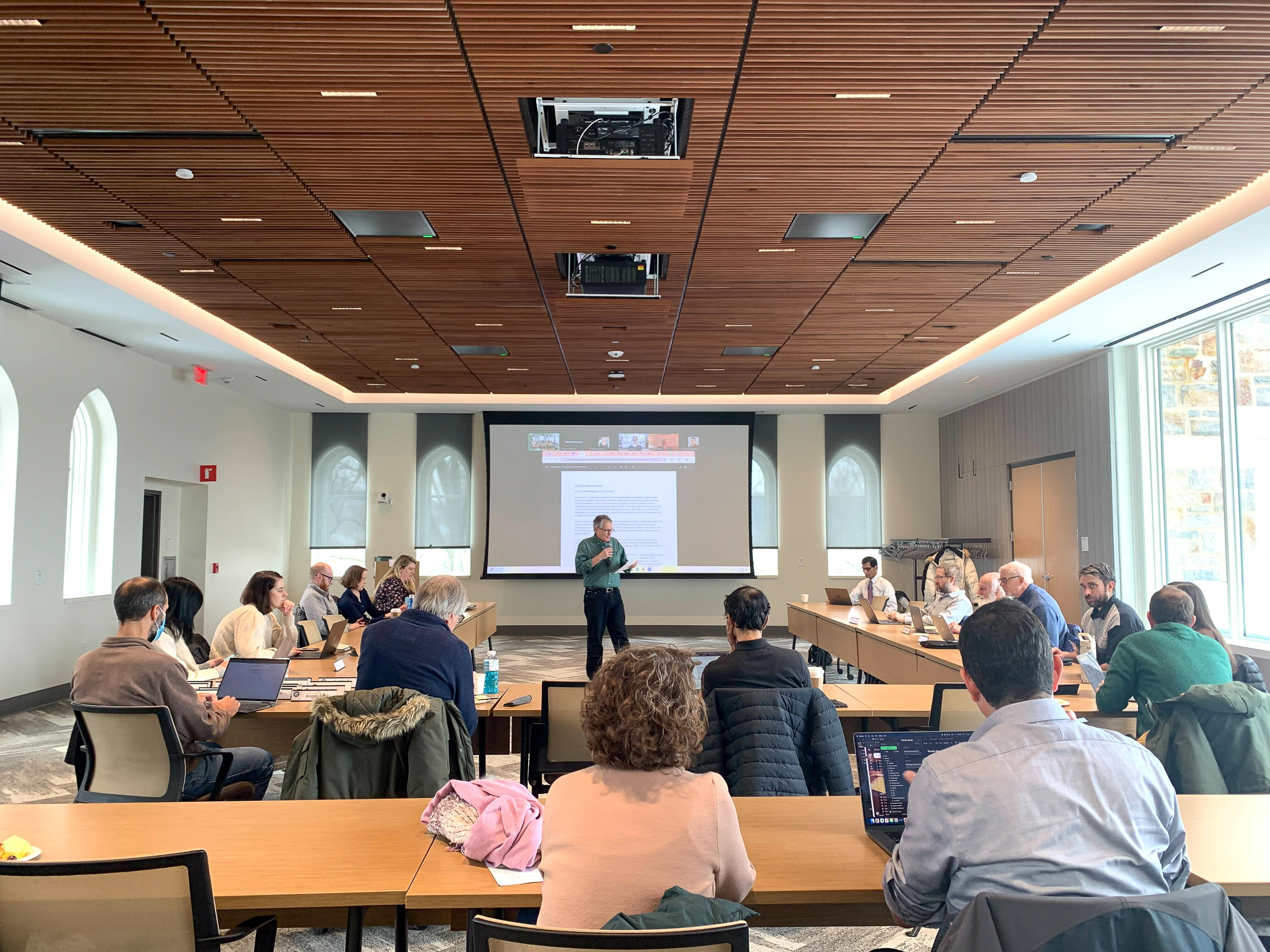
The working group includes two Faculty Senate representatives, Angela Hicks, vice chair of Faculty Senate and professor of mathematics, and Subhrajit Bhattacharya, a faculty senator and professor of mechanical engineering.
The group met during fall 2025. Its recommendations were brought to the Faculty Senate at its February 2026 meeting, where senators discussed the report and sent recommendations to Cook.
“The group evaluated benefits against four objectives: supporting employees, standardizing offerings, preserving competitive advantage and managing costs,” the report said.
According to their executive summary, the group proposed increasing vacation accrual for early and mid-career nonexempt staff, limiting vacation carryover to 12 days and ending unused vacation payouts for unclassified administrators upon departure.
These recommendations are meant to reduce long-term costs and bring nonexempt staff benefits closer to those of exempt employees and peer institutions.
The group also recommended modernizing educational benefits by expanding the tuition cash grant to nonexempt staff and increasing it to 10% of Lehigh tuition. According to the report, the tuition cash grant hasn’t been updated since 1986.
The group supported joining the Tuition Exchange, establishing a five-year waiting period and requiring employees who receive graduate tuition remission to remain at Lehigh for a period of time after completing their degree.
The group didn’t support the cost-saving reductions to retirement contributions because a significant reduction would further weaken Lehigh’s overall compensation competitiveness.
To read the full report, login to your Lehigh account here.
Lehigh deems changes necessary
Urban said every year he looks at the university budget and considers better spending strategies for the institution.
“It’s really important that we’re spending money in a way that provides the greatest benefit, that meets and promotes the university’s mission in the greatest possible way,” Urban said.
Urban said tuition dollars make up 60% of the university’s revenue.
Benefits compose about $78 million of the annual budget that’s approximately $550 million in total. Urban said about half of the benefits cost is health insurance.
Cook said the administration asked the Benefits Review Working Group to identify benefits Lehigh doesn’t currently offer and opportunities for cost containment.
“We are charged with the fiscal health of the institution,” Cook said. “The institution’s been here for 160 years. We’d like for it to be here another 160. We want to make sure that we’re doing everything that we can to maintain the fiscal health.”
Hicks, a member of the Benefits Review Working Group, is concerned about the implications of these changes for faculty and staff.
She said she’s especially questioning these changes at a time when the benefits percentage of university spending is already trending downward and Lehigh hasn’t indicated a state of financial hardship.
“It’s very important to me that Lehigh long-term is financially viable and continues to exist,” Hicks said. “I’m invested in this as are all of us. It worries me that I don’t fully understand the justification as to why now.”
Tuition Exchange Grant alternative
Cook said the administration wanted to maintain a competitive benefits package while also creating more equity among employees.
“We take very seriously what is happening to our tuition dollars,” Cook said. “Families are paying tuition to come to Lehigh. And these are dollars that were going to other schools. This is going to another institution, and we thought there might be other ways to provide that level of benefit.”
Urban said he’s aware that faculty and staff have expressed frustration about the tuition grant changes.
“The nature of that benefit is essentially to help provide access to education for the dependents of faculty and staff,” Urban said. “We think that we have a great option by providing full tuition at Lehigh for many students and dependents.”
The Tuition Exchange program is an alternative available at many of Lehigh’s peer institutions, Urban said.
Urban said the Tuition Exchange grants up to $45,000 per year of tuition benefit as opposed to $5,000 that would have been granted under the previous model.
The Tuition Exchange scholarships are funded by the institution where the student enrolls. This waives the student’s tuition as an institutional benefit. Participating institutions agree to this reciprocal system, with member institutions paying only administrative fees to the Tuition Exchange.
“The benefits or the impact of the changes were not uniformly distributed,” Urban said. “There are some people who will benefit more. The difference in part is that one was clear and predictable and the other depends on the college application process in some sense.”
Savings reallocations
Urban said the administration doesn’t expect the changes to produce significant savings in the short term because many of the changes aren’t applicable to current employees under grandfathering provisions.
He said the eventual savings will become part of the university’s ongoing resource allocation process.
“The fact that there is little clarity about what (the savings) are being reserved and reallocated for, I worry that it’s just going to get absorbed into the great budget without careful planning,” Hicks said. “I would feel more comfortable if it was part of a clearer financial strategy.”
Urban said he’s prioritizing faculty salary increases with savings.
He said over the last couple of years, faculty have received average salary increases of 3% or more across the population.
Urban said some institutions have given no salary increases in recent years because of financial challenges across higher education.
He also said Lehigh is balancing employee compensation with efforts to control tuition increases and provide financial aid to students.
Urban said there are a number of increasing costs the university is anticipating over the next few years. For example, Drown Hall is currently being renovated, including a complete replacement of its HVAC system.
“While we can’t say this dollar is going specifically for that, we’re doing this now because we have a number of things we’re expecting significant increases in costs in the coming years,” Urban said. “We’re trying to make sure that we can prioritize the things that make the university a place where both students and employees want to be. We have a beautiful campus, but it’s also a campus that needs a lot of work in an ongoing way.”
Comment Policy
Comments posted to The Brown and White website are reviewed by a moderator before being approved. Incendiary speech or harassing language, including comments targeted at individuals, may be deemed unacceptable and not published. Spam and other soliciting will also be declined.
The Brown and White also reserves the right to refuse the publication of entirely anonymous comments.