



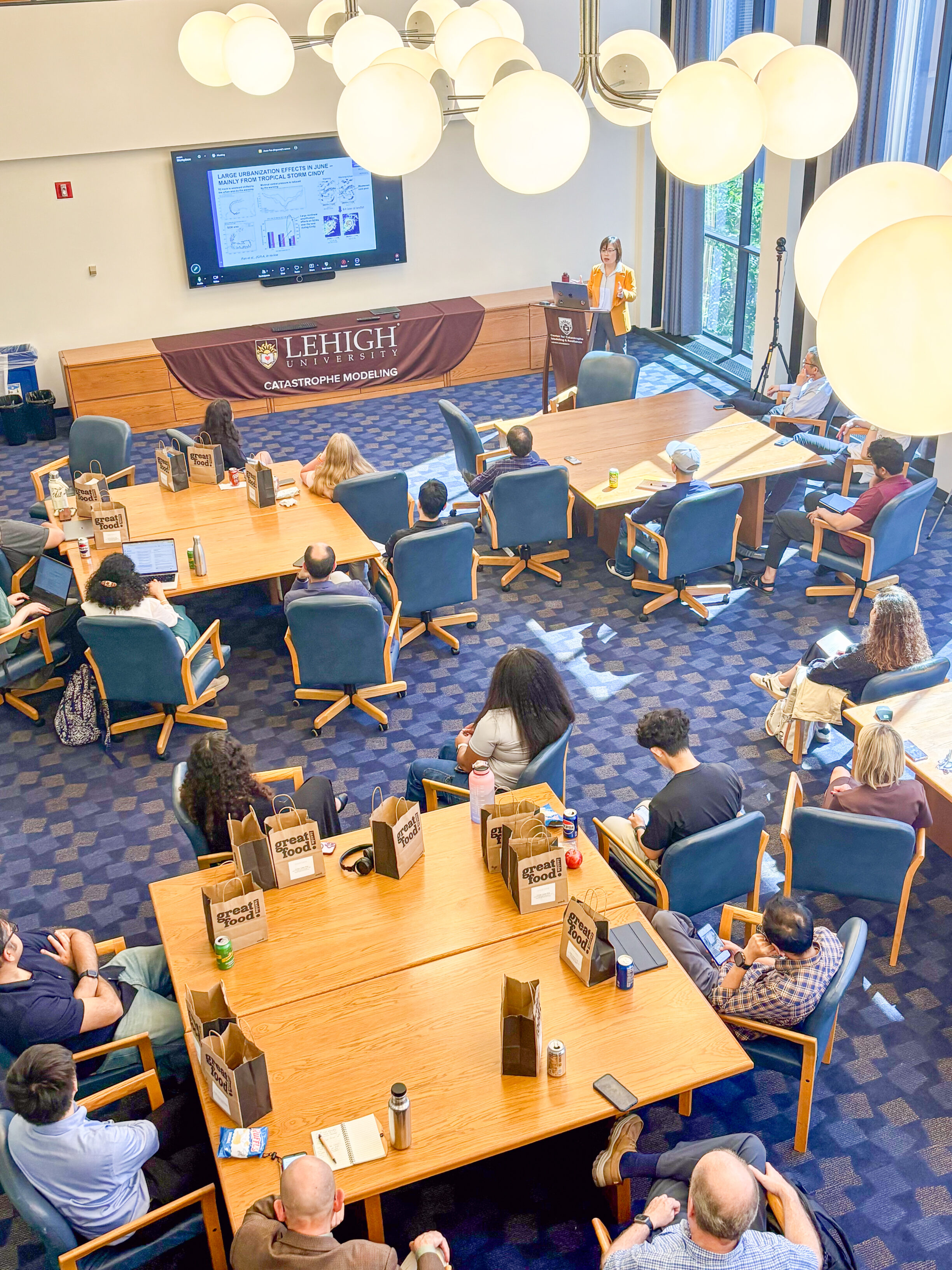
What started as an unofficial, small-scale gathering in 2014 at Lehigh grew into an officially recognized academic organization and research center for catastrophe modeling in the U.S.
Catastrophe modeling is the process of using data, technology and other information to predict disasters such as wildfires and floods. The research helps communities understand risks, mitigate damage and influence how insurance companies assess risk.
Lehigh’s Center for Catastrophe Modeling and Resilience is an academic hub, bringing together private and public sectors, including insurance companies and modeling firms, to solve natural disaster-related problems.
Paolo Bocchini, director of the center, said catastrophe modeling was a strategically sound area to invest in due to the existing groups already working on this topic at Lehigh that were reaching national and international recognition.
“From a Lehigh strategic planning point of view, the purpose of the center is to invest in an area where we already had strength to bring it to be an area of national visibility,” Bocchini said.
He said one result of the center’s development is the Consortium for Enhancing Resilience and Catastrophe Modeling, a collaboration of colleges across the U.S., including Rice University, Washington State University, Florida Atlantic University, Missouri University of Science and Technology and Columbia University, alongside major private companies.
The consortium works to identify the most pressing research topics in the field and encourages the use of the most recent advancements and practices.
According to Bocchini, Lehigh emerged as the leading institution for the consortium because of its academic and scientific strengths in the field of catastrophe modeling and resilience.
“For the projects in the consortium, we do research that is expected to be adopted immediately, and so it’s a different timeline, different pressure, maybe smaller scope projects, but particularly rewarding from the point of view of impact,” Bocchini said.
Funding from private-sector organizations, including insurance companies, allows the consortium to work on research intended for real-world applications.
Anik Das, ‘26G, is a former civil engineering doctoral student from Bangladesh who now works at the lab. He said he discovered Lehigh’s research center when looking for hands-on experience in the catastrophe industry.
Das said his research revolves around utilizing an AI language model to predict future disasters based on previous data. He’s also currently working on a project that uses the model to anticipate how reservoirs operate during floods and extreme weather conditions.
“We are planning to incorporate people from different domains, like industry, insurance, and other subject-matter experts, so they can share their real-world experience and help us identify more realistic scenarios, and critique our work to make it stronger,” Das said.
According to Das, the center allows him to work and meet supervisors who’ve shared important insights that have been crucial to his work in solving problems concerning large-scale events.
Genevieve Giammarco, ‘25, ‘27G, works at the center and said it’s opened her eyes to useful information for her field of work. She focuses on insurance for disaster resilience in farms, an area of study she’s interested in because she studied geography and agriculture as an undergraduate at Villanova University.
“There are ways that (insurance) can be used not just as something you expect after a disaster, but something that can help in preparation for a disaster,” Giammarco said.
The center allows students to utilize their studies while furthering their understanding on disaster resilience and preparation.
The Center of Catastrophe Modeling and Disaster Resilience gives undergraduate and graduate students rewarding opportunities to have a lasting impact on the world.
“(Working at the center) really helps me with the opportunity of using new tools that I won’t necessarily get to use in all my classes,” Giammarco said. “A lot of attention to modeling right now is just using technology, which is always changing.”
Comment Policy
Comments posted to The Brown and White website are reviewed by a moderator before being approved. Incendiary speech or harassing language, including comments targeted at individuals, may be deemed unacceptable and not published. Spam and other soliciting will also be declined.
The Brown and White also reserves the right to refuse the publication of entirely anonymous comments.