



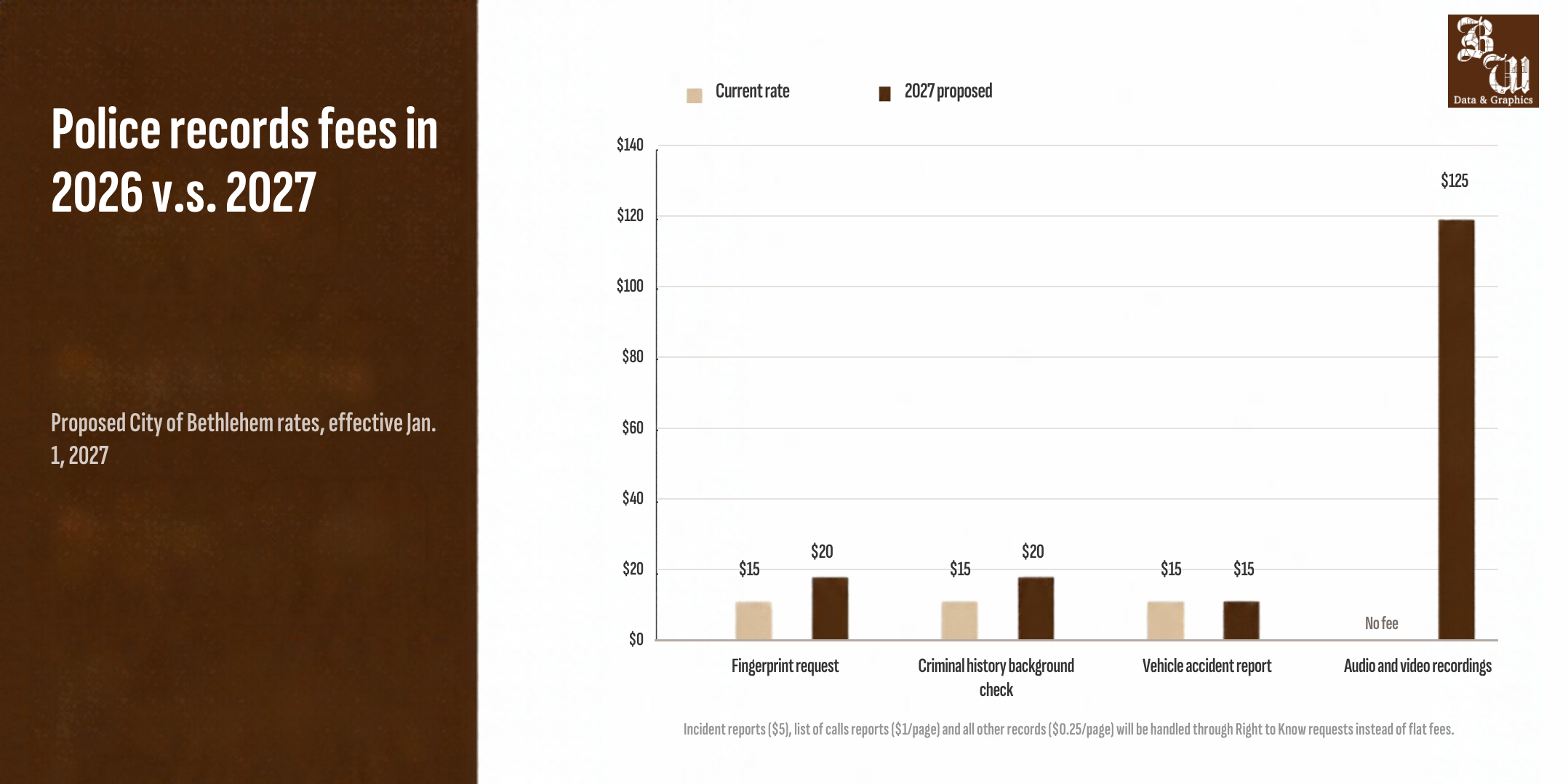
The Bethlehem Police Department increased their police record request fees and added a $125 fee for Act 22, which pertains to audio and video recording requests. These changes were approved by the City Council on Sept. 15 in a 6-1 vote.
These fee increases and changes include:
- Adding a $125 fee for Act 22 requests.
- Increasing the fingerprint request rate from $15 to $20.
- Increasing the criminal history background check rate from $15 to $20.
- Maintaining the vehicle accident report rate at $15.
- Handling incident reports, list of calls reports and all other records and documents kept by the city as right-to-know requests.
According to the Office of Open Records, Act 22 requests include “any audio recording or video recording made by a law enforcement agency.” The right-to-know law doesn’t apply to these requests.
The Commonwealth of Pennsylvania describes the Pennsylvania right-to-know law as ensuring “transparency by providing public access to government records.” Citizens don’t need to include a reason for their request.
An increase in requests
Michelle Kott, chief of police at the Bethlehem Police Department, said the department has been receiving a higher number of Act 22 requests than usual, since beginning her position in 2020, and each given request can take anywhere from four to six hours to fulfill.
Since May, she said the department has received 22 requests.
She said she discovered that the Bethlehem Police Department is outdated because she noticed the last time fees were adjusted was in January 2015.
“We quickly realized that it was taking up a lot of time and resources to fulfill those requests,” Kott said. “It’s been more than 11 years, and because of the processing, the reviewing, the copying, the redacting that is involved with the police records, we decided that it was time to update those fees as well as set a fee for the Act 22 requests.”
According to the Office of Open Records, Act 22 allows law enforcement agencies to charge a “reasonable fee” for the requests.
She said they calculated the cost by looking at what other departments in the area were doing and found that a lot of departments are charging fees for Act 22 requests.
The Pennsylvania State Police charges $150 per granted recording. The Philadelphia Police Department charges $125 per recording produced for up to an hour of labor and $200 per additional hour of labor required.
Kott said Captain William Audelo fulfills these requests and in the process he goes through video footage from body-worn cameras, in-car cameras and city cameras to redact any information that falls under Pennsylvania’s Criminal History Records Information Act. The information that must be redacted includes personal identifiers, arrest data, formal charges and dispositions.
She said an increase in requests and the amount of time it’s been since an increase in the fees drove the need for this fee increase. She also said the increase in availability of recording technology has invoked the increase in requests.
Fee increase raises accessibility concerns
Bryan Callahan, who has been on the Bethlehem City Council since 2014, was the only council member to vote against these fee increases. He said he believes transparency is very important for governments to have, and he doesn’t believe it makes sense for the city to be increasing the fees for requests.
Callahan grew up on the west side of Bethlehem in a lower-middle class family. He was a teacher for 30 years in the Bethlehem Area School District and said he taught students who were from a wide range of economic backgrounds.
“If I was still in that condition financially, which thankfully I’m not, but if I was, and I had a question or something happened to me with a police officer that I thought was wrong, I don’t have the money to spend $125 for a request,” Callahan said.
He said many people in the area will not be able to afford these requests, especially lower-income residents and students. He also said those who have the financial means to afford the fee would likely get a lawyer to handle the case instead.
Callahan said that those who can’t afford these fees are usually the same individuals who are being “abused by the system.”
Kott said she understands concerns, but there’s a lot of time, effort and resources that must go into these requests and the department is not big enough to have a civilian employee work on these like other departments can. She added that the New York Police Department, for example, does have a civilian staff that handles all their Act 22 and right-to-know requests.
She said oftentimes the department encourages people to wait and have their insurance company cover the fee.
Callahan said when he makes any decisions in the council, he reflects on whether the decision is good for the city as a whole and if the decision is good for the surrounding area or neighborhood. If both answers are yes, he votes yes.
“I don’t want to make it more expensive for someone that doesn’t have the (finances)to file a right-to-know request,” he said. “So that’s why I voted against it. The total amount of money (being made from fees) that Chief Kott said was such a small amount.”
Callahan said the city should be prioritizing affordable housing, business development and a food program for the school district instead.
The impacts of the fees in legal cases
George Nassif has been a criminal defense attorney since 2003 and has been based in Bethlehem since 2019.
He said these changes are not going to affect his practice because when he represents a defendant, he is entitled to any records that are part of the criminal case. He said none of these fees get passed down to a defendant or himself and that he gets the records from the District Attorney’s office. He said fees can be collected for private citizens in a civil case.
He also said it is important for someone to go through the footage and redact personal information to protect individuals in the footage.
“There is a huge desire for (the police department) to protect that kind of information from the public’s eye and that does require someone to actually sit there, listen, watch the video, and that is time consuming,” Nassif said.
Callahan said he voted for police officers to have in-car and body-worn cameras when it was proposed about eight years ago and said these cameras are important to protect both the officers and citizens.
Nassif also said these police records are very important for someone’s ability to defend themselves in a case because the footage helps observe behavior and action and hear unedited comments. He said the fee increases other than Act 22 are minimal, and he doesn’t think they will “make or break” anyone.
Comment Policy
Comments posted to The Brown and White website are reviewed by a moderator before being approved. Incendiary speech or harassing language, including comments targeted at individuals, may be deemed unacceptable and not published. Spam and other soliciting will also be declined.
The Brown and White also reserves the right to refuse the publication of entirely anonymous comments.