



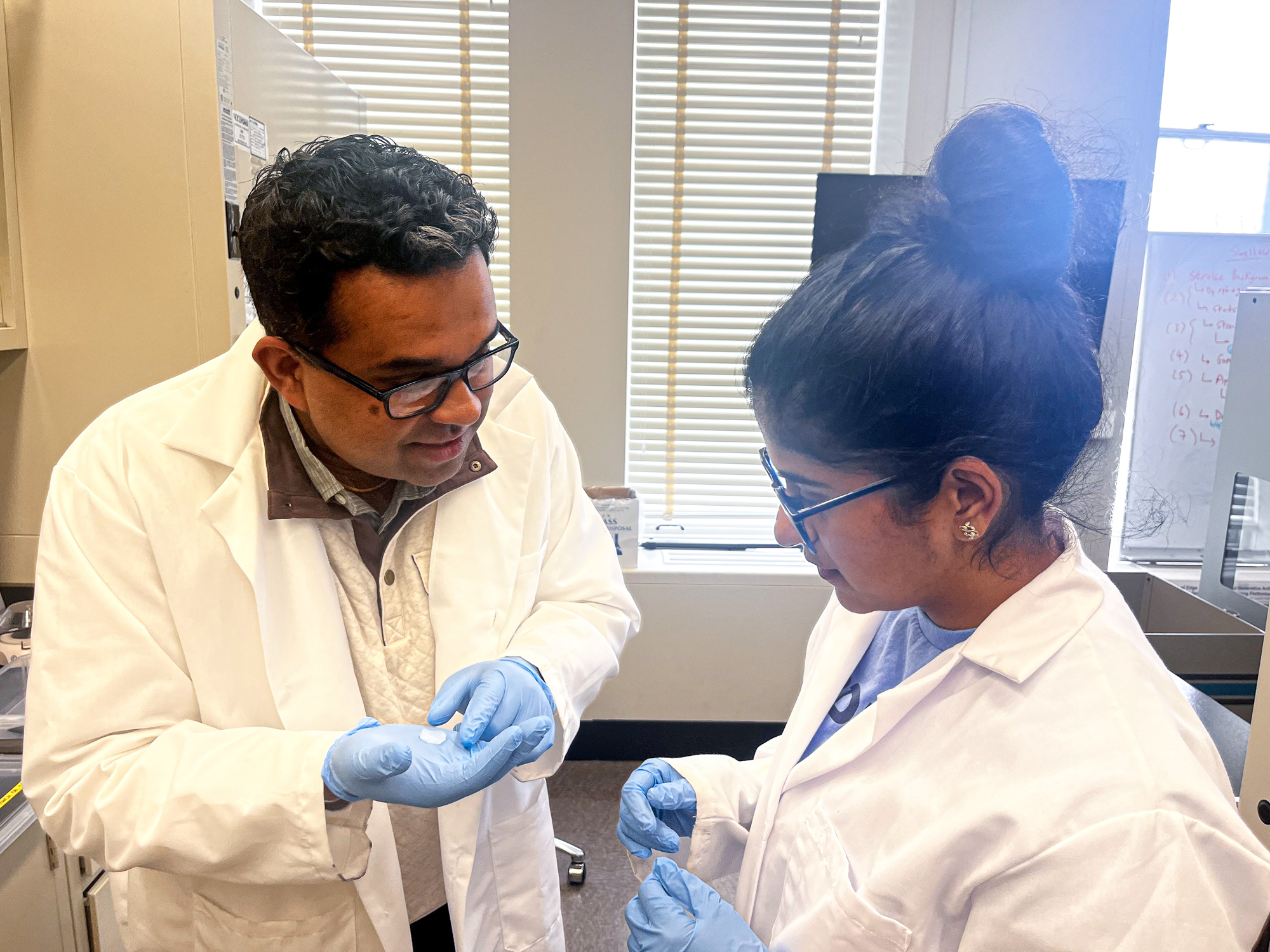
From a young age, Dhruv Seshadri learned he had to get creative with the resources he had.
He grew up in a house filled with smells of food. He’d sit on the countertop and help his father, experimenting with whatever ingredients were on hand. It was a habit he kept up as a graduate student, reconstructing expensive restaurant dishes on a student budget and shopping at ALDI.
Now, as a bioengineering professor at Lehigh, he applies the same instinct on a larger scale. Seshadri’s lab focuses on several research projects, but two in particular stand out: a low-cost menstrual pad for global deployment and a wireless heart monitor.
In both of these projects, Seshadri is finding ways to make people’s lives better and more fulfilling on a cheaper scale.
His goal with menstrual pads is to find materials and designs that make these products cheaper and more accessible globally, especially in regions of the world that can’t afford necessary hygiene products.
The heart monitor works like sensors at a cardiologist’s office — the stickers track the heart’s electrical activity, Seshadri said, but without the wires or the office visit. He said having a portable monitor can save significant amounts of money on office visits and expensive equipment.
Seshadri’s lab makes the unknown known, and he does so by focusing on experiential learning. He tells students to go out and see things for themselves.
He encourages his students to visit places like India, where his father immigrated from. He said it’s increasingly important to visit countries where it’s become difficult for international students to reach the U.S.
“You have to think, ‘How does what I’m doing impact the people in China, India, Africa?’” Seshadri said. “Because it’s all connected.”
That philosophy runs deepest through his work with menstrual health.
His passion for women’s health started with his wife. As a South Indian woman, she faced restrictions during her period, was treated differently, and was barred from certain activities and religious practices while menstruating. Seshadri explained that this stemmed from a cultural stigma that treats menstruation as something ritually impure and best kept hidden.
He said the stigma encourages women to conceal menstrual products, avoid conversations about menstruation with male family members and normalize discomfort.
“No one should have to skip school because they’re on their period,” Seshadri said. “No one should be unable to hang out with their friends because of menstrual challenges.”
He said there’s a taboo around men talking about menstrual cycles, one he wants to break down through education.
Currently, his lab is exploring how people experience menstruation in different cultural contexts.
Seshadri’s master’s students and a global health consultant in his research group are distributing a survey to Lehigh’s female students, faculty and staff about their experiences with periods and what they’d like to see change. He recently sent a similar survey to 1,200 students in South India, which his team is still analyzing.
Lehigh’s partnership with India dates to 1956, and Seshadri said he’s traveled back more than 30 times. On one trip, during a course on menstrual health and education he taught with his wife through Lehigh’s Office of International Affairs, he met a student from Wayanad, a rural area about 10 hours from the city.
He said the student had been overlooked in the past and was craving an opportunity to be challenged.
“She stayed late, came in early, asked questions, remembered what we were saying and did research on her own,” Seshadri said. “It was her drive and motivation that impressed me the most.”
He said he’s since seen on LinkedIn that she’s won awards for her work, and is proud to have played a small part in her success.
That drive is what Seshadri looks for over grades. He said he doesn’t believe GPA dictates a student’s success. What matters instead is whether someone has the intangibles, whether they’re hungry for the opportunity and whether he can work with them as a colleague.
“That’s how I hire students. That’s what I believe in,” Seshadri said.
Joe Amitrano, ‘23, ‘28G, works in Seshadri’s lab. He said Seshadri’s one of the best mentors he’s had because of his passion and care for each student, beyond research.
When Amitrano shared that he wanted to pursue a career in industry rather than academia after earning his Ph.D., Seshadri encouraged him to attend conferences, explore industry-focused opportunities and shape his research experiences with that long-term goal in mind.
“He pushes me to question things and think more deeply, which continues to drive my motivation and passion for my research,” Amitrano said.
Hayley Whitney, ‘24, a PhD student in his lab, said she has felt the same kind of investment. She said Seshadri is one of her biggest advocates at Lehigh. He always has his students’ best interests in mind, even when he’s stretched thin.
“If we need something, he will always make the time, ” Whitney said.
Seshadri’s drive to become a mentor was shaped by the people who guided his path, and he fondly remembers words from key role models and advisors.
His high school band teacher taught him to leave a place cleaner than he found it. Seshadri said his teacher would be the first to give him a hug, but also the first to tell him he didn’t do a great job.
“He made me fall in love with the process and the grind of getting from point A to point B,” he said.
Not everyone recognized that process as valuable, though. He said early in graduate school he had faculty members tell him the work he was doing wasn’t truly biomedical engineering-related. They said his work had no value or merit.
But it was his master’s advisor who saw his worth.
Anand Ramamurthi, associate dean for global engineering initiatives, served as Seshadri’s master’s advisor at Case Western Reserve University, where Ramamurthi was on faculty and Seshadri was a graduate student. He said Seshadri was highly motivated from the beginning.
What stood out to Ramamurthi was when Seshadri was a team lead for the National Science Foundation’s I-Corps program. Universities from across the country went to San Francisco for a few days to present their research and pitch it for commercialization, “Shark Tank” style.
Experts gave them feedback to help refine their plans for bringing the research to market. Seshadri’s research focused on nanotherapy for cardiovascular disorders.
It was that experience that made Ramamurthi believe fully in Seshadri’s entrepreneurial skills.
“I always encouraged him to follow his dreams concerning professional development,” Ramamurthi said. “You can pursue research in academia, but you can also be highly entrepreneurial and translational in your research.”
Ramamurthi came to Lehigh in 2020, but it was by coincidence that he and Seshadri ended up at the same place three years later. Their history together has shaped how Ramamurthi now mentors him.
“It’s easy for me to provide mentorship to him because I know exactly how he thinks and what he prioritizes,” Ramamurthi said.
Comment Policy
Comments posted to The Brown and White website are reviewed by a moderator before being approved. Incendiary speech or harassing language, including comments targeted at individuals, may be deemed unacceptable and not published. Spam and other soliciting will also be declined.
The Brown and White also reserves the right to refuse the publication of entirely anonymous comments.