



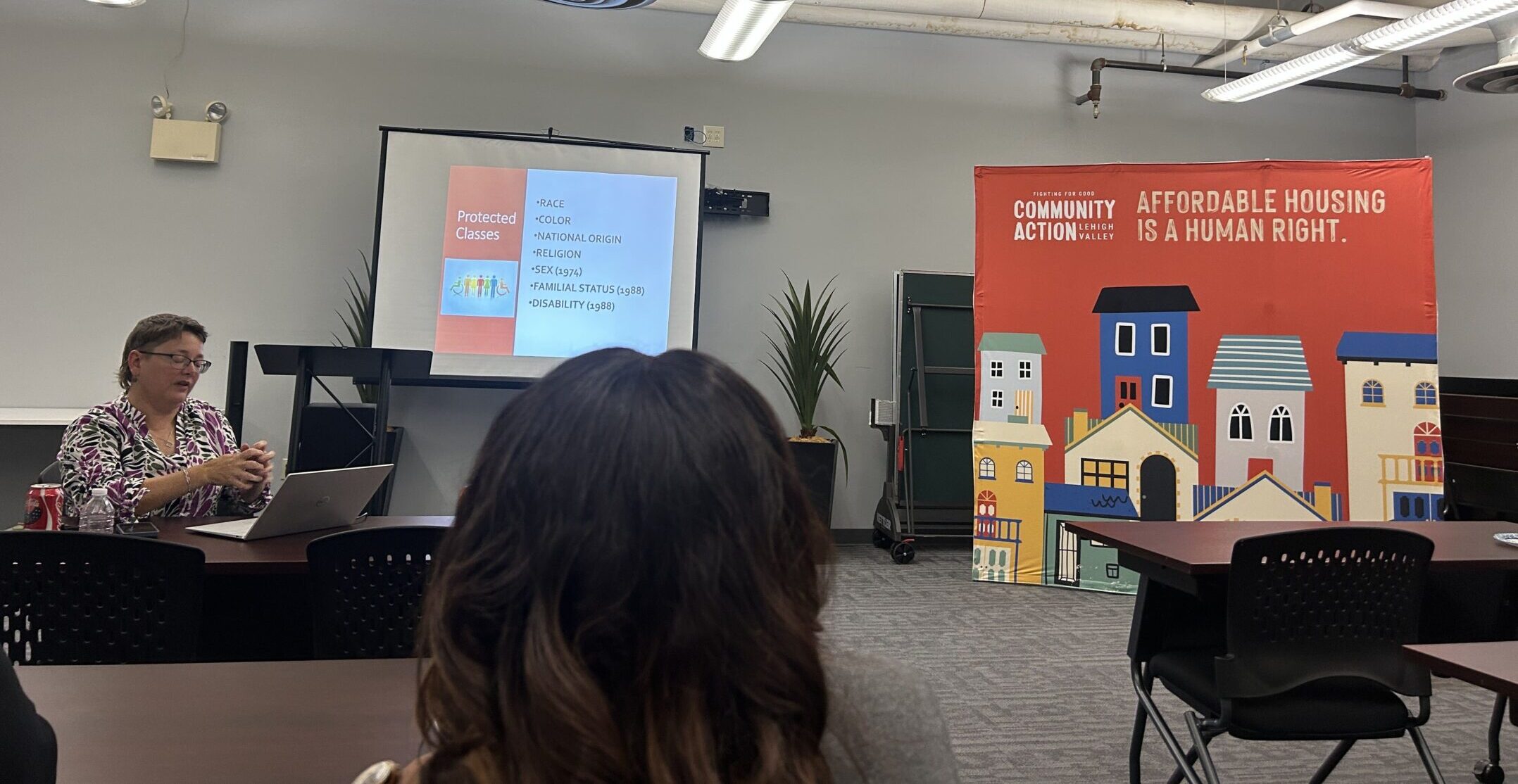
Concerns surrounding landlord responsiveness, community social services and timely repairs were voiced by a long-time Bethlehem resident and 11-year tenant at an educational session on fair housing protection for tenants on Thursday.
“Where I live they don’t really do the repairs, but everyone walks on eggshells because you need a place to live,” the Bethlehem resident, who asked to remain anonymous, said.
The resident asked The Brown and White to protect their privacy in fear of potential repercussions from their landlord.
Sarah Andrew, managing attorney at North Penn Legal Services, said Pennsylvania tenant laws are more favorable for landlords than other states. She said landlords are allowed to evict tenants with little to no reason, creating an expensive and draining cycle that leaves them scrambling to find affordable housing in an area with few options.
This event is part of an eight-part education series on affordable housing and Pennsylvania housing laws by Community Action Lehigh Valley, in conjunction with North Penn Legal Services.
The series has run three times, and approximately 40 people have completed the program thus far. This week’s topic was landlord tenant laws and fair housing, which focused on appeals and eviction, warranty habitability and the Fair Housing Act.
According to the Department of Justice, the act prohibits discrimination by direct providers of housing, such as landlords and real estate companies based on race, religion, sex, disability, national origin or familial status.
Andrew said most of the cases North Penn Legal Services sees pertain to housing affordability and renters not making monthly payments on time.
Anna Smith, director of community action development Bethlehem at Community Action Lehigh Valley, said before the COVID-19 pandemic, households with incomes below $35,000 struggled with rent payments. Now, households making $35,000 to $80,000 struggle with affordable housing.
“Along with that, people who are making higher incomes can’t afford high-quality housing,” Andrew said.
She said housing conditions aren’t improving yet rent prices are rising, forcing families and renters to accept lower-quality housing because there aren’t other options.
Community Action Lehigh Valley started offering these educational lessons to provide resources and promote housing stability in the area.
Andrew and Smith said student tenants may not realize they have the same legal rights as other tenants, and likewise should seek legal services and advocates if they’re dealing with leasing or landlord issues.
Eviction and appeals
Andrew said if a tenant misses a rent payment, their landlord ends their lease or another event triggers the landlord to begin eviction court proceedings. Tenants have a minimum of 21 days to stay in their house.
This timeline begins with a magisterial district judge ruling the tenant be evicted and the tenant has 10 days to file an appeal. On the 11th day, the landlord can get an order for possession of the unit, for which the tenant has another 10 days to move out until the constable arrives to evict them.
Andrew said appealing can grant a tenant more time and a fair evaluation of their lease agreement. Additionally, if they have a complaint with the landlord, this cross complaint will be heard at the same time as their eviction case in court.
“If the tenant has problems, like I didn’t pay the rent because I don’t have any hot water, and I haven’t for two months, then they can file a cross complaint, and both cases will be heard at the same time,” Andrew said.
Andrew said if tenants file an appeal they must continue to pay rent while they wait for the case to be heard.
If the original issue was that the tenant was not paying rent they may elect for “pay and stay,” which means paying the monthly rent in overdue installments to the landlord or court to remain in the unit, even if the landlord has won the case.
Andrew said if a tenant is evicted, they have 10 days to retrieve their items from their unit. The landlord must provide reasonable time slots for them to pick-up their belongings. After these 10 days the items may be moved to a storage unit and tenants may have to pay a storage fee to access them.
Smith said affording rent payments has been increasingly challenging for local tenants.
She said New Bethany Ministries, a local housing and food security nonprofit organization, offers assistance funds to support tenants falling behind on rent.
Warranty habitability
Andrew said tenants have a right to warranty habitability, holding the landlord accountable to provide a unit that is safe, sanitary, has working heat, isn’t infested and has working smoke detectors.
She said that if landlords are not replying or following through on repairs to keep a unit up to this code, tenants should record all of their notices and requests for repairs to show a court if necessary.
Andrew urged tenants to not fix these issues themselves and request repayment from landlords as it may be difficult to prove these units weren’t in working condition or that payment is justified. Issues such as unresolved repairs can be used in a cross complaint case in court.
The Bethlehem tenant shared their experience with a broken refrigerator that wasn’t adequately repaired. They said they notified the rental management of the issue, but when someone arrived to repair it they attempted to fix the issue with a blow dryer and left the situation unresolved.
The tenant said they aren’t alone with repair issues, other tenants they know received unclean units and slow or incomplete repair requests.
“Where I live, they don’t really do the repairs they should,” the tenant said.
Smith said Community Action Lehigh Valley has hired a tenant advocate for the past two years to help residents mediate disputes with their landlords.
She also said one of the reasons the tenant advocacy program was created was to be able to support tenants through the dispute.
“It’s been amazing to see how many landlords who couldn’t possibly fix anything or answer an email or respond to anything the second someone else shows up and gets involved, their story changes completely,” Smith said.
Smith said the organization has been successful in helping students and residents get actionable responses from previously uncooperative landlords.
Fair Housing Act
Andrews also discussed disability accommodations and discrimination in housing in relation to the Fair Housing Act and tenant rights in her presentation.
Tenants with mental or physical disabilities that live in public housing, may request reasonable accommodations that the landlord must pay for and approve. For disabled tenants in private housing, landlords must approve accommodations but don’t have to pay for them.
Andrew said, for example, if a tenant is reliant on their social security benefits to pay rent, they may reasonably request to pay rent immediately after receiving their social security check, instead of paying on the first of the month.
She said tenants with children and families may not be discriminated against and should seek legal protection if faced with restrictive leasing.
Federally, tenants may file complaints with the U.S. Department of Housing and Urban Development, however due to recent workforce cuts made by the current administration, they’re not hearing as many Fair Housing Act cases.
At the state level, citizens may file a case with the Pennsylvania Human Resources Commission, within six months of a discriminatory act to be heard in court.
Andrew said most housing discrimination cases North Penn Legal Services receives are disability and familial.
North Penn offers free civil legal services and is accepting new clients that can apply on their website.
Social services
The Bethlehem tenant also voiced concerns about a lack of social services and community understanding from rental management and developers.
“These builders come in and build these apartments and they forget people live in these buildings, they don’t understand the community,” the Bethlehem tenant said.
The Bethlehem tenant described the community and rental environment in earlier years as being a welcoming place where people would spend time together outside once their children fell asleep, men playing games and women chatting.
“It was a nice place, everyone that came through respected the neighborhood,” they said.
The tenant said the city has changed and the neighborhood doesn’t feel as safe or collectively bonded as it once did.
They said they’re concerned about the support and lack of programs for young children in the area.
“We need more safety,” the resident said.
Comment Policy
Comments posted to The Brown and White website are reviewed by a moderator before being approved. Incendiary speech or harassing language, including comments targeted at individuals, may be deemed unacceptable and not published. Spam and other soliciting will also be declined.
The Brown and White also reserves the right to refuse the publication of entirely anonymous comments.