



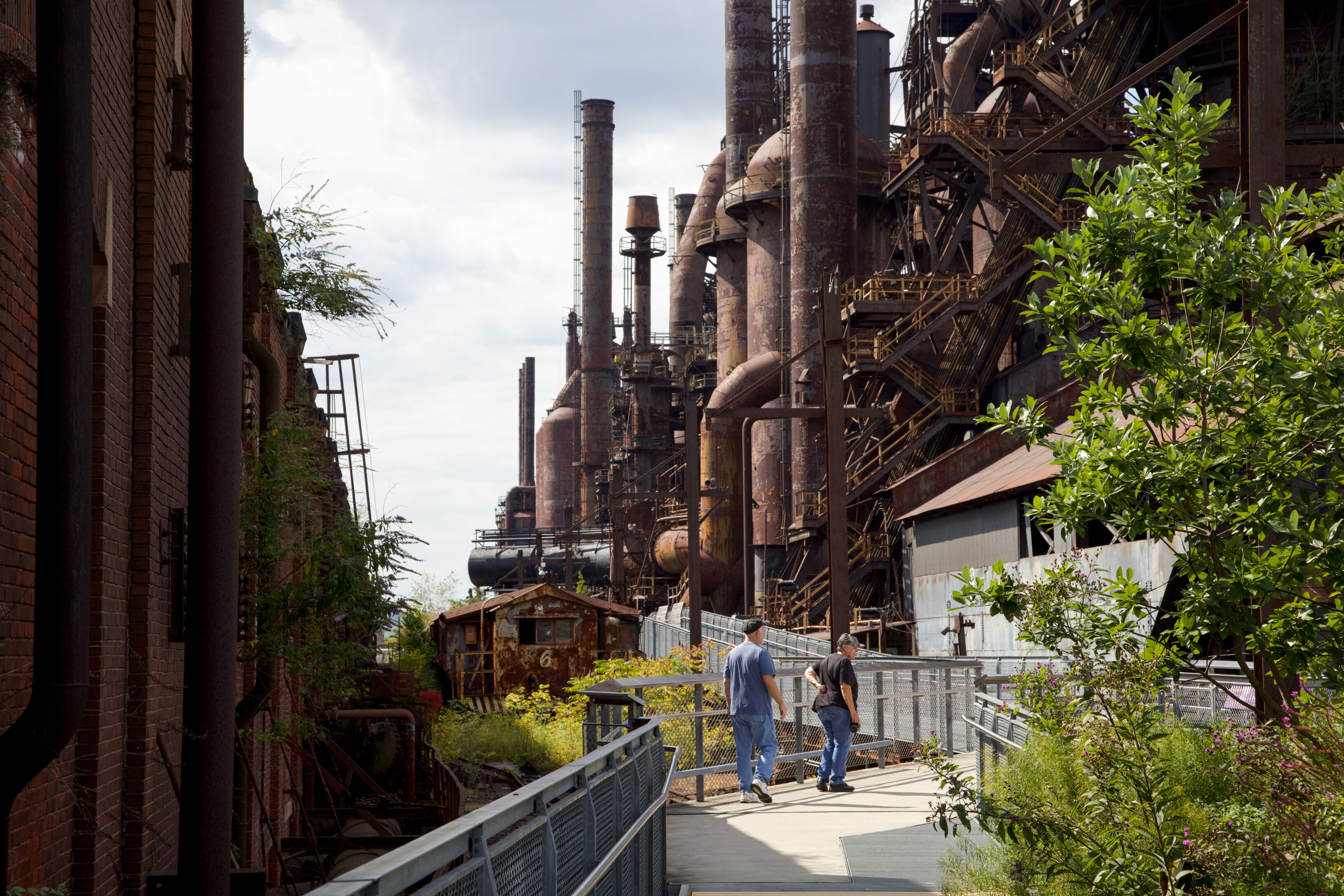
The Industrial Archives & Library was founded in Bethlehem in 2015 by Steve Donches as an independent archive to preserve the history of Bethlehem Steel. With a seven-person staff, it has since expanded to cover industrial history across the country.
The main office, where most of the Bethlehem Steel archives are housed, is located on West 4th Street. They also have a temperature-controlled space on the North Side which holds most of their non-Bethlehem Steel archives, which they bought in 2021.
While Bethlehem Steel had been declining for years, it officially filed for bankruptcy in 2001, and the company was dissolved in 2003, according to Lehigh Valley Live.
“We wanted to make sure we preserved as much as we could about the company,” said Donches, who now serves as the industrial library’s president and CEO.
Donches, who grew up three blocks from Bethlehem Steel, began his time at the company in 1967 through the “Loop Course,” a training program where recent college graduates are rotated through various operations of the company.
After serving in the U.S. Army from 1968 to 1969, Donches, who had a degree in accounting from Saint Joseph’s University, took a position in the company’s public affairs department.
“One time, someone asked if I would like to go into the sales department, and I said I don’t want to go into the sale of the products — I want to sell the company’s name,” Donches said.
He retired as vice president of public and government affairs, corporate communications, community affairs and news media relations, having spent almost 35 years at the company.
The library accepts archives from both individuals and companies. According to their website, Industrial Archives & Library manages over 10,000 volumes of books and other items, including magazines, journals, brochures and monographs related to industries beyond steel and mining. This includes ship building, munitions, technological developments and labor.
Bilheimer said originally, the library only accepted paper documents and archives, but will accept certain objects depending on their value.
The Bethlehem Steel specific archives contain drawings, oral histories and corporate materials, such as blue prints, budgets, phonebooks and newsletters.
Nick Zmijewski, Industrial Archives & Library archivist, said the collection is approximately 8,000 cubic feet.
He said the further away in time there is since the end of Bethlehem Steel, the less people will care and understand the significance of their archives.
Bob Bilheimer ‘82M, general manager of Industrial Archives & Library, worked at Bethlehem Steel for 22 years, serving as general manager of public affairs in charge of corporate communications from 1998 to 2003, and a member of the 1981 loop class.
Bilheimer is the third generation in his family to work for Bethlehem Steel. His father also worked at the plant, his mother worked on plant patrol in 1942 and his grandmother was a metallurgical inspector in 1918.
“You hear a lot about Rosie the Riveter, and the two women in my life, my mom and my grandmother, actually did that (and were like her) in both World Wars,” Bilheimer said.
Bilheimer grew up next to Nitschmann Middle School near the former Martin Tower. He was at Martin Tower until the last day of work, and said watching it get taken down was bittersweet.
He said his passion for industrial history and the legacy of Bethlehem Steel, as well as the industrial history across the country, fuels his work.
“I want to see industrial history preserved,” Bilheimer said. “This is just a wonderful opportunity for us to make a difference and chronicle history that’s being lost.”
The Industrial Archives & Library is an independent archive, meaning they aren’t affiliated with another institution, which allows them to take more than they would if public, like an entire set of books instead of just one.
They also have more freedom to expand the scope of what they currently accept.
Bilheimer said as an independent archive, the library is able to pour all of their resources into their mission, and don’t have to worry about any other outside entity.
John Smith, Lehigh associate professor emeritus of history, who specializes in the history of technology, said the history of the Bethlehem community is remarkable.
“I always said you could take an American history textbook and you could write one chapter practically on what happened in Bethlehem,” Smith said.
Smith said jobs in steel provided long-term economic security.
Roger Simon is also a Lehigh history professor emeritus, who specializes in urban and social history, said in 1975, he and his students spoke to various Bethlehem Steel workers who had been working there for decades.
Simon said he spoke to children of immigrants or second-generation steelworkers — mainly from Slovakia, Hungary and Poland — who were able to buy houses and cars from steelworker pensions.
He stressed the difference between the blue-collar work, which was very physically demanding, and the white-collar workers, who were treated much better at Bethlehem Steel.
“Economic security was everything to them,” Simon said. “It meant a secure and reasonable lifestyle.”
Lehigh accounting professor Dave Hinrichs worked at Bethlehem Steel from 1979 to 2002.
His office is decorated with Bethlehem Steel badges, business cards and other commemorative items. He said he also has a sign from one of the company’s coal mines in his basement.
“Most of the folks, I think, developed a real loyalty to the company, not necessarily to the corporation, but to the people they worked with,” he said.
“The destruction of Martin Tower, that huge symbol, is gone,” he said. That removal erases a piece of physical history from the steel plant.
Billheimer said once Martin Tower was gone the records that were once there went to all different homes and institutions.
“Personally, I want to see if we can find the entire press release collection at Bethlehem Steel Corporation because it was right in the office next to me, and we referred to that all the time,” Billheimer said. “Adding that would tell the full story of Bethlehem Steel.
Materials in the collection include multiple issues of the Bethlehem Review, one of which featured photos of him in elementary school, maps and plans for the Homer Research Laboratories, which is now Mountaintop, a photo of his mother and aunt from their time working at Bethlehem Steel, a book that belonged to Bethlehem Steel president Eugene Grace, and more.
The company had plans for the post-Bethlehem Steel era, including educational and preservation efforts, but their bankruptcy brought efforts to a halt.
“The idea, called Bethlehem Works, between the Fahy Bridge and the Minsi Trail Bridge, was intended to be part of a museum area of industrial history,” Donches said.
In the early 1990s, Donches was assigned to manage the redevelopment of the 1,800-acre steel plant.
Matt Assad is now the managing editor of the Lehigh Valley Planning Commission, but he was a reporter for The Morning Call during the fall of Bethlehem Steel and one of the authors of Forging America: The Story of Bethlehem Steel. He discussed the dominance of the company in one area and the community’s dependence on it.
Assad said Bethlehem had a plan to diversify its economy through entertainment, tourism, healthcare and education. He said the city was in a transition period for years, but ultimately the plan has been executed well.
“The end of Bethlehem Steel, while devastating at the time, has really led the way to a modern Lehigh Valley that is thriving because of its economic diversity,” he said.
City councilman Justin Amann, the grandson of a steelworker, said the connection of generations of families to industry at Bethlehem Steel is an important part of the city’s identity. He said part of his role is to recognize Bethlehem’s history and look ahead to the future.
Amann said his grandfather’s work at Bethlehem Steel is important to how the family remembers the company.
“It was like the spirit of Bethlehem, this idea that if you worked hard, you could make a living, provide for your family, and be successful, the American dream,” he said.
Zmijewski said the most frequent research requests the Industrial Archives & Library receive are for information about relatives. The Bethlehem Steel internal phonebooks, when applicable to the individual’s former role, can be helpful.
Over the next 5 years, the library plans to move to a state-of-the-art facility on Santee Mill Road, 62 acres of land that originally belonged to Archibald Johnston, the first mayor of Bethlehem and one of Bethlehem Steel’s presidents.
“You grew up here, and it became a deeper part of you than you would think.” Donches said. “So I’m very proud of getting us to where this is today.”
Comment Policy
Comments posted to The Brown and White website are reviewed by a moderator before being approved. Incendiary speech or harassing language, including comments targeted at individuals, may be deemed unacceptable and not published. Spam and other soliciting will also be declined.
The Brown and White also reserves the right to refuse the publication of entirely anonymous comments.