



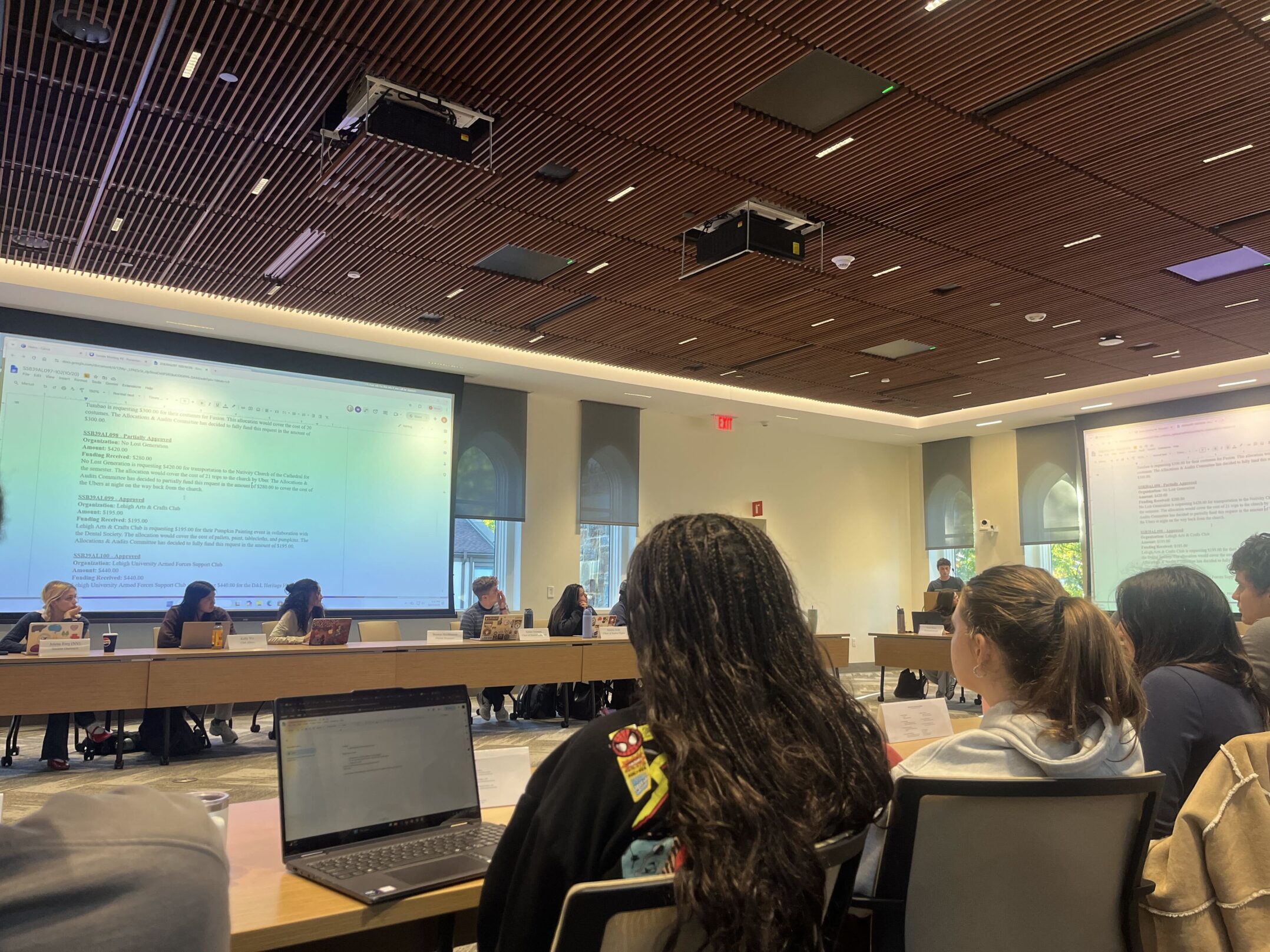
At its most recent meeting on Tuesday, Lehigh Student Senate discussed several changes to the language to its constitution, which hasn’t been amended since 2018.
One line in particular, which is part of an amendment to Article 4, Section 2 of the constitution, outlining the role of senate president, was one of the major topics of discussion. It currently reads, “The president should consult the full senate on matters relating to the capacity as official spokesperson.”
Heidi Bauer, ‘28, the Senate’s parliamentarian, said that the word “should,” principally, is best left out of the constitution to limit ambiguity.
The amendment would place guardrails on Senate President Drew Smith, ‘27, and his ability to use the term “we” to represent the Senate in matters of correspondence that pertain to all Senate members.
Mariana Roldán, ‘28, Senate’s vice president, said that this amendment “offered a protection to the senators” in terms of how they are represented as a collective.
Senate discussed this amendment for over 20 minutes. Motion to extend conversation was granted four times.
Smith acknowledged prior mistakes he made in Senate communications. In a recent email to The Brown and White and greater Lehigh community, he said he included the pronoun “we,” but signed the email as senate president. A few senators had voiced their displeasure with Smith speaking directly on their behalf.
Smith said although he doesn’t believe the vast majority of senators, or even a majority, disagreed with the sentiment, he said it’s important that the senators who he represents don’t feel misrepresented.
“So I took today’s meeting as an opportunity to recognize that mistake, and I’ve been very mindful in not repeating that in the future,” Smith said.
He also said the role of being spokesperson doesn’t shut off when he leaves the boardroom, and that students often approach him with questions when he’s on his way to dinner, when a professor mentions Student Senate in class, or over email with other universities.
Smith said he believes that being able to speak respectfully and mindfully is one of the most important aspects of the Senate president’s job.
“Pressure is a privilege. This role of being the leader of what I would say is the most important organization on campus, is something I take exceptionally seriously, and choosing my words carefully in specific situations is something I’m very mindful of, especially when going on the record,” Smith said.
Senator and Chair of the Student Outreach Committee Eddie Grinnan, ‘29, said emails drafted by Smith to be sent to The Brown and White weren’t reflective of the entire Senate’s position.
Grinnan said this resulted in an effort to restrict the president’s ability to speak on behalf of the full Senate.
He added that Smith had personally told the Senate he would commit to being more transparent about professional correspondence in the future.
During the meeting, Grinnan said that trust in the longevity of the constitution is of great importance given that the document will apply to future executive boards.
The amendment ultimately failed in a 20-12 vote.
Article 4, Section 3 pertains to the Vice President’s responsibility to meet with each committee chair at least once per week over the course of the academic semester. A vote to change the verbiage from “should meet” to “shall meet” was passed in a 25-1 vote.
Re-vote on the trial period for Students Demand Action
Students Demand Action, a student volunteer-run organization, advocating for gun violence prevention, was recently denied approval for a six-week trial period to receive Senate recognition.
Senate approval is based on a rubric that grades clubs’ prospective ability to sustain engagement, create benefit to the student body and achieve specific, measurable goals within a six-week time frame. The rubric is completed solely based on an interview with a club’s executive board and two senators on the Club Affairs committee.
The organization was denied an abbreviated trial period at the meeting’s re-vote on the basis of not meeting enough of the rubric’s criteria. The club affairs committee believed they did not create SMART goals, had weak external communication, and failed to outline an appropriate recruitment strategy.
Student Outreach Committee Member Simone Levy, ‘29, said this denial didn’t sit right with her.
“I think this is a very important club,” Levy said. “I viewed that as important and I didn’t understand how it wasn’t properly communicated through the interview.”
She said the organization is one of the most active clubs she’s ever seen.
“It just didn’t feel right to me,” Levy said. “I talked to Drew about it, I talked to the executive board and I wanted to discuss it and see if people were thinking the same thing as me.”
In the time it has operated without Senate recognition, Students Demand Action has gone door-to-door, encouraging Bethlehem residents to vote, canvassed for gun sense candidates and encouraged Lehigh students to register to vote, among other events.
Raquel Romero, ‘27, Club Affairs chair, reported that SDA outlined qualitative goals to meet within the trial period, including visibility and providing volunteer opportunities, “but didn’t have a transparent or accessible external communication plan when it (came) to their membership.”
Romero added that the organization may be at a “very large disadvantage” in terms of achieving those goals given the time-constrained trial period, because they would be held to the same standard as clubs working to achieve specifically-defined metrics in the standard time frame.
The organization is able to reapply for Senate recognition in the upcoming spring semester.
Senator Jackson Dancy, ‘28, said that the six-week period is for the Senate to “assess if a club can sustain its operations” for a sufficient period of time.
Dancy said these assessments don’t serve to reflect a club’s ability to benefit the community or ultimately achieve success.
Proposal of a Student Senate judicial board
Article 4 of the constitution, which would implement a Student Senate judicial board and exist to invoke consequences against senators who violate the Student Senate Constitution and Bylaws was also debated at Tuesday’s meeting.
The amendment failed in a 22-5 vote.
According to Smith, increasing the different roles and capacities for senators detracts from the time they can spend representing students. He also said, there are not many judicial cases, so this would create excessive work, and there are senators whose current jobs are to be exceptionally knowledgeable of the constitution and its bylaws.
Weekly allocations bills
At the beginning of each meeting, allocations bills for clubs requesting event funding are discussed and voted on.
At this meeting, all clubs were granted their full requests, with the exception of No Lost Generation —- a club focused on advocacy and education for refugees —- which was granted two-thirds of its request. Denial of the full request was based on the club’s request for complete transportation funding, which the Senate deemed unnecessary by a 17-13 vote.
The following clubs received full funding:
- Tumbao
- Lehigh Arts and Crafts Club
- Dental Society
- Armed Forces Support Club
- Society of Asian Scientists and Engineers
The next Senate meeting will be held on Oct. 27.
Comment Policy
Comments posted to The Brown and White website are reviewed by a moderator before being approved. Incendiary speech or harassing language, including comments targeted at individuals, may be deemed unacceptable and not published. Spam and other soliciting will also be declined.
The Brown and White also reserves the right to refuse the publication of entirely anonymous comments.