



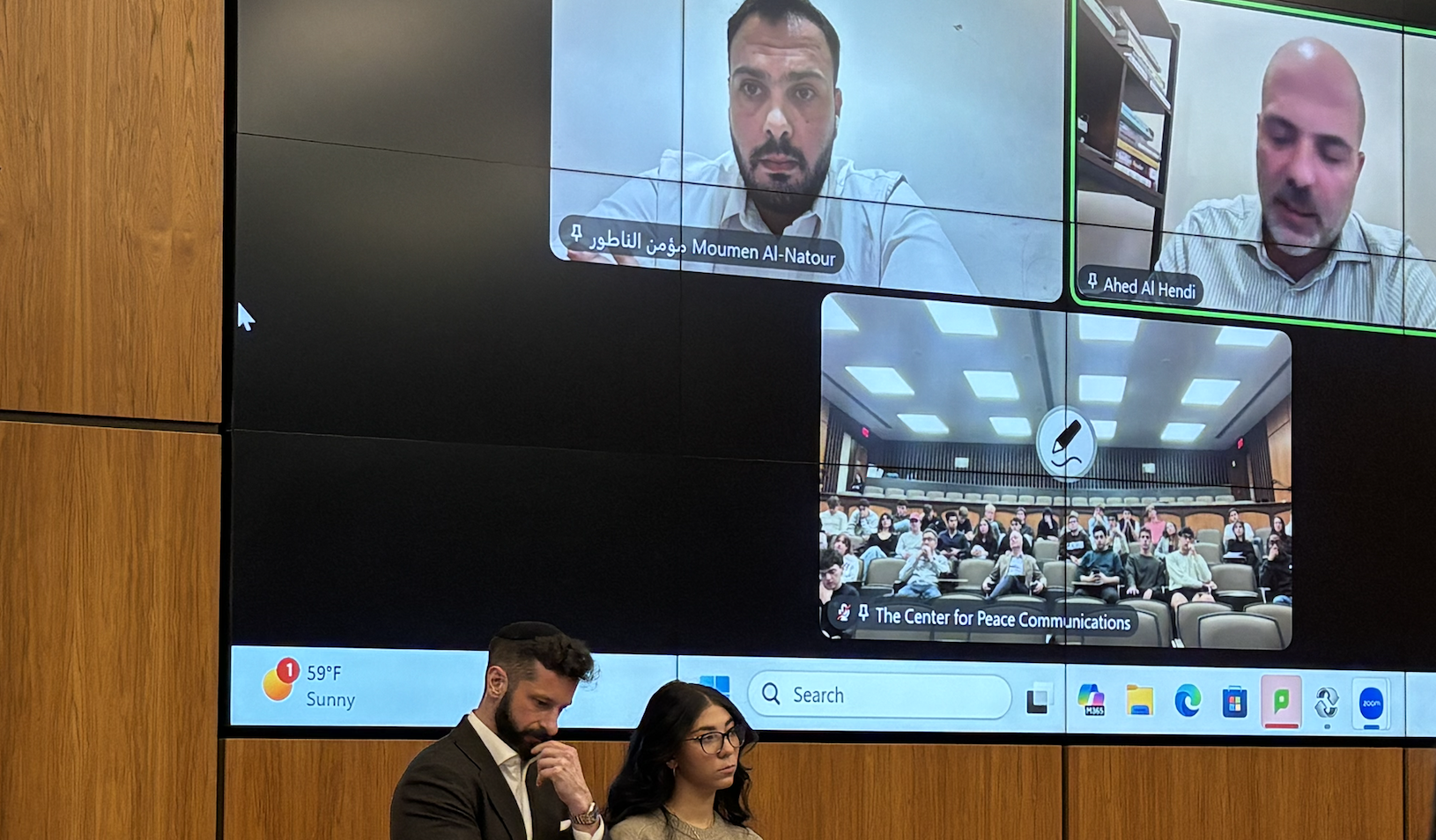
Gazan lawyer and human rights defender Moumen Al-Natour spoke at “Talk for Peace,” an event hosted by the Center for Peace Communications, Lehigh’s Hillel, Friends of Israel and Lehigh’s chapter of Alpha Epsilon Pi in Sinclair Laboratory, Wednesday evening.
The event focused on life under Hamas’ rule in the Gaza Strip, Palestinian opposition to the group and the potential for peaceful coexistence between Palestinians and Israelis.
Al-Natour spoke in Arabic during the event, and Ahed Al Hendi, a senior fellow at the Center for Peace Communications, translated his remarks into English for the audience. Al-Natour said he was eventually able to flee Gaza and is now living in Italy, where he recently received political asylum.
He spoke on his experiences organizing protests against Hamas, including demonstrations over unemployment, corruption and unequal access to jobs. He said Hamas authorities had repeatedly detained, beaten and tortured him in response to his activism, and his protests against Hamas ultimately forced him to leave the Gaza Strip.
Al-Natour said he began confronting Hamas in 2019, when he and other young Palestinians joined the “We Want to Live” movement, which consisted of protests demanding better economic conditions and greater opportunities for young people.
He said the demonstrations challenged a system in which political connections with Hamas, rather than qualifications, determined access to employment.
According to the International Labour Organization, a specialized agency of the United Nations , the unemployment rate in Gaza was 34.9% before Oct. 7, 2023. Afterwards, the unemployment rate rose to 79.7%.
The conflict further escalated after Hamas-led attacks on Israel on Oct. 7, 2023, in which civilians and soldiers were killed and hostages were held in Gaza.
Al-Natour’s advocacy against Hamas began in 2019, when he joined the “We Want to Live” protests. The protests demanded better living conditions and economic opportunities.
Human Rights Watch reported that Hamas security forces responded with arrests and beatings of protesters. Al-Natour said his activism led to repeated detention and torture, ultimately forcing him to flee Gaza.
Al-Natour described the movement as a campaign for Palestinians to live with greater freedom and dignity. Hamas, according to Al-Natour, responded to the demonstrations with violence, detaining activists and threatening their families.
He said his experiences shaped his belief that Hamas does not represent all Palestinians.
Al-Natour also criticized the tendency to treat Palestinian society and Hamas as interchangeable, arguing that many Palestinians oppose the group and want a government that allows them to live without fear.
“Hamas does not represent all of them,” al-Natour said, referring to Palestinians in the Gaza Strip. “If you want to free the Palestinians, free them from Hamas,” he said.
Michael Nahum, chief operating officer of the Center for Peace Communications, said the organization seeks to amplify voices in the Arab world that speak out against Hamas and other militant groups, and support peaceful coexistence with Israel.
Founded in 2019, the Center for Peace Communications is a New York-based nonprofit organization, aiming to promote a culture of peace in the Middle East through reform of media, institutions of cultural formation, religious institutions and educational institutions.
Nahum, who is fluent in both Arabic and Hebrew, has previously lived in the region and has spent many years working in the counterterrorism field. He said the organization began working with al-Natour very shortly after Oct. 7, 2023, and has since arranged university appearances to give him opportunities to speak directly with students.
He also said opposition to Hamas within Gaza receives insufficient attention in international coverage of the conflict.
“One of the things we do is try and give such individuals platforms in order to make their case to the wider world,” Nahum said.
Abigail Ryvkin, ‘29, Lehigh Hillel’s cultural programming chair who also serves as public relations chair for Friends of Israel, said the event was intended to expose students to perspectives on Gaza that they might not otherwise encounter.
Ryvkin said the Center for Peace Communications reached out to her about organizing an event that would include perspectives beyond those commonly heard in campus discussions and address the possibility of a two-state solution.
When Ryvkin was approached to host the event, she spoke with Rabbi Steve Nathan, Lehigh’s director of Jewish Student Life and associate chaplain, who shared that the Office of Jewish Student Life would both support and promote this event.
Nathan said hearing and learning about al-Natour’s story is important for students to hear.
“It just seems like a no-brainer to me,” Nathan said. “It’s a very unique type of event, you don’t hear speakers like this very often.”
He said it’s important to realize not everything people see in the news here paints a full picture of conflict in the Middle East, and this topic is much more nuanced than people may originally think.
Ryvkin said she hoped the event would encourage students to learn more about the conflict before drawing conclusions about people living through it.
“I hope people are more educated on the war, and they understand that what we have in the U.S. is not what is happening in Palestine or Israel,” Ryvkin said. “And I just would like people to be educated before they make really bold claims on something that they have no experience with.”
She said she contacted several student organizations about co-sponsoring the event and AEPI ultimately agreed.
Ryvkin declined to identify the organizations that did not participate.
Al-Natour said his advocacy is rooted in his experiences under Hamas rule and his belief that Palestinians should be able to choose their own political leadership.
He argued that a future political arrangement should include local leaders who support peaceful coexistence with Israel and do not rely on Hamas’ authority.
Al-Natour also addressed the war’s impact on Palestinian civilians and the Israel Defense Force’s military conduct.
When asked about defining the war with Israel as a genocide, al-Natour said that, in his personal view as a lawyer, the destruction did not meet the legal definition of genocide.
According to the United Nations, genocide means acts committed with intent to destroy, in whole or in part, a national, ethnical, racial or religious group by the following actions:
- Killing members of a group
- Causing serious bodily or mental harm to members of a group
- Deliberately inflicting on a group conditions of life calculated to bring about its physical destruction in whole or in part
- Imposing measures intended to prevent births within a group
- Forcibly transferring children of a group to another group
During his talk, al-Natour said Palestinian civilians should not be conflated with the motives of Hamas, nor be responsible for its actions. He said Palestinians hold independent political views from Hamas and oppose Hamas’ existence in Gaza.
“I’m just a normal Gazan who really wants to live safely in my birthplace without any conflict, without any troubles,” al-Natour said.
Comment Policy
Comments posted to The Brown and White website are reviewed by a moderator before being approved. Incendiary speech or harassing language, including comments targeted at individuals, may be deemed unacceptable and not published. Spam and other soliciting will also be declined.
The Brown and White also reserves the right to refuse the publication of entirely anonymous comments.