



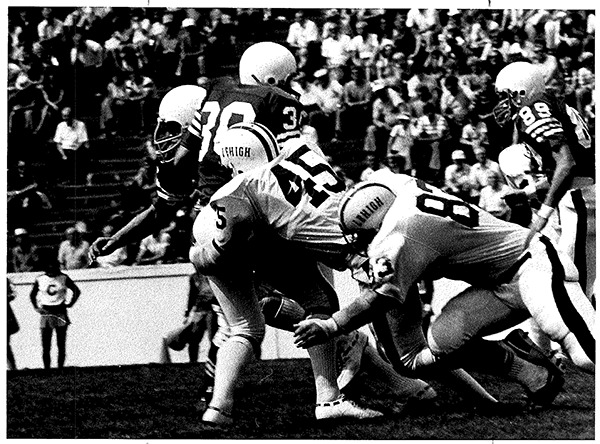
Former Lehigh defensive lineman and defensive end Greg Clark, ’78, spoke with The Brown & White about playing on the football team back in 1977 and his experience being inducted into the Lehigh Hall of Fame.
Q: You came to Lehigh as a fullback before moving to defensive lineman prior to your junior year. How did carrying the ball early in your career help you read plays and anticipate opposing offenses?
First off, when I came to Lehigh, I wasn’t expecting to be a fullback. I was a fullback for one year in high school because I was the fastest lineman. So I ended up as a fullback, which was kind of surprising when I got to Lehigh. I was behind Rod Gardner, who’s a Hall of Fame running back. But it does help you out . There’s a lot of things you learn and see about how people move and what they do, and it helps you out when you’re playing defense, knowing what the opposing team may do or where they want to go. So, you learn a little bit of something from everything you do.
Q: Setting the school record for 38 tackles for loss in a single season is an honorable achievement. What were the key techniques that allowed you to disrupt plays over the line of scrimmage on a consistent basis?
I was a wrestler for four years in high school, and you learn a lot of hand control, how to get around people and how to move people out of the way. So I used a lot of my wrestling techniques when I played football, and I just hate losing. I have one of those engines; it just goes forever. So, I just kept going and going and going, and I had some good teammates that tied up some of the other linemen so that I could get through, and it worked pretty well for me.
The biggest thing I learned was the arm drag when I wrestled, where you grab the guy’s arm and pull it by, and that motion is the same when you play football. If you grab his arm while he’s trying to block you and pull it by, and you can go around the outside of them. That was a key maneuver I used for many of my sacks that I had.
Q: As the defensive captain, how did you get your unit to perform at intense levels during crucial moments during games while having a positive spirit to ensure the team didn’t lose their cool in instances where you would play top schools?
The biggest thing is leading by example. If you want people to want to do something, you’ve got to do it too. So you have to be committed, and I was very committed to the team. The team had good teammates; everybody respected everybody, which was very importantand we always believed we could win.
That kind of mindset we had amongst ourselves and the whole team, but not just the defense.We really never believed we would lose. Even when we were losing on the scoreboard, we still believed we could come back. You have to have faith and trust in your teammates, and they have to believe in you. And that was one of the biggest things I wanted to do as captain was to instill that and people looked up to me, and I thought that was very important.
Q: Completing an Industrial Engineering degree at Lehigh while participating in top-tier, championship-level football is no easy task. How did your experiences with this challenge prepare you for your 40-year career in manufacturing management?
It’s come a long way. It’s very hard being an engineer and trying to play football because you have to practice every day and games on weekends. Once you get out, you have to kind of set yourself into a regimen. You go practice at a certain time, you lift, you do things that you want to do. It makes you very regimented, and that regimented situation is very helpful when you get into the real world and have a job. I did the same thing in the real world. I always wanted to be a captain, so my drive when I got to work was to be the boss. It took me a while, but I ended up being a manufacturing manager of three companies, and that all came from my leadership roles as a football player and a coach.
Q: When comparing the Lehigh football program today to the college football that you played in your time at Lehigh, what aspects seem to be completely different and what aspects of tradition have remained the same?
A lot of it remains the same. I’m sure there are a lot of things behind the scenes that I’m not aware of that are different. We had a very loose group. We played in Taylor Stadium as opposed to the Goodman Stadium area now, where you guys play today. Taylor Stadium was quite a nice stadium to play in. Things were just different back then. Things change every year. People change. The coaches change. We had a hard-nosed coach, one who wouldn’t survive in today’s world, but back in the day, that was the way we played.
A lot of the things I did when I was playing football today would be a penalty. And that’s just the way it was. Back then, if the quarterback threw the ball, you hit him anyway. That was part of the game. It has changed completely. Maybe for the good, maybe not, but it has changed.
Q: When you heard about your upcoming induction into the Lehigh Athletics Hall of Fame, who did you think of first among your teammates or mentors? What wave of emotions overcame you when hearing that news?
The first thing that overcame me was I didn’t believe it. I got an email or a text, and I really wasn’t sure if it was true, so I called a couple of my buddies and had them check around and finally realized it was. I’ve been kind of hoping to get this for a long time. It’s been 50 years since we played at Lehigh, and I thought I did enough as a player to get into the Hall of Fame. It was something I was hoping for all my career. I was very pleased, very elated. I thought they did a great job. The induction ceremony was wonderful and I got inducted with a group of good people. It was really nice, and that’s about all I can say about it. It was something I always wanted. And it really solidifies how I felt about football and how Lehigh was.
Comment Policy
Comments posted to The Brown and White website are reviewed by a moderator before being approved. Incendiary speech or harassing language, including comments targeted at individuals, may be deemed unacceptable and not published. Spam and other soliciting will also be declined.
The Brown and White also reserves the right to refuse the publication of entirely anonymous comments.