



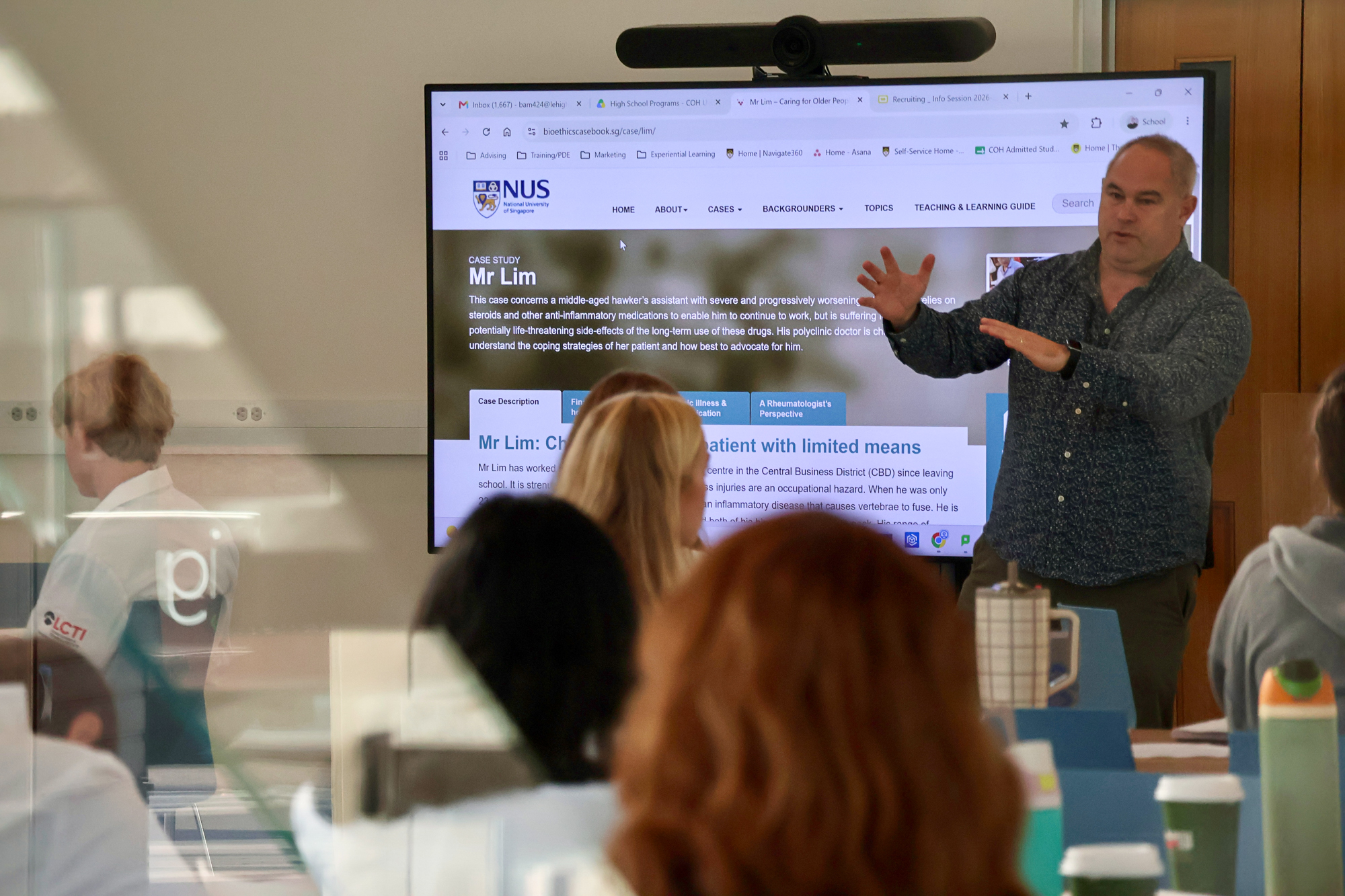
A career trajectory and daily life don’t have to be linear.
Michael Gusmano studied political science at SUNY Albany and was planning to attend law school, but quickly lost interest when learning about the typical lifestyle of lawyers. Instead, his interest in the Constitution led him to a research-oriented career in health policy.
Now at Lehigh, he maintains a diverse set of roles: from a professor of health policy, to associate dean for academic affairs, to the director of the Center for Ethics, co-director of the health, medicine and society program, to research projects on healthcare patterns across the globe.
For Gusmano, every day is different and his path to these positions wasn’t direct.
As an undergraduate, Gusmano took courses on how people make decisions that govern their lives and political institutions, which sparked his interest in public policy.
Gusmano also studied unequal access to health care in the U.S., where he became fascinated with ethics. His passion for public policy and ethics laid the groundwork for his career as a professor, researcher and administrator.
Gusmano now teaches justice, equity and ethics in population health at Lehigh. He said he teaches his students how to make a good argument about ethical dilemmas involving aging populations, poverty and immigration. At the end of the semester, students debate issues such as populations, poverty and immigration.
The point of ethics isn’t to reach one correct answer, he said, but to develop better arguments and think critically about others’ arguments.
Since 2001, Gusmano has collaborated with Victor Rodman, a professor emeritus at New York University, on the World Cities Project, comparing public health systems of four major cities: New York, Paris, London and Tokyo. The pair published two books on their findings called “Growing Older in World Cities” and “Health Care in World Cities.”
Through this research, Gusmano’s team received contracts from these city governments. He said policymakers use the team’s data and analysis to improve their health care systems and in exchange, the governments fund the team and provide exclusive government health insurance data for further research.
Each government has a health care problem they’re trying to improve. For example, they could be interested in geographic inequities in care and improving preventive care.
Gusmano’s team analyzed the outcomes that would be related to these problems and presented their findings to the government and published academic papers.
“I think our work has largely exposed inequities and contributed to a better understanding about what governments need to do to improve access to healthcare and reduce large inequities in health care,” Gusmano said.
He said one frustration his research documented was racial and ethnic inequities in avoidable hospitalizations and treatment of heart disease.
Avoidable hospitalization is when a patient is admitted for a condition that could’ve been treated at an outpatient facility if there’d been timely care. Although avoidable hospitalizations have declined over time as health insurance has expanded, challenges remain.
“The expansion of health insurance helped a lot, but I am deeply concerned about recent policy changes that may undermine that law and reduce coverage,” Gusmano said.
He also conducts research at the Hastings Center for Bioethics in New York. His project focuses on the ethics of gene therapies, which involve modifying a defective gene or replacing a missing gene that causes a disease.
One of the biggest issues with gene therapy is the cost. According to Gusmano, a one time infusion can exceed $4 million.
“We’re worried about equity,” he said. “There seems to be growing evidence that they do work well, but if that’s the case, are the people who need them getting them?”
Collaborating with Karen Mashke, a senior research scholar at The Hastings Center for Bioethics, the pair distributed a survey to physicians across the country, gathering their perspectives on gene therapy.
They also conducted over 80 interviews with gene therapy developers, advocacy groups and experts at the Food and Drug Administration and the Centers for Medicare and Medicaid Services.
Due to his successes, in October 2025, Gusmano was nominated as the first Iacocca Chair for the College of Health.
The Iacocca Chair is the highest honor Lehigh bestows on faculty, and with the position comes additional funding for research and scholarships.
“I really appreciate that my colleagues nominated me, and that I received it,” Gusmano said. “It’s a very nice honor to have.”
Gusmano said he’s using the awarded funding to design and conduct a public opinion poll on gene therapy to test hypotheses in behavioral economics.
In the fall of 2021, Gusmano started teaching at the college, just one year after its launch. He witnessed it evolve from 10 faculty members and 40 undergraduate students to over 30 faculty and more than 250 undergraduate students.
“The growth has been remarkable,” he said.
The college of health has developed into three departments: community and global health, population health, and biostatistics and health data science.
For three years, Gusmano ran the Silicon Valley Social Impact Fellowship: Uninsured and the Healthcare Safety Net, which focused on access to health care for undocumented immigrants in the San Francisco area.
He worked with undergraduate students to review current policies and conducted interviews with experts who serve undocumented people, to understand the effectiveness of health and social policy systems.
“Having the opportunity to work with undergraduate students to both start a project from scratch, execute it and actually lead the way in academic publications and very well-regarded journals has been a fantastic experience,” Gusmano said.
Mackenzie Barlow, ‘28, became part of the team her first year at Lehigh as a Silicon Valley Social Impact Fellow, a program where students address sustainable development challenges in the Silicon Valley area.
Barlow said she came into the project unsure how to conduct health care research, but Gusmano guided her.
“He was good at challenging me and having me grow my own skills independently and step in when needed,” she said.
Barlow also said that it wasn’t until she was apart of Gusmano’s research team that she discovered her passion for public policy.
“I feel very lucky because it was exactly what I wanted to do,” she said. “It was affirming in terms of my career goals.”
Barlow wrote an analytical paper on the qualitative interviews she conducted for the project, which will be published in The Journal of Urban Health.
Gusmano was a huge part of why her team members’ papers were published, Barlow said, because he helped the team choose journals, create outlines and review drafts.
Frank Thompson, a professor emeritus of public affairs and faculty director at Rutgers University, has frequently collaborated on research with Gusmano.
Thompson said they met when he was dean of the Rockefeller College of Public Affairs and Policy at SUNY Albany, and Gusmano was a master’s student who came to Thompson to learn about career paths.
Though they’d known each other for a while, they didn’t collaborate until Gusmano earned his doctorate from the University of Maryland and the two began running into each other at national conferences.
Their mutual interest in Medicaid formed a research partnership.
Gusmano and Thompson are currently researching the effects of the Trump administration’s campaign on federal funding for Medicaid.
The effects they are studying include denial of Medicaid to people who need care.
“I’ve always been amazed that (Gusmano) can juggle all these balls in the air at once because he’s a very busy guy with his administrative tasks,” Thompson said.
He reflected on Gusmano’s character, sharing how they had a similar sense of humor, making the long hours of work easier.
“Lehigh is lucky to have a guy as dynamic as him,” Thompson said.
Comment Policy
Comments posted to The Brown and White website are reviewed by a moderator before being approved. Incendiary speech or harassing language, including comments targeted at individuals, may be deemed unacceptable and not published. Spam and other soliciting will also be declined.
The Brown and White also reserves the right to refuse the publication of entirely anonymous comments.