



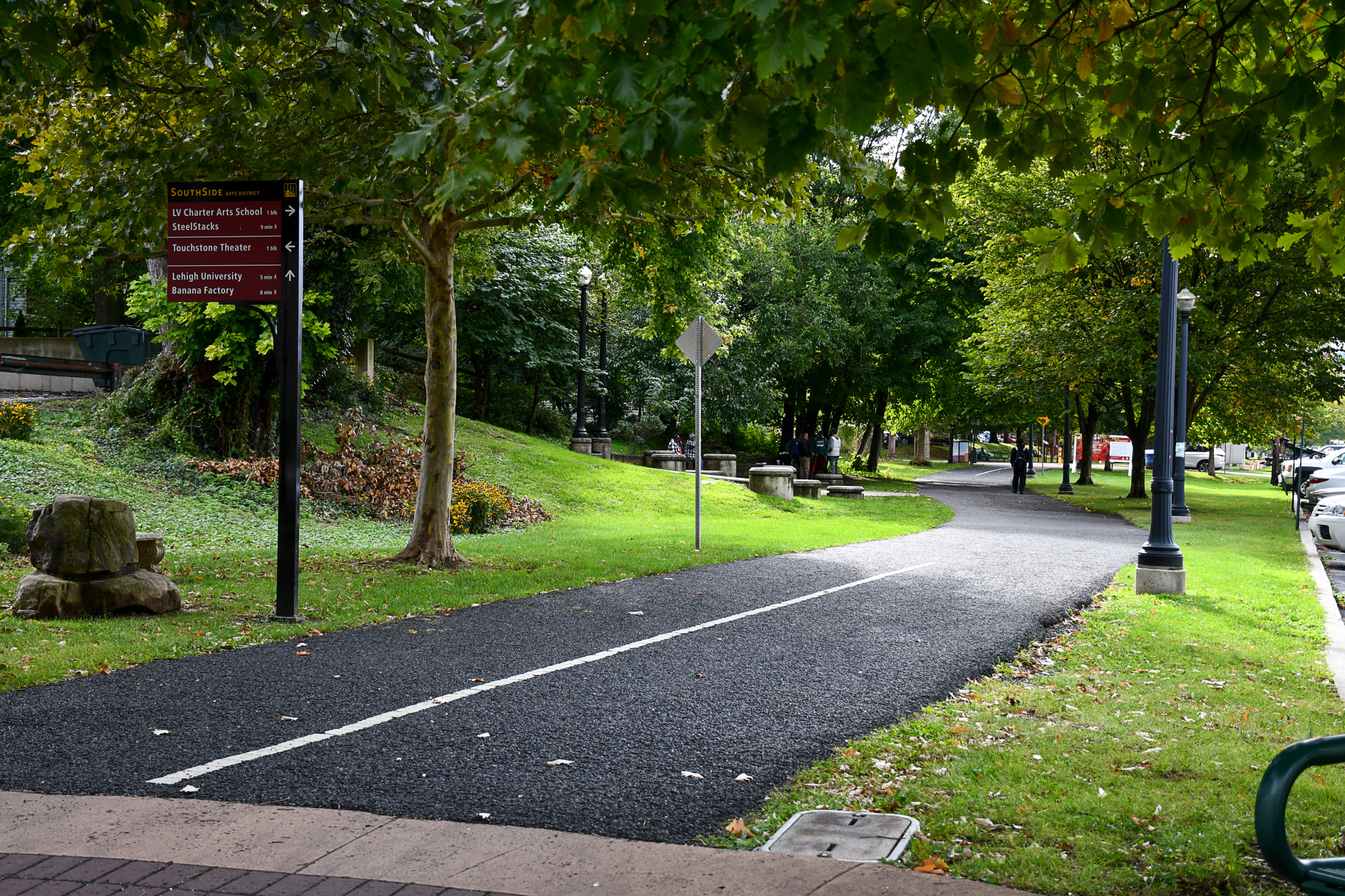
Three months after 85 Litzenberger House residents signed a petition calling for improved safety along the South Bethlehem Greenway, residents say some conditions have improved, but questions remain about the unhoused population along the trail.
Litzenberger House, a 100-unit low-income housing building operated by the Bethlehem Housing Authority, sits directly behind a pavilion on the Greenway.
The petition, presented to Bethlehem City Council and Bethlehem Housing Authority in July, called to make the Greenway safer for residents and other members of the public. According to petition organizer Krisann Drust-Lustig, a Litzenberger resident, the petition was prompted by a June 28 stabbing on the Greenway.
The Greenway is a two mile paved trail built upon a former railroad between Third and Fourth streets. It serves as a place for community members to walk, run and bike.
“Over the years, people without homes have used (the pavilion) as their place to sleep at night,” Drust-Lustig said. “It deters people from walking on the Greenway.”
She said many people experiencing homelessness have been friendly, but some encounters have left residents feeling unsafe. She said some residents have been verbally accosted by unhoused individuals on the Greenway.
Drust-Lustig said Litzenberger House residents used to walk along the Greenway to get to the grocery store, but recently, residents have felt unsafe walking the trail without another person accompanying them.
She said residents’ concerns were further exacerbated by the stabbing in June.
“This was too close to home for us,” Drust-Lustig said. “Ever since then, we’ve been upset.”
She said in the months since the petition, she’s noticed an increased police presence on the Greenway and hasn’t seen any unhoused individuals living under the pavilion. Still, she said residents are concerned for their safety.
Captain William Audelo of the Bethlehem Police Department said incidents that occur on the Greenway don’t always have the trail itself listed as its address. He said the Greenway isn’t a roadway that uses block numbers or fixed addresses to identify locations, so reports may use cross streets.
He said 10 crimes were specifically documented on the Greenway from January to Oct. 27, most of which occurred on the western portion of the trail.
The crimes included three assault cases, two drug possessions, one robbery, one public intoxication and three city ordinance violations.
Audelo said quality of life issues and arrests on the Greenway are most common, citing residents who imbibe on Greenway benches.
He said the unhoused population frequents the area because of the benches and the ability to charge their devices on with electrical outlets.
“We were receiving complaints in August regarding some of the individuals that weren’t utilizing the space as intended, whether that be drinking or possibly sleeping on the benches,” Audelo said. “We did increase our presence in August and September, which leads to higher offense numbers because you are proactively going out and making those arrests.”
Audelo said the Bethlehem Police Department has taken additional steps to turn off the electrical accessibility for some of the city-owned outlets in the area to decrease the draw to those specific spots.
Justin Amann, chair of City Council’s public safety committee, said homelessness is a complex social and economic issue.
“Homelessness is not a crime,” he said. “We have to approach unhoused individuals with the compassion that they deserve, and connect them with outreach teams, shelter options and social services rather than defaulting to criminalization.”
He said this approach shouldn’t come at the expense of residents’ safety.
“Every resident deserves to feel completely safe walking on our trails,” Amann said. “Law enforcement and public safety efforts must remain focused on targeting illegal behavior and active threats, not selectively policing people based on their housing status.”
Amann said balancing compassion with decisive public safety measures requires coordination between city leadership, law enforcement and local social services. Part of that, he said, is being careful about how the unhoused population is viewed.
“We can’t assume that crimes are happening just because people are homeless and that the crimes that are existing are only being done by people who are unhoused,” Amann said. “I think that’s an unfair assumption — it certainly could be that they are victims of crimes as well.”
Karen Pooley, a professor of practice of political science at Lehigh, said since the COVID-19 pandemic there have been growing concerns about the unhoused population and their need for services, but at the same time, the number of encampments around the Lehigh Valley have decreased.
On Dec. 15, 2025, city authorities shut down a homeless encampment along the Lehigh River on railroad land owned by Norfolk Southern Railway.
“If people felt that on the Greenway there was an increase in some unhoused population, I could see that being directly related to some of the encampment clearouts that we saw in Allentown and as well as by the railroad company in Bethlehem,” Amann said.
Audelo said unhoused members who were moved from the Norfolk Southern property, would most likely not have gone to the Greenway. He said police find those residents prefer forested areas away from other people.
“When we did the clearance of the encampment last year, we tried our best to find them alternative housing, whether it be temporary or permanent, mental health evaluation and treatment and substance abuse treatment as well,” Audelo said. “Some individuals took us up on that offer.”
Pooley said the debate over how to address homelessness has shifted in recent years. She said for the last decade, the general consensus was a “housing first” approach: get people inside, then work on services.
She said the consensus has changed in the last year to prioritize services first and housing second.
“There’s been a shift in what kinds of support services are covered by federal policy and that flows through states and localities,” Pooley said. “There’s been an additional pinch on housing for folks who are also needing supportive services.”
She said the challenge comes from coordinating those services with a limited number of places that exist for unhoused people to stay.
The Point-in-Time Assessment is an annual assessment conducted on a single night in January to estimate the number of people experiencing homelessness in an area. In 2025, the assessment identified 764 people experiencing homelessness across Lehigh and Northampton counties, a 10.8% increase from 2024 and a 53.1% increase from 2020.
According to Pooley, Bethlehem is in the planning and fundraising stage for an emergency shelter, which she described as a long-term, multimillion dollar effort.
In the meantime, she points to resources such as New Bethany for food and housing, and The Essentials Cafe, a pay-what-you-can restaurant run out of the Moravian Church.
Drust-Lustig said the residents of the Litzenberger House are no strangers to the Lehigh Valley’s housing challenges, as there is a two year waiting period to receive housing through Bethlehem Housing Authority.
“I would love to see more low income housing,” Drust-Lustig said. “When I say low income, I think affordable housing should be governed by your income.”
She said residents also want better communication from the City Council and Housing Authority.
Drust-Lustig said the Litzenberger residents are waiting to receive the outreach meeting City Council promised, and would like to see an annual meeting with local representatives to discuss the Greenway’s safety and security.
“We want the Greenway to be more safe for all people of the city of Bethlehem,” Drust-Lustig said. “I’m so excited about our voices getting out there, and I was very happy with the response. Now we want to see it carried through.”
Comment Policy
Comments posted to The Brown and White website are reviewed by a moderator before being approved. Incendiary speech or harassing language, including comments targeted at individuals, may be deemed unacceptable and not published. Spam and other soliciting will also be declined.
The Brown and White also reserves the right to refuse the publication of entirely anonymous comments.