



Both the number of students in individual classes and the number of declared majors in the humanities and social sciences have declined in recent years at Lehigh, particularly since the economic downturn, which is consistent with the national trend.
However, steps are being made to reverse this.
“I can say that in the four years I have been (at Lehigh), there have been some marked changes in student enrollment patterns,” said Cameron Wesson, associate dean for undergraduate programs and professor of sociology. “There seem to be, if you go back before I got to Lehigh and simply look at the numbers, enrollment numbers in a range of social science, humanities fields have been trending downward for about a decade or so.”
These trends are made clear by numbers of declared majors and course enrollments that cover until the fall of 2013. It is clear that, while some departments have fared better than others, the declines have been across the board, although there have been a random spikes.
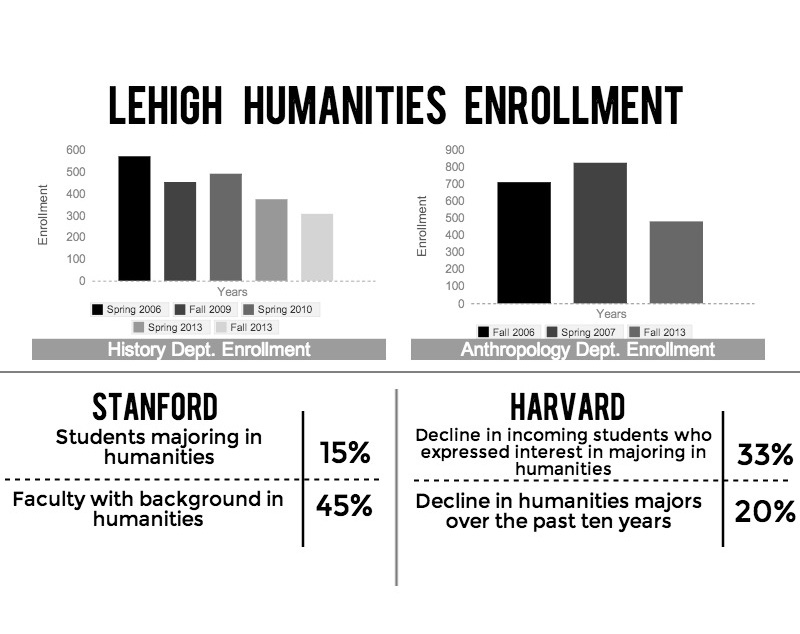
The History Department had 571 students enrolled in the spring of 2006, 453 in the fall of 2009 and 491 in the spring of 2010, according to the office of the dean of the College of Arts and Sciences. There has since been a steady decline, with only 374 enrollments in the spring of 2013 and 307 in the fall of 2013.
In addition, the department of anthropology consistently surpassed 600 students before reaching its highest numbers for the 2006-2007 academic year, with 711 and 825 students enrolled in the fall and spring, respectively. The department has not surpassed 700 enrollments since the spring of 2010, only surpassing 600 twice and falling as low as 481 in the fall of 2013.
The same trend can also be shown for the decline in majors in these disciplines with anthropology, dropping from 39 in the fall of 2011 to 20 in the fall of 2013. International relations went from never having fewer than 77 majors before its spring 2010 high mark to dropping steadily to a low of 45 in the fall of 2013.
The numbers tend to be closely correlated, as students who take upper-level courses tend to be majors, while students in entry-level courses are usually the students whom the department tries to attract as majors, typically during their sophomore year.
According to Michael Raposa, chair of the department of religion studies, while entry-level courses have been popular because of first-year and upper-class engineering and business students, the 200- and 300-level courses have been declining in enrollment from typically having 18 to 20 students a few years ago to now having seven or eight. John Smith, chair of the history department, attributes the decline in majors to the decline in students in the college.
“There’s been a shift in students toward engineering,” Smith said.
Students who choose to major in what are seen as more “practical” disciplines typically do not pursue humanities and social sciences. This is, in many ways, similar to the national trends that are emerging at various universities around the country.
At the time of a June 2013 column by David Brooks in The New York Times, 7 percent of students in American universities majored in the humanities, as opposed to 14 percent 50 years earlier. Another figure Brooks used showed that the number of incoming Harvard University students who expressed interest in becoming humanities majors dropped by one third.
According to an October 2013 New York Times article, Harvard experienced a 20 percent decline in humanities majors over the previous 10 years. Stanford University is experiencing a similar predicament where, according to the article, only 15 percent of students majored in the humanities. Forty five percent of its faculty have backgrounds in the humanities, despite the fact that no humanities disciplines make the list of the five most popular majors at the university.
Even at a truly liberal arts college like Pomona College has seen the same trends. According to a June 2013 Verlyn Klikenborg op-ed in The New York Times, only 16 out of 1,560 students at Pomona majored in English, and the two most popular majors at the college were economics and mathematics.
“Undergraduates will tell you that they’re under pressure — from their parents, from the burden of debt they incur, from society at large — to choose majors they believe will lead as directly as possible to good jobs,” Klikenborg writes. “Too often, that means skipping the humanities.”
Wesson also said he has come to the conclusion that many students are turning away from the humanities due to pressure from parents to find a major that is seen as more practical in terms of getting a job. In light of the 2008 recession and the common rhetoric associating science, technology, engineering and math fields with jobs, the pressure is great.
“This generation lived through 2008,” Wesson said. “At that time, a lot of students saw one or both of their parents lose their jobs. They saw one or both of their parents, or somebody close to them, lose their home, go into foreclosure.
“The American Dream was sort of being pulled away…in a crisis like that, you can almost understand the thinking where people are telling their kids, ‘Don’t make the mistake I did, go and do something that’s going to make you lots of money so that the next time something like this happens, you’re immune from it,’” he said.
Wesson feels this is especially true at Lehigh, where students come with a much more “career-focused” mindset as opposed to some other institutions in which students tend to be more “experientially focused.” But he feels things are improving, as these trends tend to be economically based, especially with the decline of law school applications, and he believes the worse of the decline is behind us due to several initiatives taken across the departments of the college to change their courses and better market their major and the career opportunities that come with it.
According to Smith, the History Department is about to begin reviewing its classes and bringing back alumni to speak about various career opportunities.
The English Department has shown how changes resulting from such a review can be successful. After noticing a sharp decline in class enrollment, particularly in 100-level courses a few years ago, the department took steps in changing these courses and make them broader in focus regarding time period and theme.
As a result, English Department Chair Scott Gordon said this has led to a broader appeal not just to non-majors looking to fulfill requirements, who have often taken more classes in the department, but also to first-years and sophomores who have become majors. As a result, some career-centered programs that have drawn high turnout, the number of majors has recovered to approximately 80 percent of what it had pre-recession.
Comment Policy
Comments posted to The Brown and White website are reviewed by a moderator before being approved. Incendiary speech or harassing language, including comments targeted at individuals, may be deemed unacceptable and not published. Spam and other soliciting will also be declined.
The Brown and White also reserves the right to refuse the publication of entirely anonymous comments.