



Lehigh has a first-year retention rate of 95 percent, meaning 95 percent of first-years stay for their sophomore year. Despite this, students still transfer in and out of Lehigh, as well as between Lehigh’s three undergraduate colleges.
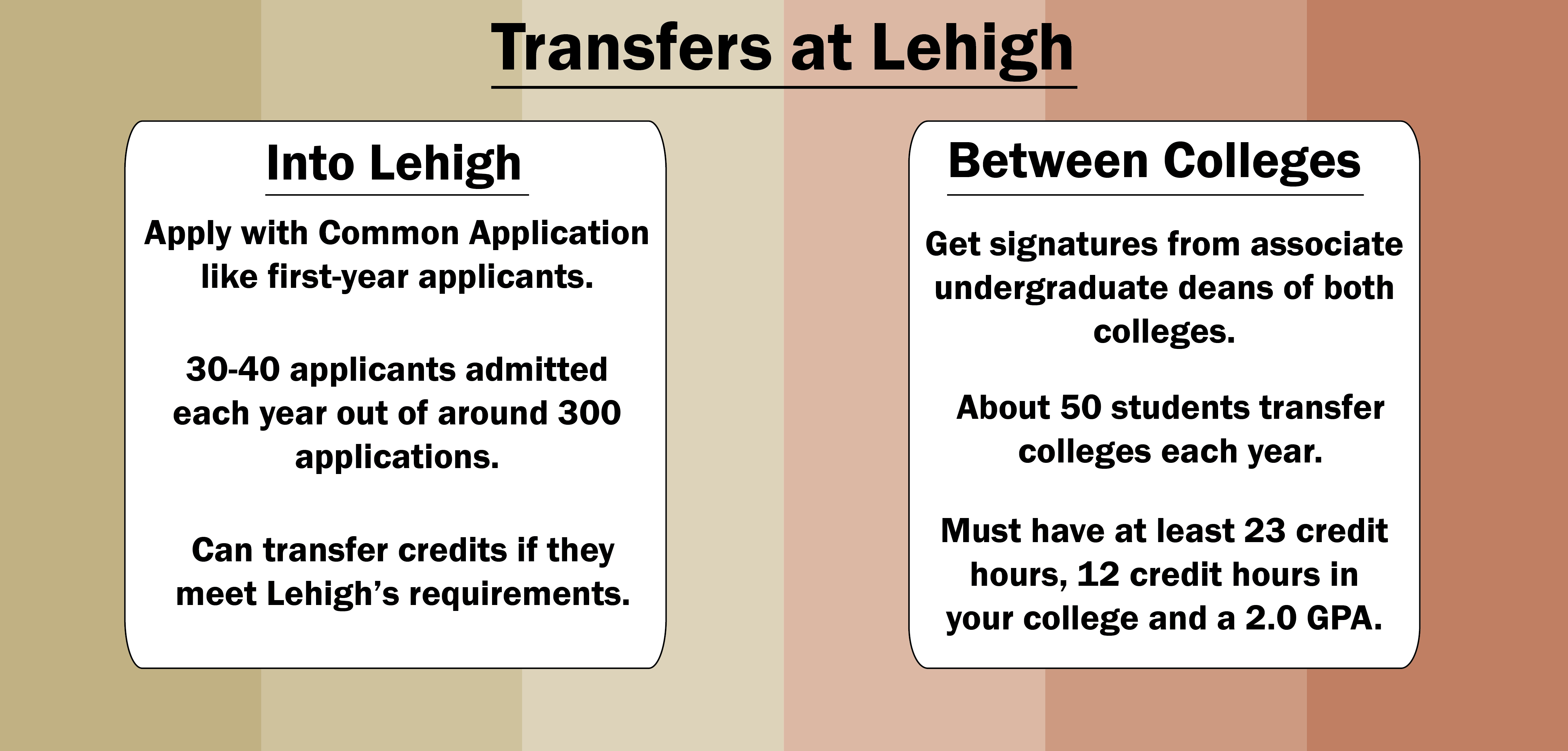
Overall, transfers into Lehigh are a relatively small part of the student population. Sarah Bombard, the senior associate director of admissions, said only around 30 to 40 undergraduate transfers are allowed each year because of limited spots.
The transfer application process is similar to the first-year undergraduate process. Prospective transfers apply through the Common Application. Bombard said the fall deadline is March 1, and students find out about their acceptance later in the month. The main difference between first-year applications and the transfer application is that transfer students do not have the option to have an interview.
After acceptance, transfer students can have a credit evaluation to determine which credits will transfer over. In order to have credits transfer to Lehigh, the university must have a version of that course with the same number of credit hours, students must fulfill the same prerequisites that Lehigh requires for the course, and the student must have a C or better in the class. Pass/fail classes cannot be transferred for credit.
Lehigh also accepts AP credits with a score of 4 or 5, excluding Calculus AB, Chemistry and both English exams, which require a 5. Transfer credits are not factored into Lehigh’s GPA. The admissions website lists more caveats and rules regarding transfer credits.
Once students are at Lehigh, they have the option to transfer between colleges. To do so, students must meet with and get signatures from the associate undergraduate deans of both their college and the college they wish to transfer into. Once they complete this and turn it into the registrar, they can transfer if they meet the requirements to do so.
The only requirements to transfer are that the student must have completed 23 credit hours, which can include AP credits and transfer credits, and have at least a 2.0 GPA. A rule was changed last year that now requires 12 of these credit hours to have come from the college the student originally applied to.
The only unique college requirement is that the College of Business requires students to get at least a C- or better in ECO 1 and MATH 81.
It’s a common misconception that students apply to the College of Arts and Sciences, believing that it’s easier to get into, and then transfer into business or engineering. Cameron Wesson, the associate undergraduate dean of the College of Arts and Sciences, said while this used to be a more common occurrence, the number of students who do this has greatly decreased.
“At one point it was as many as six or eight students leaving the College of Arts and Sciences for every one that came back, but now it’s much closer to on par,” Wesson said. “I would say that’s in large part because they’re doing a very good job in the admissions office of making sure that they read the applications very carefully. A student that might look like they might be playing that game, like ‘I’ll apply to arts and sciences but I really want to be in business,’ they spot them very quickly and usually weed them out of the application process.”
Another reason this is less common than it used to be is that students are now more likely to receive dual degrees instead of transferring colleges. Wesson said only about 50 students transfer both in and out of the College of Arts and Sciences in a year.
“I would say, right now, there’s more students pursuing a dual degree program than those that just switch,” Wesson said. “I would imagine it’s probably around 50 to 60 students in the College of Arts and Sciences that are simultaneously pursuing another degree in business or engineering right now.”
Isabel Buenaga, ‘17, a global studies and political science major, transferred from the College of Engineering into the College of Arts and Sciences. While she had no problem with the technical process, she found the social aspect of switching colleges difficult.
“The social aspect to it was really hard for me,” Buenaga said. “All my friends are engineers. There’s this huge thing at Lehigh with like the ‘arts and crafts,’ thing which is odd, very odd cause we’re all smart at Lehigh . . . But I think I learned to cultivate the relationships that I really enjoyed, and they also learned how to approach my different major without looking at it like I was less or not as smart.”
Buenaga said she thinks it would be helpful to look into the social aspect of switching colleges.
“I think I felt OK about the process because I think, when it comes to the social aspect, that’s definitely hard when you (switch colleges),” Buenaga said. “I think that’s something that maybe there could be some service to provide support, but I think it’s very individual to a certain extent.”
Comment Policy
Comments posted to The Brown and White website are reviewed by a moderator before being approved. Incendiary speech or harassing language, including comments targeted at individuals, may be deemed unacceptable and not published. Spam and other soliciting will also be declined.
The Brown and White also reserves the right to refuse the publication of entirely anonymous comments.