



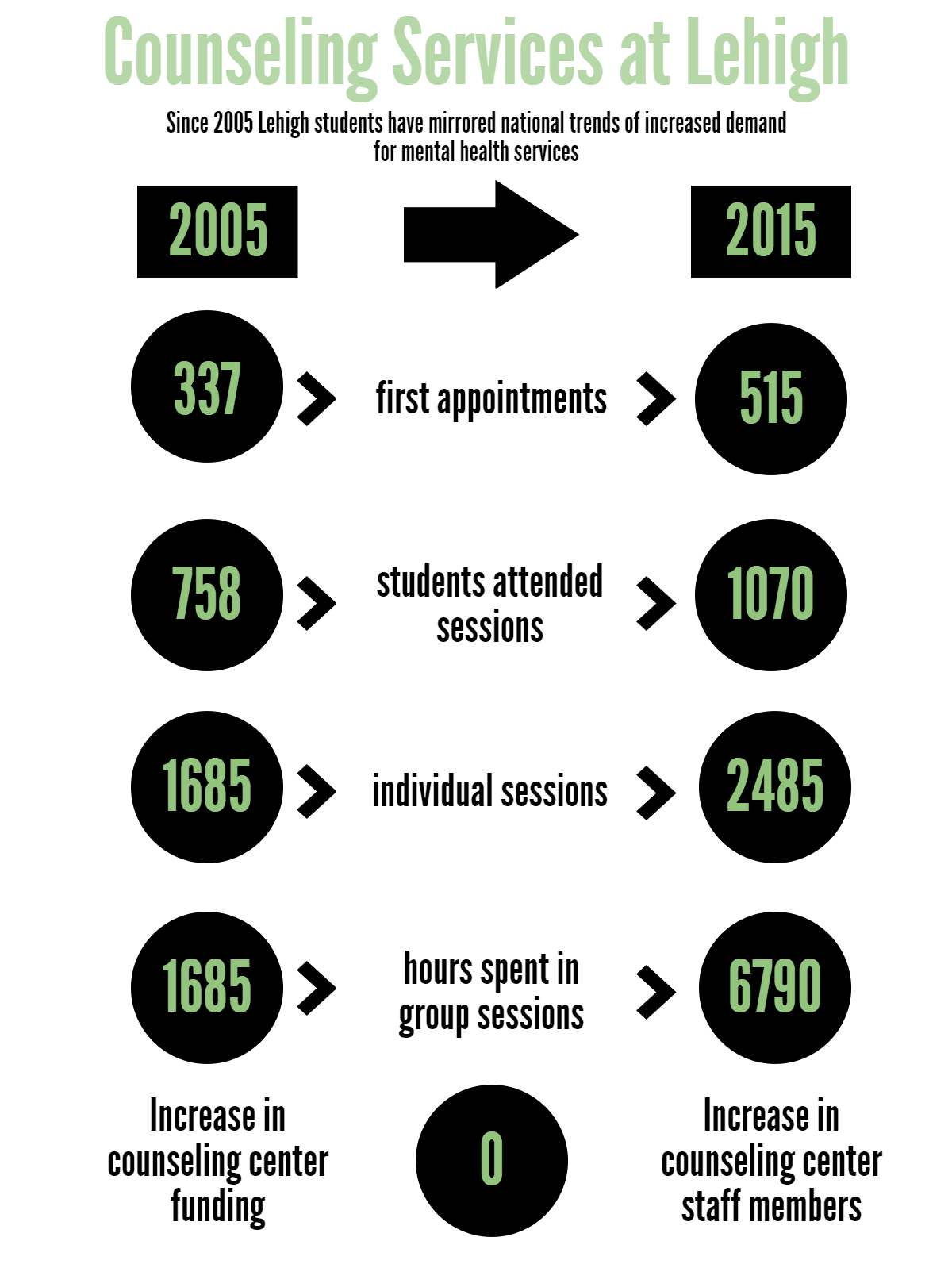
With 6,790 hours of time, a student taking 15 credits per semester would complete nine semesters.
Lehigh students spent 6,790 combined hours in group counseling in 2015. In 2005, they spent one-fourth that amount of time in group sessions, mirroring a national trend of an increase in students seeking mental health services on college campuses.
A 10-year summary report produced by the Center for Collegiate Mental Health looked at more than 340 university and college counseling centers and more than 100,000 college students seeking mental health treatment. According to the report, not only are the rates of students seeking mental health services growing, but they are outgrowing enrollment rates by more than five times as much over five years.
Ian Birky, the director of Lehigh’s counseling and psychological services, said after looking at the literature and his conversations with colleagues at conferences, the overall sense is nationally the numbers continue to rise, stigma is going down and there are not enough counselors in most universities to handle the number of students who want to be seen.
This overall increase has contributed to both a national conversation about the resiliency of today’s “special snowflake” college students and a seemingly ever-present demand on collegiate counseling centers.
The resiliency of college students
After enduring an abusive relationship in high school, Carine Leslie, ’17, found herself struggling with depression and engaging in self-harm. She attended therapy sessions but said they didn’t help because she didn’t want to be there.
She hoped going to college would help her get better. What she found was to the contrary.
Her depression led her to isolate herself, and after the end of a second, two-year relationship, she found herself falling into what she called “a downward spiral.”
“I became really suicidal, and I didn’t see the point in anything anymore,” she said.
She walked into Lehigh’s counseling center and told them she wanted to kill herself. They spoke with her and told her she could call them if she felt this way again.
Four days later, her friends who feared for her safety called the police, and she was taken to the hospital. In the following months, Leslie went through psychiatric therapy, a slew of medications and a semester away from Lehigh before returning to school.
“Now two years later, after all of that, I still have anxiety,” Leslie said. “The issues are still there, but I don’t go to therapy anymore, and I’m such a different person.”
Leslie, the president of Lehigh’s chapter of the National Alliance on Mental Health, is not an anomaly.
Birky said the counseling center saw just shy of 100 students “in crisis” last year. However, students at risk of self-harming or suicide are not the only students in the counseling center. They do not even represent the top three issues students seek help for.
Cristie Cunningham, the assistant director of counseling and psychological services, cited anxiety, depression and relationship issues as the top three things that land students in the counseling center.
In addition to these, Lehigh students who responded to an anonymous survey also said they went to the counseling center to manage issues such as eating disorders, sexual assault, drug and alcohol abuse, and pregnancy.
In 2005, the counseling center saw 1,685 individual counseling sessions, whereas 2,485 individual sessions took place in 2015. While some believe the increase in sessions are a direct result of a less resilient generation of college students, representatives at Lehigh disagree.
Cunningham said she believes the decrease in stigma surrounding mental health issues has had an impact on the increase in students seeking help.
“I don’t know that students are necessarily less resilient,” she said. “It’s hard to say because they’re seeking services more, but with the decrease in stigma, who knows if 10 or 15 years ago the numbers would look the way they look now if the stigma hadn’t been present.”
Leslie shared her story publicly for the first time Friday night at Frattle of the Bands, an event NAMI co-sponsored to raise money for a local organization that aids South Bethlehem residents struggling with mental health issues.
She said the decline in stigma helped encourage her to share, and she hopes that by sharing, she contributes to that decline. She hoped talking about her problems would encourage students to share theirs with her.
“At this point I’m not ashamed of anything I went through,” Leslie said. “There are so many people out there who if they’re not suffering they know someone who is, and it just takes one person to stand up and share their story to inspire them.”
She said she generally doesn’t expect people who have never suffered from mental illness to be able to empathize but said increased efforts at educating students will continue to help eliminate the stigma.
NAMI vice president Lauren Miller agreed educating students to be cognizant of issues other students may be facing will only make them more progressive and accepting of one another.
“Awareness leads to change, so students that become more aware of these problems are more likely to want to see change and want to make change,” she said.
Cunningham said the counseling center has worked with students in leadership positions such as Gryphons and orientation leaders to educate them on how to recognize students who may need to seek help and how to refer them to the counseling center.
In addition to the move toward eliminating the stigma, Birky said while the competitive nature of college students can often lead to stress or anxiety, that drive to succeed may also make them more likely to seek help, using it to get an edge.
Cunningham agreed that this mentality, paired with student leaders on campus becoming more educated, have led to students using the counseling center to succeed.
“I definitely think Lehigh students are students who are driven and want to excel in what they’re doing,” she said. “I think if people are talking to them about the different resources on campus that could be helpful, then they’re going to be likely to try it and say, ‘OK if this is going to be helpful to me in the long run, why would I not?’”
Aside from students who have sought out the health center as an effort to succeed, Miller believes students who do struggle with mental illness and choose to seek help are stronger than they receive credit for.
“I definitely don’t think students are less resilient,” she said. “I think students who have mental illness are actually more resilient because (they) have to deal with not only life, but also (their) own personal problems so that (they) can continue on like every other student and not be afraid. You’d be surprised at the number of students who have mental illnesses but you’d never know unless you asked them.”
The demand on the counseling center
In the 10-year period that Lehigh’s counseling center has seen an increase in students, the center has received the same increase in funding as it did in staff members: zero.
The increase in students, juxtaposed with the center’s stagnated growth in staff, has led to a fairly overwhelmed counseling center staff struggling to meet the demands of its community.
“Here as well as elsewhere nationally, any increase in numbers makes the counselors feel as though they are working harder and harder to keep up,” Birky said.
He also said in past years students used the center more casually as “an existential journey of self-discovery.” Today, that happens less because of the rise in students seeking help for mental health issues, but he said the burden on counselors often feels heavier now.
The more drastic increase in hours spent in group sessions — 1,685 in 2005 compared to 6,097 in 2015 — also comes as a direct result of the increase in students trying to schedule sessions.
In an effort to manage the workload of more students with the same number of counselors, the center has had to spend less time with students in individual sessions. Referring them to group therapy or outside counseling has become increasingly more common.
“While we used to see every student coming to the center, and sometimes for lengthy periods of time, we now refer quite a number of students to therapists in the private sector and limit the number of times they can be seen in individual counseling,” Birky said.
She said the increased demand from students prevents her and her colleagues from engaging with campus as much as they’d like to, which affords them little to no opportunity for educational efforts.
Organizations on campus, such as NAMI, seek to make up where the counseling center is forced to lack.
Miller said the organization’s primary goal is to educate Lehigh’s campus on a variety of mental illnesses. She said education helps students recognize symptoms, not only in each other but in themselves as well.
“I think as with any movement, becoming more aware of mental illness is definitely an important factor because mental illness covers so many different facets,” Miller said. “Once students are aware that mental illnesses are an issue, students can recognize symptoms in themselves and not just brush it off as typical college feelings.”
Miller said, in the future, if students can get educated and decrease the stigma, they can work together to check in on one another and ensure these issues are brought to the forefront of the conversation the way any physical ailment or disability might be.
She said no one of any race, ethnicity, gender or religion is immune to mental illness, and because of that, it’s important that people get educated and work together in the future to decrease the stigma.
“Besides my own personal dealings with mental illness, I think the interconnectedness of the movement is cool too see,” Miller said. “It affects so many different things, and I think now more so than ever people need to be aware of it.”
1 Comment
—-Cunningham said she believes the decrease in stigma surrounding mental health issues has had an impact …
I wonder is she has ever considered who taught her to say there is a stigma to mental illnesses? Why, instead of correcting people who do, she repeats them?
Comment Policy
Comments posted to The Brown and White website are reviewed by a moderator before being approved. Incendiary speech or harassing language, including comments targeted at individuals, may be deemed unacceptable and not published. Spam and other soliciting will also be declined.
The Brown and White also reserves the right to refuse the publication of entirely anonymous comments.