



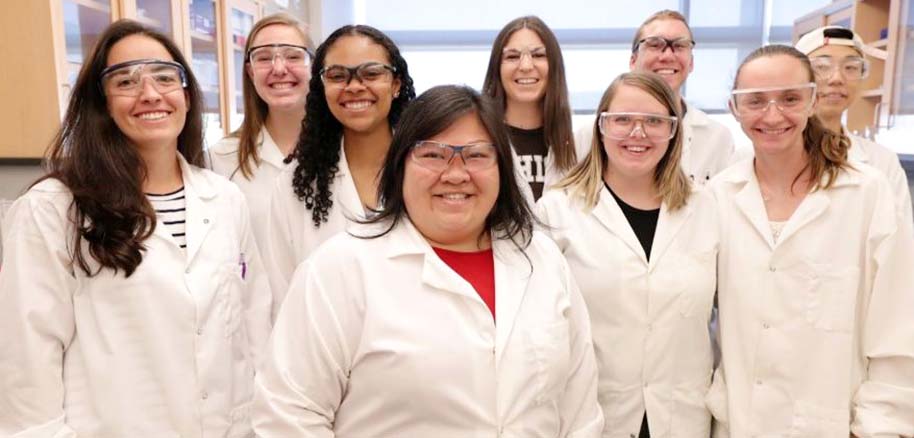
Lesley Chow, an assistant professor at Lehigh, felt inspired to develop a novel method to fabricate scaffolds that resemble native biological tissues. To do so, her research takes place in ‘The Chow Lab.’
Chow, who completed her Ph.D at Northwestern as a polymer chemist, and her lab work primarily with polymer modification. She works in the bioengineering and materials science department, said her lab takes the polymers and modifies them with peptides, which are thought of as the building block to make different types of molecules to form cells with respective specialties.
“We started adding peptides onto the polymers because that allowed us to create something which we call bioactive,” Chow said. “It’s almost like giving a signal to the cell to check out a molecule on the surface, and then bossing them around and trying to tell them all the different things they need to do.”
Intrigued and aware of the intricately-organized structure of tissues, Chow said the lab then tries to use 3D printing to control where each of the molecules go to replicate the organization of different tissues.
Diana Hammerstone, ’20, a materials science and engineering student, said the lab’s overarching project is to try to regenerate the osteochondral tissues, the cartilage in the knee that does not regenerate on its own.
“We use solvent-cast 3D printing to fabricate scaffolds made of biodegradable polymers,” Hammerstone said. “We can independently change the physical and biochemical cues the scaffolds give cells using this technique.”
In one specific project, Chow said they found that cells responded differently in their material that has organized signals, rather than just being mixed together, which illustrates how intelligent cells are.
Chow said one of the biggest things the lab is doing is taking some of its technologies in vivo, or “with the living,” to implant them into animals and see how the existing cells in the animal would respond.
“We want to try and demonstrate the ability for our materials to be useful and hopefully one day make materials that can be implanted in the clinic,” Chow said. “What would be really cool, is if our small, little material helps regenerate that tissue. For instance, say you have an injury, you could just get this material implanted in your body, and then it’ll heal itself better.”
The research team collaborates as a whole to achieve its overarching research goal.
As a new member of the team, Yaa Donkor, ’23, chemical and biological engineering student, said a lot of her collaboration is asking and clarifying questions to her lab members.
“When my team and I need to figure something out, each of us shares our ideas and talks through the problems together to achieve the goal of our project,” Doker said.
Chow said the team has a broad, big picture goal of being able to make materials that guide the organization of tissues, and each student in the lab has a specific job that fits within that larger goal.
Chow said the dynamic of the lab is like a “dream situation” for her, and she said she values the way the group interacts with each other.
Matthew Fainor, ’20, said every undergraduate in the lab is paired with a graduate student to collaborate on larger projects.
“I work with my graduate student, and then the graduate students work together to piece together the bigger picture of the research, and we all work with Dr. Chow to communicate that research and make sure everything is coming together cohesively, ” Fainor said.
Hammerstone said the biomaterials lab allows her to apply her material science and engineering background in a bioengineering setting. She said her research experience will be helpful as she transitions to a graduate researcher.
Hammerstone said the most rewarding part of her research is getting to work with experienced and bright engineers to make a difference in people’s lives, as osteoarthritis affects millions of people worldwide, according to the Mayo Clinic.
As someone who will be leaving the lab in a few months, Fainor said he hopes that the projects he is working on can be handed off successfully to someone and made easy for them to understand.
“I really believe in the goal our lab has and looking forward to seeing how Dr. Chow, and the graduate students that will continue to be there, continue to move toward our goal,” Fainor said.
In the future, Donker said she hopes that ‘The Chow Lab’ will continue to be the heartwarming place that contributes to life-improving medical knowledge.
Comment Policy
Comments posted to The Brown and White website are reviewed by a moderator before being approved. Incendiary speech or harassing language, including comments targeted at individuals, may be deemed unacceptable and not published. Spam and other soliciting will also be declined.
The Brown and White also reserves the right to refuse the publication of entirely anonymous comments.