



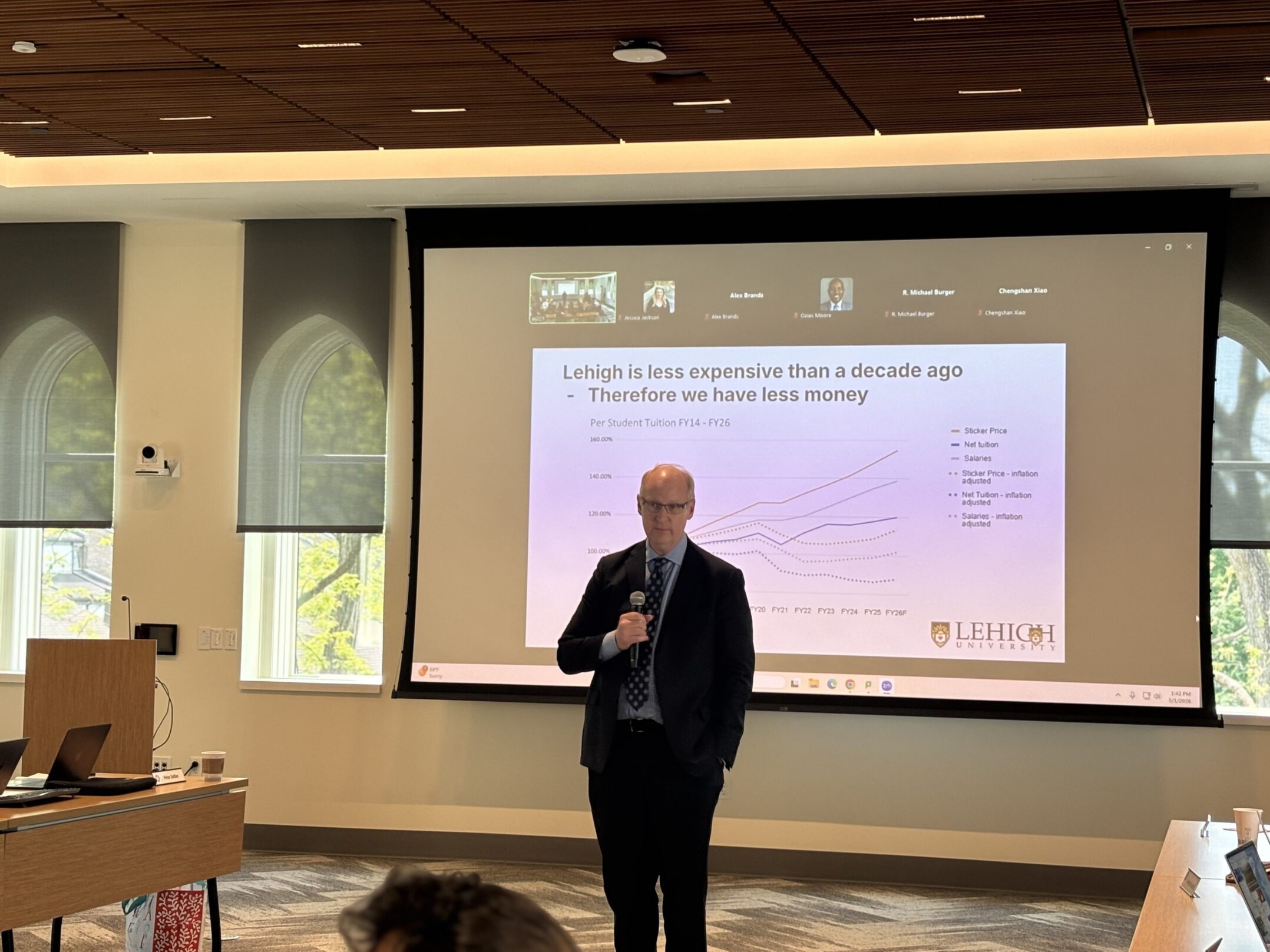
On Friday, the Faculty Senate had its final meeting of the semester at the University Center Boardroom.
At the meeting, faculty members discussed the university budget, heard updates from Senate working groups and addressed campus climate concerns.
Memorial resolutions
The meeting began with a memorial resolution honoring former Lehigh biological sciences department chair and professor Murray Itzkowitz, presented by Kathy Iovine, current chair of the department of biological sciences.
Iovine said Itzkowitz joined Lehigh in 1979 and retired as professor emeritus in 2020. She highlighted his research on animal behavior, including courtship, parental behavior and aggression through his work with various fish species.
“For over four decades, he was a scholar, educator, mentor, colleague, friend and advocate,” Iovine said. “Murray’s legacy includes the nine faculty he hired as chair, the 18 students he mentored towards their PhDs, his over 90 research publications and the countless acts of kindness, sarcasm, wit, advice and knowledge that are remembered by those who knew him.”
Following Iovine’s remarks, attendees shared a moment of silence.
Next, Kate Arrington, professor of psychology and department chair, presented a memorial resolution for George Shortess, who joined Lehigh in 1979 and retired in 1994 as a professor in the department of psychology.
Arrington said Shortess died at 93 years old on Dec. 3.
She discussed Shortess’ research in neurophysiology, funded by the National Institute of Health. She also said Shortess combined his interest in science and art by publishing multiple journal articles exploring “neural art” and visual arts research.
“(Shortess) is remembered by colleagues as a devoted teacher and mentor who was always interested in improving the student experience,” Arrington said. “He was generous in his time providing advice to junior faculty on the balancing of teaching and research.”
A moment of silence was also observed following Arrington’s remarks.
Lehigh’s financial model and adjustments for next year
Provost Nathan Urban gave a presentation on factors affecting Lehigh’s academic budget and changes needed moving forward.
Urban began by discussing external factors affecting higher education, including inflation, research funding cuts and immigration issues impacting international student enrollment.
He shared examples of universities across the U.S. laying off employees and shutting down research centers because of budget cuts, citing Duke University shutting down three research centers, Yale University reducing college staff by 7.5% and Stanford University laying off more than 360 staff members.
Urban then outlined Lehigh’s strengths and weaknesses in relation to its financial model.
He also said Lehigh’s relatively low debt, endowment per student in the taxable range and international student enrollment of 25% are all beneficial to the university’s financial position.
Although Lehigh’s relatively low level of international student recruitment initially seemed like a weakness when he arrived about six years ago, Urban said current immigration challenges have made it an advantage.
He also said Lehigh’s limited number of research faculty fully supported by grants and its 27% admission rate currently have neither a positive nor negative financial impact.
Among the university’s biggest financial challenges, Urban cited Lehigh’s dependence on undergraduate tuition and the high cost of maintaining campus.
He said around 60% of Lehigh’s budget comes from undergraduate tuition, while about 15% comes from investments, 9% from auxiliary enterprises, 8% from grants, 3% from gifts and 5% from other sources.
In his presentation, Urban showed that of the university’s expenditures, 43% goes toward compensation and 25% toward financial aid.
Despite Lehigh’s tuition being $82,200 last academic year, he said the cost to educate each student is $100,516.
Urban said more than half of Lehigh students receive some form of financial aid, with the average tuition discount across all students sitting at about 40%, raising questions about how the university can maintain that model long term.
The university’s endowment, he said, and other revenue sources help close that gap.
He also said Lehigh must reduce expenses while preserving its “core values and strategies activities.” He said reputation and “quality” are key to Lehigh’s long-term success.
“Universities, especially private universities, are in a reputational battle,” Urban said. “We recruit students based on reputation. Our reputation drives our ability to get research funding. Our reputation drives our ability to bring in philanthropy. Our reputation drives our ability to hire the best faculty and staff. And so reputation and and the underlying core of reputation, which is what I’m naming as quality here, is critical for our success.”
Urban also said Lehigh needs to attract students who don’t require financial aid and want to attend because of the university’s academic reputation.
He said enrolling more upper-income students who choose Lehigh for its academic reputation rather than large merit scholarships could reduce the university’s discount rate and improve net revenue.
To strengthen that reputation, Urban said Lehigh should continue developing innovative academic programs, summer offerings and graduate certificate programs.
Faculty Senate working groups
The Faculty Senate currently has two working groups — one focused on “codifying” university subdivisions and another on revising faculty evaluation.
The first presentation was led by Anders Knospe, assistant professor in the department of physics.
Knospe said the group has been consulting with deans of Lehigh’s five colleges, the provost’s office, the vice provost’s office, general counsel and program directors to more clearly define academic programs and departments.
Creating those distinctions, Knospe said, would help clarify the process surrounding program closures, including the handling of scholarships, endowment funds and faculty placements.
Given funding cuts across universities, Jenna Lay, vice chair of the Faculty Senate, said having a clear process is especially important.
“We see departments and programs being shut down across the country, and we want to make sure that we are very clear on what that looks like at Lehigh,” Lay said. “Hopefully we won’t face this, but if we face this here, we are doing it in a way that is not surprising, that is transparent to people, that people understand that this is how we approach this.”
The second presentation was led by Haiyan Jia, associate professor of journalism and communication.
Jia said Lehigh has relied heavily on student evaluation of teaching when assessing teaching excellence, despite concerns about their reliability.
She said the group is exploring how teaching can be evaluated for review, promotion and tenure.
Jia shared a draft proposal that would assess faculty using four categories of teaching activities, six interrelated criteria for teaching effectiveness and multiple forms of evidence for teaching excellence.
Campus climate discussion
Recent acts of bias, including a swastika found near campus and a racial bias incident in March, prompted discussion among faculty members.
Peter Ziegler, chair of Faculty Senate, opened the floor for conversation about the incidents.
Filippo Casati, assistant professor in the department of philosophy, said several of his Jewish students had reached out to him regarding the swastika incident.
He said he felt horrified when students approached him about the incident, and, after asking how he could help, was told they’d brought ideas and concerns to multiple campus offices but felt ignored or saw no action taken afterward.
Based on his involvement in the Jewish community, Casati said he’s observed students feeling unheard and frequently encountering offensive remarks on campus.
Iovine suggested holding a joint meeting with the Student Senate to continue conversations surrounding bias incidents.
Henry Odi, deputy vice president for equity and community and associate provost for academic diversity, said his office has been regularly meeting with small groups of students to discuss the incidents. Most recently, he said the office met with students from Lehigh Hillel and Chabad.
Odi said the office is actively gathering feedback and plans to focus on implementation over the summer.
“The work is going to continue, and the message across campus is that we are interested in building partnerships with our students,” Odi said. “So it’s just not going to be a group or other administrators working on this. Students are going to be involved, and we also will explore the role that faculty and staff will play in this.”
Faculty Senate elections
Lay will become chair of the Faculty Senate in August as Ziegler retires.
There are currently 10 open seats on the Faculty Senate, and Lay opened nominations for those positions.
An electronic vote will be held during the week of May 18, Lay said.
The meeting adjourned at 2:59 p.m.
1 Comment
I believe seeking more (or only) students who do not need any financial aid is utterly nonsensical.
Comment Policy
Comments posted to The Brown and White website are reviewed by a moderator before being approved. Incendiary speech or harassing language, including comments targeted at individuals, may be deemed unacceptable and not published. Spam and other soliciting will also be declined.
The Brown and White also reserves the right to refuse the publication of entirely anonymous comments.