



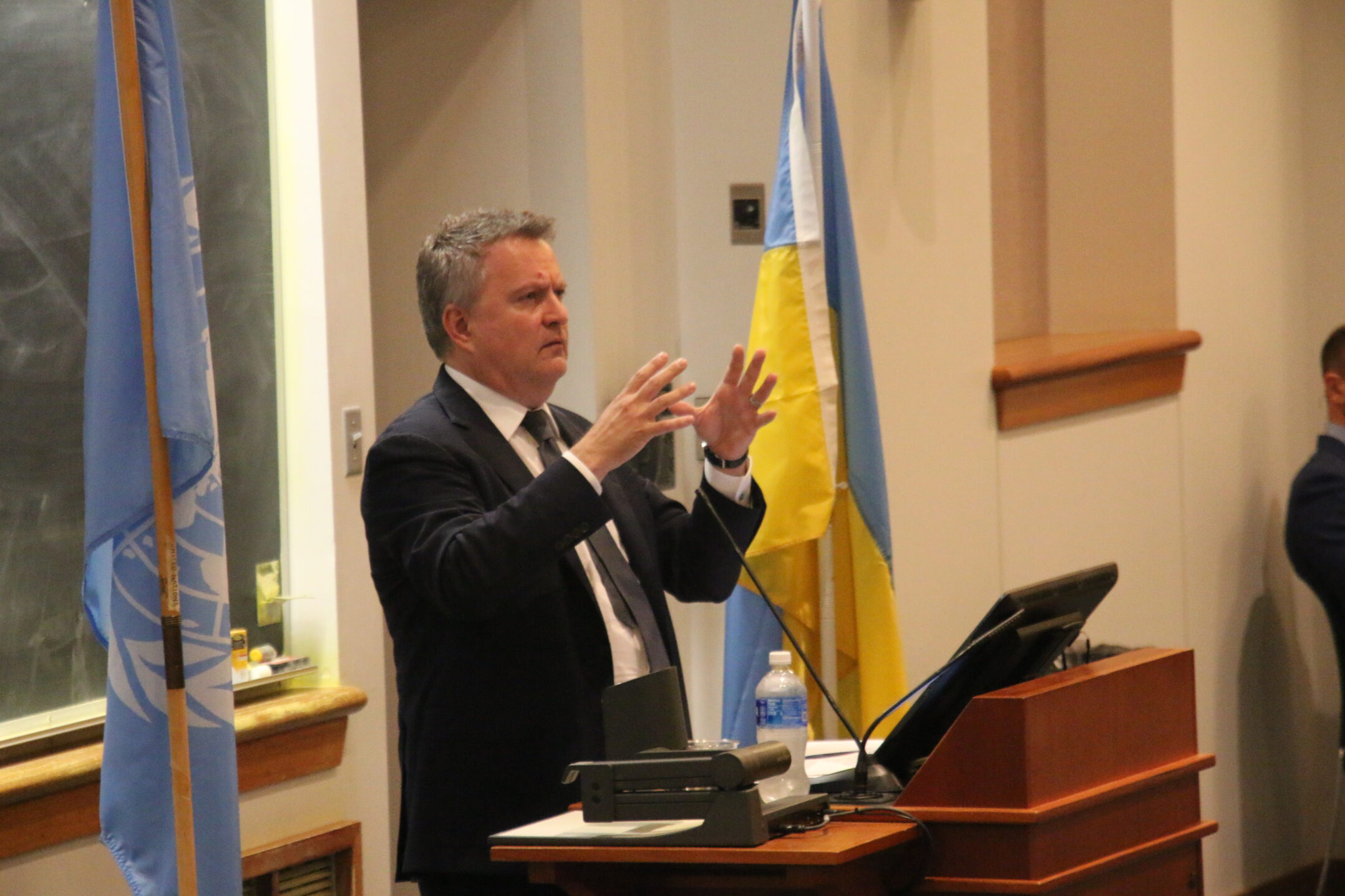
Sergiy Kyslytsya is a Ukrainian career diplomat who has served as Ambassador and Permanent Representative of Ukraine to the United Nations since February 2020. Six years prior to him taking on this role, in February 2014, the ongoing Russia-Ukraine War began.
Though Kyslytsya has held numerous diplomatic roles and additional positions since he started his career, his current role posits him as a crucial point of contact in connecting Ukraine to its allies to promote international peace and security.
This year marks the twentieth anniversary of Lehigh’s attainment of Non-Governmental Organization accreditation at the UN, from which the Lehigh University/United Nations Partnership was formed. This partnership has allowed students to engage with ambassadors such as Kyslyska, as well as other senior diplomats and world-renowned figures.
For students, navigating opinions on international affairs and comprehending international diplomacy may be challenging. However, engagement with organizations such as the UN can increase understanding and, ultimately, influence diplomatic discussions.
Kyslyska spoke with The Brown and White about these topics before speaking to Lehigh faculty and students Wednesday.
What is the role of institutions like Lehigh University in advancing international diplomacy and student understanding, especially regarding the ongoing Russia-Ukraine war?
I believe that the most invigorating and most interesting (part), for me, (is that) audiences are the students and parliamentarians – members of national parliaments – because those two types of people, they are (the) most creative, most hardworking, and basically, when we speak about the students, that’s basically the future. So, one of the decisions that we’re now working on in New York for the Summit of the Future is the declaration for the future generations.
How can university partnerships with the UN be leveraged or expanded upon to support current peacekeeping efforts?
It’s a two-way traffic. First of all, the United Nations requires lots of expertise, and today, the United Nations agenda, if you look at the agenda of the General Assembly, it’s more than 170 agenda items, and you can find practically everything that matters for the population of this planet. So it’s not pure foreign policy; it’s also climate change, micro(biology), contagious diseases, how you develop rural areas, how you develop health systems, practically everything. Politicians (and) foreign policy professionals are not trained, so we need expertise from you guys, and you can do research. Then, you can offer new opinions. It’s up to the government to make a final decision, but the decisions of the government should be informed.
And on the other hand, the UN has this responsibility to explain to the public at large — including to young people — what (the) UN is and what (the) UN is not, because everybody (has heard of the) UN, but it’s very rare that a person can really go beyond basics. There are many misperceptions about the United Nations, and the United Nations is often blamed for something that the United Nations was never designed to deal with or to do.
What challenges do U.S. universities face when trying to engage with international organizations like the United Nations?
I do not represent an American university, but I think that there are ample opportunities for students, faculty, and for the universities to engage. You can have cooperation with your national missions. You can apply for internships when it comes to the students. I have many interns in my Mission. They are Ukrainians (who study) here in the United States. There are many opportunities with the agencies of the family of the United Nations that have lots of programmes where they are willing to work with academic institutions. So I think that the fact that Lehigh University has this UN programme and UN dimension is particularly important. It’s not that often that I would go (to) a university even in New York (that) would be so manifestly interested in the work and operation of the United Nations. It doesn’t mean that you should be in agreement with everything that the UN does, but it is very commendable that there is genuine interest.
Noting the fact that Ukrainian and Russian students specifically are both minority populations, what advice would you give them in regard to navigating different opinions of the war here on campus?
First of all, we have to say the truth, and in (the) case of the Russian aggression against Ukraine, I believe that it’s very easy to say the truth. And the truth is that there is only one victim of the aggression, and there is only one aggressor. And any discussion should start with acknowledgment of who is the aggressor (and) who is the victim. Then, you have to establish the fact that there is a set of international rules that the aggressor violates. And then you proceed from that point. And then you ask your opponent on what side you are. If your opponent is on the side of the aggressor, well, you may express your regret, and then you see if you can engage in conversation with your opponent. And if there is any opportunity to invite this person to discuss what’s going on, some people are hopeless. Some people are so framed by the ideology that they cannot care less about international law, relevant norms and rules.
How can students and other individuals mitigate the risks associated with language barriers or mistranslations when reading or listening to the news coverage of the Russia-Ukraine war?
The initial stage of dealing with any problem is the emotional stage, but then sooner rather than later, you have to look into the scientific or academic or legal nature of the problem. And in this case, I think the United Nations was absolutely clear when the General Assembly by 141 votes voted on the 2nd of March (2022), which was almost a week after the beginning Russia’s full-scale invasion of Ukraine, and the General Assembly by 141 votes designated Russia as an aggressor state. There is no question whatsoever. There is no gray (area in) that. The Russian Federation is an aggressor state. It is the Russian Federation that invaded our territory. And for that, it requires quite an effort to study. You cannot deal with a problem of that magnitude just based on emotions.
You’re active on the social media platform X, formerly known as Twitter, engaging in multimedia efforts concerning victims of the war. Given how accessible technology like that is for students, is there a change that you’d like to see in their behavior on social media, especially when it comes to humanitarian crises?
Social media is part of our life. There was a period when Twitter — today, X — became a significant part of our life. Some of my colleagues were trying to avoid it, but sooner or later, they realized that it’s there. (You) will either use it or you become a victim of not being part of the future. But social media is very dangerous because social media can be very misleading… especially if people cannot even care to open an attached link to your short tweet. That’s very dangerous. Therefore, while recognizing and appreciating the existence of social media platforms, I still insist that people invest their time and effort into studying the subject.
As we mark (the 20th) anniversary of the Lehigh/UN partnership, is there anything students can get involved in (regarding) the war effort and peacekeeping efforts?
Well, first of all, every person should take responsibility for his or her life. You are the master of your life, and at the same time, you are a member of your community. So, before you blame the United Nations for your government, you have to look at yourself, and you have to tell yourself, ‘What exactly have you yourself done to advance the cause that you believe in?’ And then you build on, and then you work with your fellow members of the community here in Lehigh, and then you advance your course. I like to work with people who are responsible. I appreciate opinions of other people who are hardworking, but I would not accept criticism from people who just criticize. When it comes to the United Nations, it’s very easy to blame the United Nations, but you have to recognize that in New York, it is not the skyscraper (on) 1st Avenue that (makes) decisions. It’s not the Secretariat that we hired to work for the governments that (makes) decisions. It is the assembly of the governments that (makes) decisions. So if you’re not happy with something that is decided in New York, all of you have your representative in the government, in the parliament, in the Congress, and then you address the question to your representative in the US Congress and you ask why this or another decision is taken. To recap, I think that the primary responsibility is on yourself, and before you start criticizing others, look critically at what you do daily.
Comment Policy
Comments posted to The Brown and White website are reviewed by a moderator before being approved. Incendiary speech or harassing language, including comments targeted at individuals, may be deemed unacceptable and not published. Spam and other soliciting will also be declined.
The Brown and White also reserves the right to refuse the publication of entirely anonymous comments.