



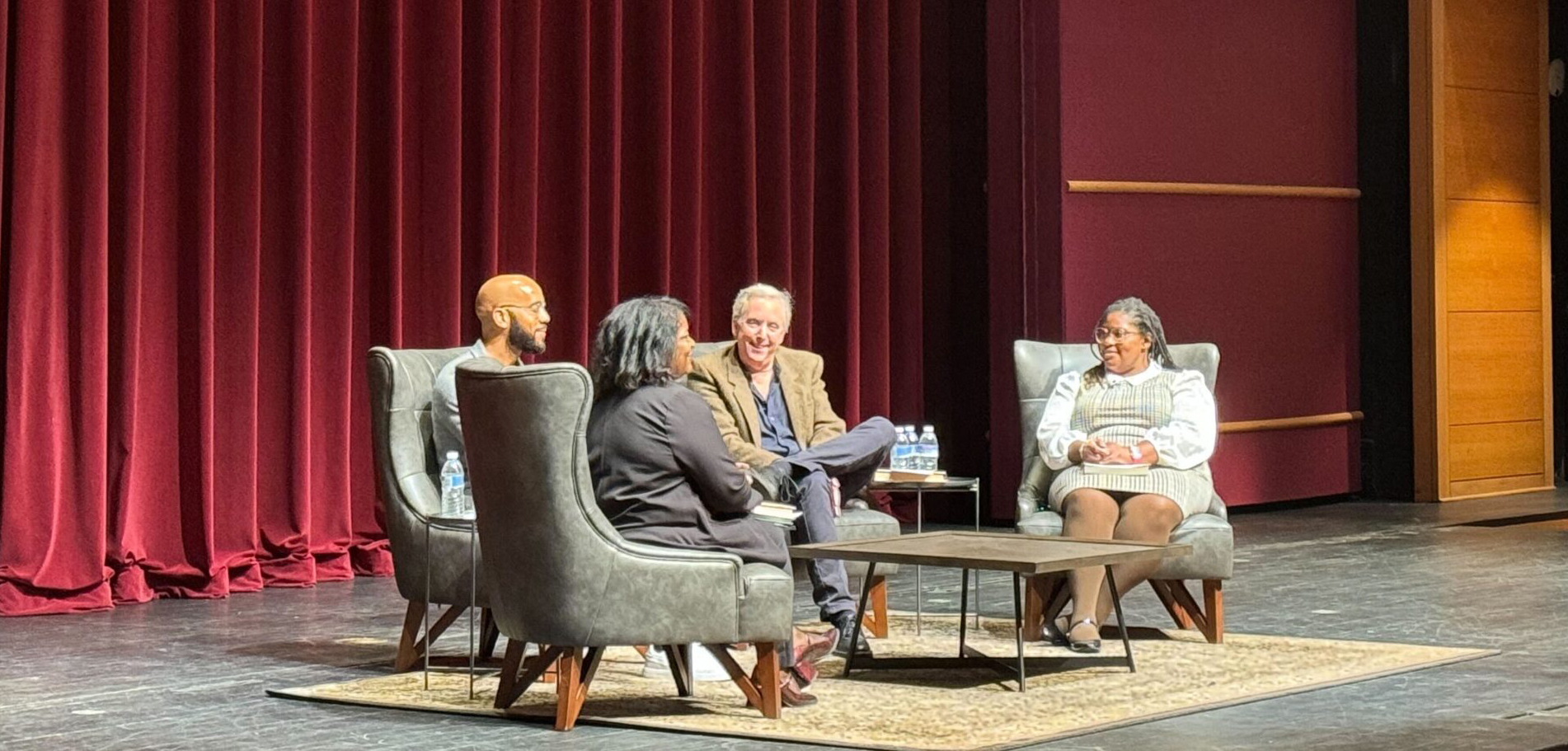
Clint Smith traveled across America to research the history of slavery in America for his #1 New York Times best selling book, “How the Word Is Passed: A Reckoning With the History of Slavery Across America.”
The idea for the book came in 2017 when Smith watched statues of confederates including Robert E. Lee and Jefferson Davis get torn down in his hometown of New Orleans.
As a child he had to walk Robert E. Lee Boulevard to get to school, and his middle school was named after a Confederate leader. Smith’s parents still live on a street named after a man who held over 115 enslaved people.
Smith said he realized there were far more monuments honoring enslavers than those who were enslaved.
“We know that symbols, and names and iconography aren’t just symbols, they are reflective of the stories that people tell,” Smith said. “Those stories shape the narratives, and those narratives shape policies, and the policy is what shapes the material in addition to people’s lives.”
Smith spoke at Lehigh on Oct. 29 in Zoellner Arts Center to discuss his book and share his experience.
He said he grew up in a city at the heart of America’s domestic slave trade. Even though his great great grandfather was a slave, he realized he didn’t fully understand the history of slavery.
Smith said writing his book helped him fill in his knowledge gaps and learn parts of history he was previously unaware of.
He began research for his book in Monticello, Thomas Jefferson’s home. Even though Jefferson advocated for independence against British colonization, it was at the direct expense of millions of enslaved people.
On a slavery tour in Monticello, Smith said he noticed two older women who were shocked to learn of Jefferson’s slave-holding history. He said people rented cars, stayed in hotels and bought plane tickets to Monticello, but many of them had no idea it was once a plantation.
“There are still millions of people in this country who don’t understand the history of slavery as it relates to our founding in any meaningful way,” Smith said.
The Declaration of Independence, drafted by Jefferson, states “All men are created equal,’ but Jefferson wrote in his book that Black people are inferior and the first Black woman to publish poetry was “below the dignity of criticism.”
Smith said Jefferson believed Black people didn’t have the same creative or intellectual abilities as white people.
“That was a version of Jefferson that I was never taught growing up,” Smith said.
He said a widespread lack of knowledge about slavery stems from the structure of America’s educational system and impacts everyone.
He said while people learn about Harriet Tubman and Fredrick Douglass, these don’t reflect the experience of every enslaved person who lived and died in the country.
He said hearing stories of exceptional Black people can warp people’s understanding of how brutal slavery actually was.
“It distorts your sense of how possible it was to escape,” Smith said. “In an effort to light up the stories of extraordinary people, it can sometimes do a disservice to the ordinary people who were just trying to find a way to survive.”
He said people need to tell a new story about America, especially about key figures like early presidents and founding fathers.
Smith said history isn’t about primary sources or documents for most people. It’s about the stories they are told.
During the discussion, Smith discussed his sensory experiences while visiting various historical sites and said his feelings at the sites was distinctive.
“There is something so singular about the feeling in one’s body when you walk through the cabin that an enslaved person once lived in,” Smith said. “There is something so singular about walking across the land people once picked cotton from.”
“When you realize how much your sense of self has been shapen by a particular story about America, and then they are told that story of America isn’t true, it is a profoundly fear-inducing experience,” Smith said.
Gianna Sottile, ’25, attended the event and said she she enjoyed listening to and learning from Smith.
She said she thinks it’s important for people to understand the complex history of slavery.
“We are still actively combating those institutions hundreds of years after it had dissolved,” Sottile said. “He is just so eloquent and well spoken and he made something that is such a struggle to write about beautiful.”
Angel Deluhery, a Moravian Academy student, attended the event for her AP African American Studies class. She said she expected the event to be a history review, but she ended up learning a lot.
“I think it is really important that people come to these talks because the different perspectives is the main impact,” Deluhery said.
Comment Policy
Comments posted to The Brown and White website are reviewed by a moderator before being approved. Incendiary speech or harassing language, including comments targeted at individuals, may be deemed unacceptable and not published. Spam and other soliciting will also be declined.
The Brown and White also reserves the right to refuse the publication of entirely anonymous comments.