



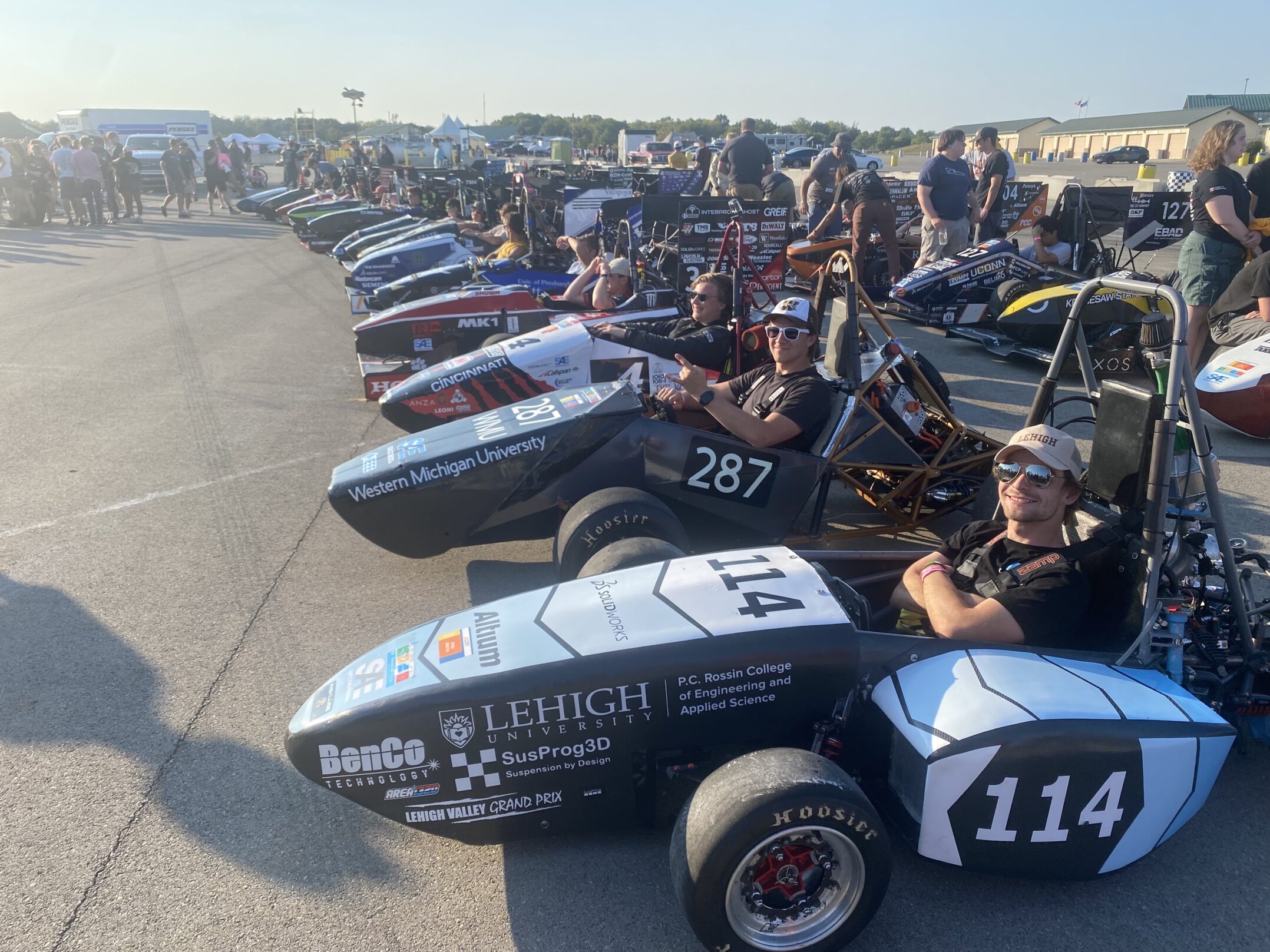
Lehigh’s Formula Society of Automotive Engineers Team shifted gears this spring, building its first reliable car since the start of COVID. They placed 28th out of 108 in their annual competition, a record high for the team.
Every fall, the team builds a race car from scratch, working in Packard and Mohler Labs to design it.
Tyler Lewis the captain of the aerodynamics team, ‘26, said the team transformed from barely being able to get a car to start to a top 30 team within four years.
He said the team is divided into six sub groups, each focused on one aspect of the car to divide the man power. These groups include aerodynamics, powertrain, suspension, the base frame, brakes, ergonomics and electrical.
Lewis said as per Formula SAE rules, they can reuse pieces, such as the engine and steering wheel, but they have to rebuild the base frame, also known as the chassis.
Every spring he said the team attends a competition hosted at the Michigan International Speedway, which is a NASCAR course. Once in Michigan, the car must pass multiple tests before it can compete in different events including, autocross, skid pass, acceleration and endurance.
Lewis said all of the events are designed to test and evaluate the performance of the car.
In the past, he said the team struggled in competition with unreliable cars or exploding car parts.
In 2020, their car was built but never competed due to COVID. In 2022, the car made it to the competition but failed, and in the following year, the car was unreliable.
Lewis said these struggles were due to lost knowledge during the pause of COVID, but there’s been a lot the team has learned from its setbacks.
After four years of trial and error, team captain Patrick Stanton, ‘27, said the 2024 competition was when things started to turn around.
“2024 was a big stepping point forward,” Stanton said. “We managed to complete all the events reliably.”
Coming into the 2025 competition as the underdogs, the team showed remarkable improvement, rising 48 places from 68th place to 28th while more than doubling their point score.
The team also won the efficiency event by completing a 14 mile race in a reasonable amount of time while burning the least amount of fuel.
Stanton said the adoption of carbon fiber car frames, a strategy they learned from an advising professor, helped their car improve. He said this allowed them to build a lighter car, while improving acceleration and speed around corners.
Stanton also credits the team’s improvement to their camaraderie and culture.
“ Since COVID, the team has grown very strong and very close together,” Lewis said. “That’s probably one of the main reasons for our success.”
Club member Matt Connors, ‘26, said the team spends long hours together designing, building and testing their cars.
While the group is mainly engineering students, Lewis said there are also members studying business or pursuing an integrated degree in business and engineering.
He also said many join for their interest in automotives and their desire for hands-on engineering practice, but like to stick around for the team’s culture.
“The engineering is great, but the culture of the people, it’s just gotten better every year I’ve been here,” Lewis said.
He also said the team is hoping to continue their upward trajectory into their next competition, focusing on making their reliable car faster.
He said the team plans to attend more local events this year in order to test and improve their car for the spring, while making the club more engaging for its members.
Stanton said the club provides students, particularly engineering and business majors, with real-world opportunities. Members can take what they learn in their classes and apply it directly to building the team’s car.
“ It’s one thing to go do the homework and do it on a test,” Connors said. “It’s another thing when you actually have to do it, and then it’s a lot more difficult when it doesn’t work and you actually have to work to figure out what went wrong.”
Stanton said building a car from scratch is rewarding because it combines the team members’ passions for automotives with the skills they’re learning, allowing them to see the application of their skills first-hand.
“ I built some really crazy things here and it was super awesome to see my parts on the car,” Lewis said. “That’s probably one of my favorite things.”
Comment Policy
Comments posted to The Brown and White website are reviewed by a moderator before being approved. Incendiary speech or harassing language, including comments targeted at individuals, may be deemed unacceptable and not published. Spam and other soliciting will also be declined.
The Brown and White also reserves the right to refuse the publication of entirely anonymous comments.