



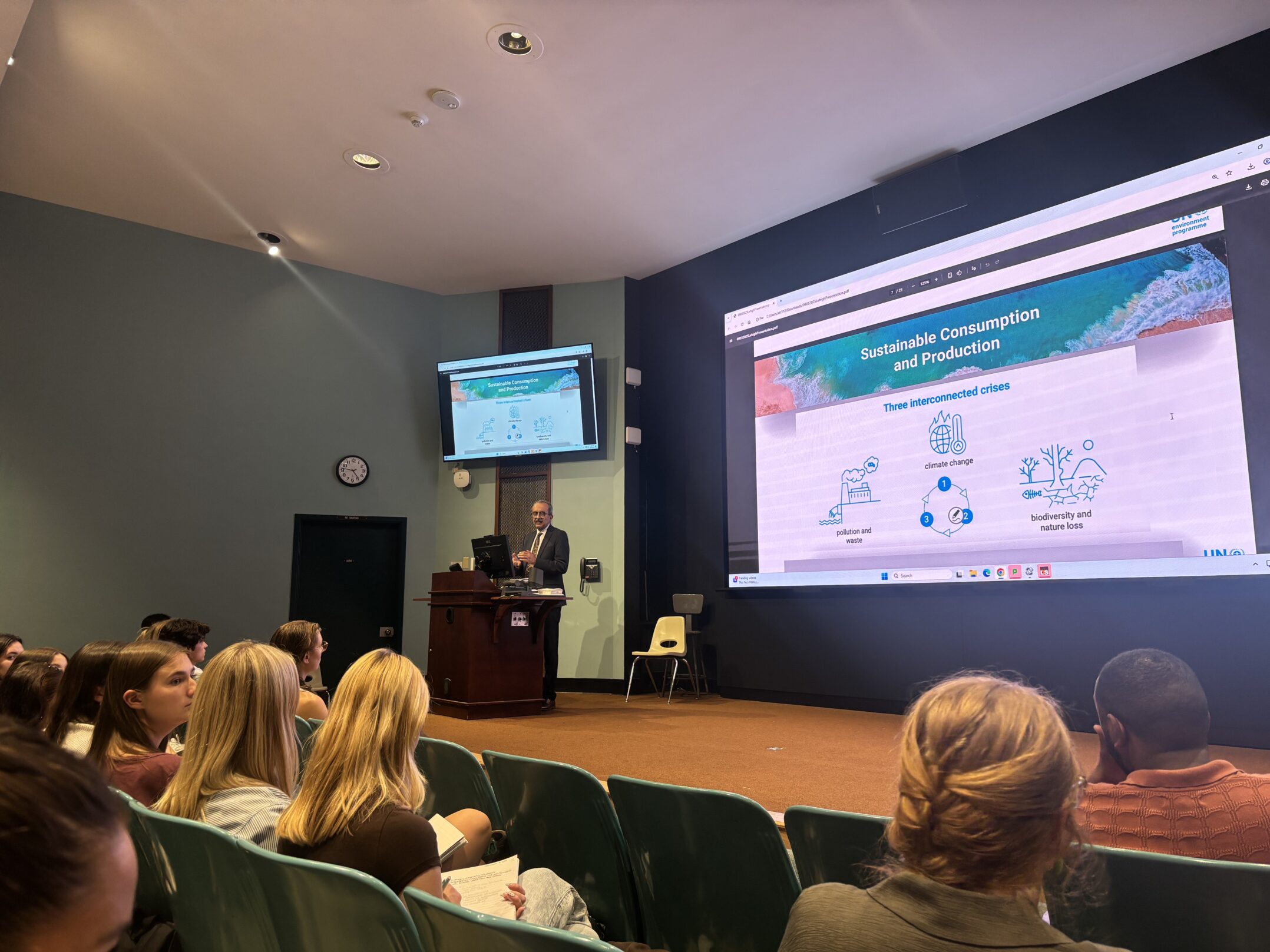
Jamil Ahmad, the director of intergovernmental affairs at the United Nations Environment Programme, spoke at Lehigh on Wednesday to address the world’s need for sustainable consumption and production to combat climate change.
Hosted by the environmental studies department and Lehigh’s United Nations partnership office, Ahmad described how consumers’ everyday actions are linked to environmental degradation.
“The capacity of the planet to generate natural resources is limited, but the ways we are consuming, and the ways we are producing, is more than the planet can regenerate,” Ahmad said. “There is no planet B.”
UNEP is the UN’s leading global authority on environmental issues, keeping the environment under review with scientific assessments, policies, decisions and partnerships.
Ahmad joined the programme in 2008 as the secretary for governing bodies in Nairobi, Kenya, and now directs intergovernmental affairs in New York.
In his lecture, he said humans are consuming resources faster than the planet can regenerate them.
UNEP has a framework to help combat people’s material footprint and stabilize the consumption of natural resources.
Ahmad also introduced the programme’s 2030 Agenda for Sustainable Development, which is a plan of action with 17 goals that are to be met by 2030, including eliminating poverty and hunger, and sustaining good health and economic growth.
Ahmad said progress toward these goals has been slow in the last 10 years, with only 15% of them being on track to be met by 2030.
He said this lack of progress illustrates the need for sustainable consumption and production at both a global scale and an individual level.
Ahmad said his overarching goal with his lecture was to encourage attendees that anyone can contribute to sustainable production and consumption.
“Our behaviors, as individuals, as consumers, as investors, as entrepreneurs, as scientists, as students and as young people, can contribute to sustainable consumption and production goals,” Ahmad said.
He explained this by outlining the food system, detailing that sustainable foods with visible and verifiable labels allow consumers to be aware of their footprint and make a conscious effort to shop sustainably.
Ahmad also said there is an importance of circularity in sustainability, focusing on two core objectives: “reduce by design,” and “recycle, repurpose and reuse.”
Rather than treating waste as an inevitable byproduct, he said “reduce by design” is the idea that waste should be eliminated at the design stage. He said “recycle, repurpose and reuse” is the need to use materials more than once, no matter the function.
“What cannot be reused is time, and time is of essence,” Ahmad said
Ibtihal Gassem, ‘27, intern for Lehigh’s UN partnership office, said it was great to understand more about environmental agencies within the UN.
“Someone brought up the U.S.’s lack of adherence to the (sustainable development goals),” Gassem said. “Seeing the impact of that and how the U.S. is abandoning the UNEP framework that director Ahmad explained earlier can give us a void to understand action on the environment.”
Gianna Olinger, ‘27, said she was encouraged by her professor to attend the event.
She said Ahmad’s discussion was appealing to her. “I am interested in environmental sustainability and its relationship with government agencies,” Olinger said.
After the lecture, Ahmad discussed the importance of being informed as a consumer.
He said eco-labeling and information about how a product is made is critical information a consumer must have when making sustainable purchasing decisions.
Ahmad said UNEP is working with governments and green procurements, private sector industries and research institutions to push labeling and other sustainability initiatives forward.
He concluded with the idea that a more sustainable future is rooted in everyone coming together to work toward these goals.
“This is a whole society approach in which we have to engage in,” Ahmad said.
Comment Policy
Comments posted to The Brown and White website are reviewed by a moderator before being approved. Incendiary speech or harassing language, including comments targeted at individuals, may be deemed unacceptable and not published. Spam and other soliciting will also be declined.
The Brown and White also reserves the right to refuse the publication of entirely anonymous comments.