



Twelve artworks from student and faculty artists representing topics from obsessive-compulsive disorder to cultural identity were displayed at Mountaintop Campus to illustrate different perspectives about mental health.
The works were part of a Phenomenologies of Mental Health exhibition held on Sept.18 that featured a variety of mediums like digital design, embroidery, painting and sculpting.
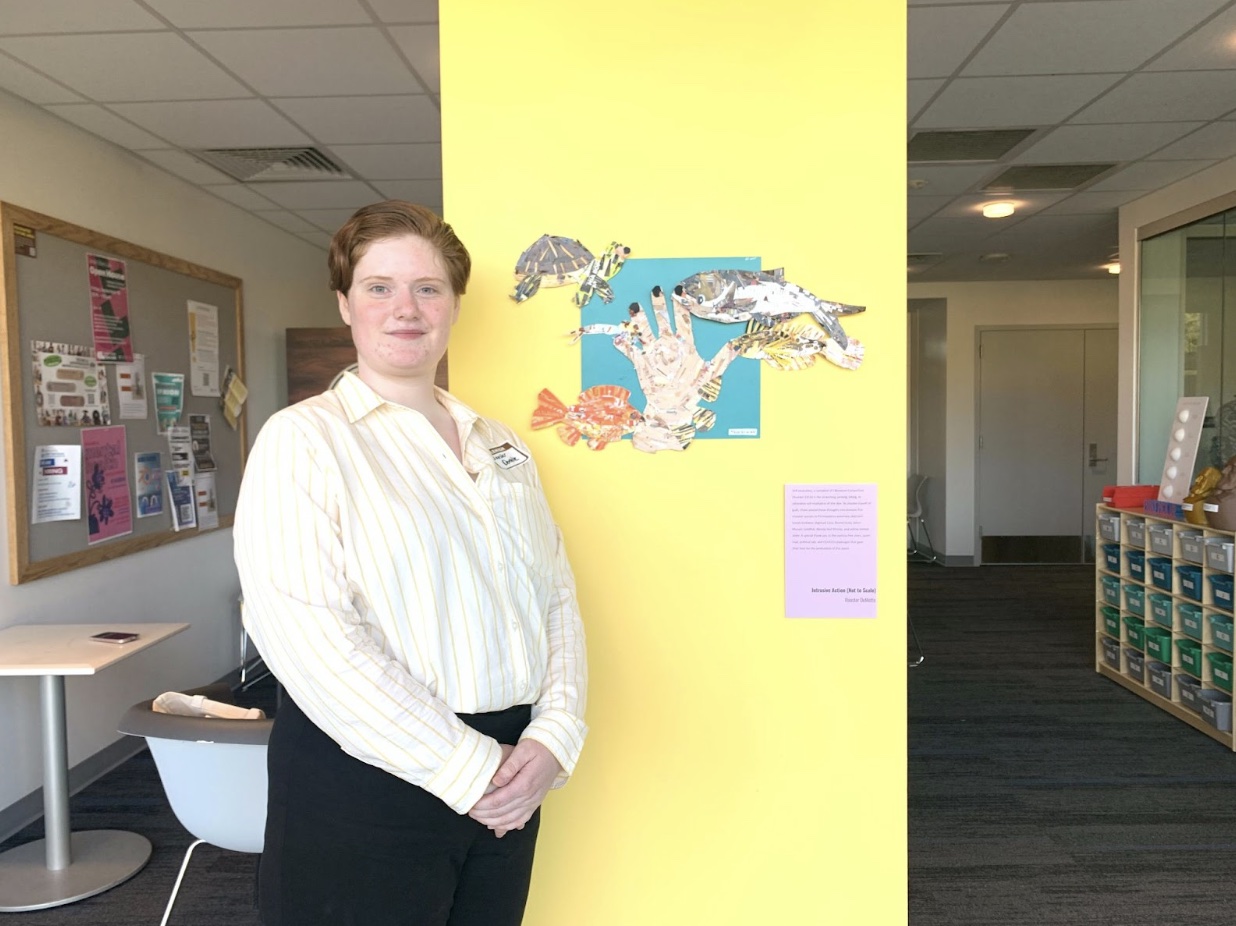
Rooster Demotte, ‘27, created a collage from junk mail titled “Intrusive Action,” which depicted an invasive fish species eating away at a hand. The fish represented self-excoriation, a symptom of OCD in which individuals pick or bite the skin around their fingers.
Demotte said the label on the piece reading “not to scale” illustrated the exaggerated size of the fish and the gap between the visible effects of self-excoriation and the invisible weight of living with OCD.
“I want people to look closely at all the little details,” Demotte said.
Emma Valle, ‘26, said she at first hadn’t planned to enter the exhibition, but her friend encouraged her to submit her piece.
Her work, “Bailey: Paws and Reflect” is a prototype of an app, created with the design tool Figma, where a lavender dog named Bailey guides students through mindfulness practices.
Valle said her inspiration came from her involvement in the Technology, Research and Communication program at Lehigh where she learned about mindfulness.
“There’s such a stigma around mindfulness and practicing meditation that a lot of people think ‘It’s not for me’ or ‘I can’t do that,’” she said. “But there really are so many different ways to practice mindfulness, and it is beneficial to a lot of people.”
The prototype includes four categories — audio, physical, visual and creative — with practices such as guided meditation, stretching and journaling.
Valle said she hopes to someday further develop the app.

“If this could be something that was in the App Store, that would be beyond my wildest dreams,” she said.
Faculty also contributed to the exhibition. Jennifer Kowalski, an art, architecture and design professor, presented “Repetitions,” a cross-stitch embroidery piece featuring phrases like “Everything will be okay,” “I am not in danger” and “This shall pass.”
Each phrase was constructed from tiny X’s, resembling pixels, which Kowalski said aligned with her career in teaching graphic design.
“Doing cross-stitch embroidery, it forces me to take the pixels off the screen and into my hand,” she said. “It makes me work really slow, which when it comes to mental health, going slower is really helpful.”
Eric Posa, an attendee, said Kowalski’s work stood out to him.
He said the exhibition encouraged him to be more open about living with attention deficit hyperactivity disorder and to be supportive of others struggling with their mental health.
“I think on any university campus, we’re finally getting more aware of how important it is to acknowledge that we’re not all neurotypical,” Posa said.
Kate Saltovets, ‘26, who fled Ukraine in 2022 due to the country’s war with Russia, submitted a painting titled “Joy.”
She said prior to creating this painting, she would use dull colors, but for this one she used brighter hues as it symbolized the liberation she felt from Russia’s oppression.
“I feel that on campus, you cannot really talk about it that much,” Saltovets said. “You kind of just have to hide all these political worries, especially from your own culture. And so this piece was really liberating for me.”
Other works explored cultural identity.
Betzi Manjarrez, ‘27, created “Me Doblé, Me Quebré, Me Levanté, pero Nunca Me Rajé” by shaping and burning a 2 by 4-foot wooden beam into an abstract form with breaks in the wood.
Manjarrez said the piece represents the resilience of children of immigrants, showing how scars can strengthen identity.
“It invites viewers to learn to feel those breaks rather than push them away, as breaking down can be part of building a stronger person,” Manjarrez said.
Lara Parada-Tixe, ‘27, said she appreciated the vulnerability of Manjarrez’s art piece.
“You’re able to connect with the artist even if you don’t know them personally,” she said.
Kowalski said the exhibition was important because it created conversations about mental health, where people who may be struggling can see that they’re not alone in how they feel.
“Seeing all the different experiences and emotions that are reflected in the exhibition can be really valuable,” Kowalski said.
Comment Policy
Comments posted to The Brown and White website are reviewed by a moderator before being approved. Incendiary speech or harassing language, including comments targeted at individuals, may be deemed unacceptable and not published. Spam and other soliciting will also be declined.
The Brown and White also reserves the right to refuse the publication of entirely anonymous comments.