



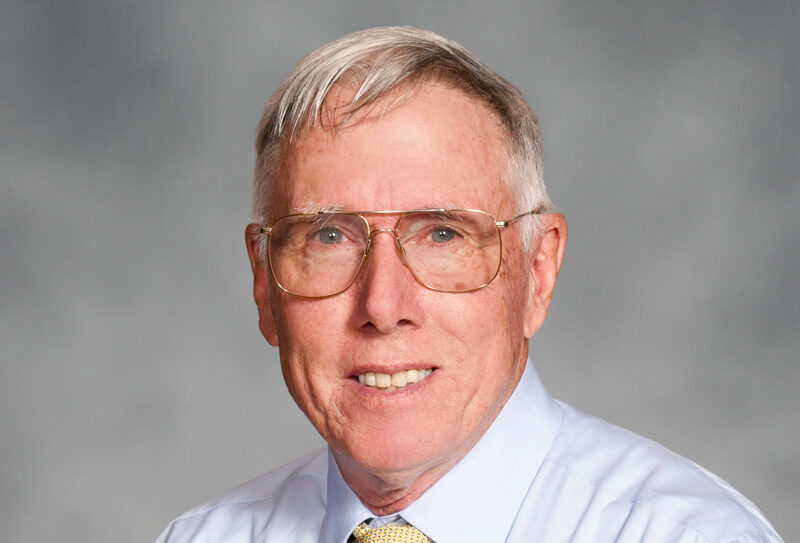
Frank Gunter never wanted to be a professor. He spent nine years as an undergraduate student himself, jumping between five colleges across the United States — from the University of Miami to Los Angeles City College — before finally earning a bachelor’s degree in economics from Penn State.
Gunter’s goal was banking and he achieved it. After earning his masters from Johns Hopkins University, he worked for a bank in Chicago.
During those few years in Chicago, he said he made a mistake — one that would change the course of his life, career and education.
When asked to teach a night class at a Chicago community college, he agreed, not realizing the decision would redirect his entire career. That classroom experience led him back to Johns Hopkins for a Ph.D. in political economy and launched what has become a 41-year journey in academia.
Gunter began teaching at Lehigh in 1984. Around 2003, he began teaching the introductory economics course Principles of Economics after longtime professor Richard Aronson retired. He said he would sit in on Aronson’s lectures in Packard Auditorium, which once held over 600 students.
Aronson had his own style of teaching that worked for him, but Gunter said he simply couldn’t copy him. He had to develop his own methods.
“In my time in the Marines, they taught you how to be a good teacher,” Gunter said. “There are only three things that are essential to be a good teacher. Always show up prepared, always show enthusiasm, even when you’re not feeling enthusiastic, and always open with a joke.”
As a Marine reservist, Gunter was deployed after 9/11 to help train 6,000 Marines in desert warfare for two years. He then returned to Lehigh for a short amount of time before working in Baghdad for 13 months, where he said he was appointed to what he believed was the best job in the country: the chief economist in Iraq, responsible for providing economic advice to the U.S. government.
When he got back, he wrote the first of two editions of his book, “The Political Economy of Iraq.”
Back in Bethlehem, Gunter became known for his interactive yet traditional teaching style in ECO 001, even at 7:55 a.m.
Gianna Grillo, ‘28, who took Gunter’s introductory class during her freshman fall semester, said his ability to present information dynamically and captivate all of his students was incredible.
“He had a very unique style,” she said. “Unlike most professors who use slideshows these days, he really found a way to get his message across with just the chalkboard.”
Grillo said his comments and anecdotes helped her remember material during exams.
Whether his students realize it or not, Gunter said his jokes and analogies are carefully planned. He writes them in a notebook and reuses them semester after semester. He said sometimes, when students retake ECO 001, they’re surprised to hear the exact same joke during the same lesson.
“You have to smile, you have to rant, you have to rave and you have to show enthusiasm, especially when you’re not feeling enthusiastic,” Gunter said. “Humor is a way of keeping them relaxed because they’re laughing and yet keeps them awake because they don’t want to miss the next funny remark.”
By continuing his original methods from when he first started teaching the class to now, including writing on the chalkboard instead of using the projector and cold calling, students like Grillo said his lecture hall of 150 students felt like a classroom of only 20.
Andre Caiola, ‘27, who had Gunter for ECO 001 the first semester of his freshman year, said he would make the classroom feel even smaller by walking around while presenting and talking to smaller groups of students.
“I was actually thinking of even just switching to a full (economics) major because of the way he taught (ECO 001),” Caiola said. “He made (economics) seem like this gigantic puzzle that nobody had the solution for, but we were all trying to put the pieces together and kind of do what we think is best.”
After nearly 23 years of teaching ECO 001, Gunter will spend the spring semester on sabbatical in London and will officially retire in the summer of 2026.
While in London he will work on a book with the working title “The Missing 14%,” examining the 28 countries that make up the 14% of the world’s nations that haven’t experienced economic growth in the past 30 years.
Caiola said he is looking forward to the book and wouldn’t be surprised if it was taught in Lehigh classes in the future.
Gunter chose to spend his sabbatical in London because of his connection to the Iraq Britain Business Council that’s headquartered just a few blocks away from The British Library, which he said is one of the best libraries in the world.
“If you ever become an academic and you’re given a sabbatical every seven years, leave town,” Gunter said. “You have to leave town because if you don’t, you’re gonna get pulled back in for teaching.”
When he returns, he said he plans to stay in the Lehigh Valley, where he will enjoy his 5,300-volume home library, indoor pool and proximity to New York and Philadelphia.
The economics department has yet to determine who will teach Gunter’s sections of ECO 001. Professor Marija Baltrusaitiene will continue teaching the other section.
Gunter said any of his colleagues are capable, but the question is whether they would want to or not. He said the economics department has professors who each specialize in fields from entrepreneurship to international trade, but teaching ECO 001 requires keeping up with the entire range of economics, which would likely mean giving up a speciality course.
“Professor Gunter’s legacy here at Lehigh does not end just because he’s leaving,” Grillo said. “When we enter our career paths and make decisions, we take a lot of the principles we learned from his class. He prepared students and my peers not only for their time at Lehigh, but for life outside of it as well.”
Comment Policy
Comments posted to The Brown and White website are reviewed by a moderator before being approved. Incendiary speech or harassing language, including comments targeted at individuals, may be deemed unacceptable and not published. Spam and other soliciting will also be declined.
The Brown and White also reserves the right to refuse the publication of entirely anonymous comments.