



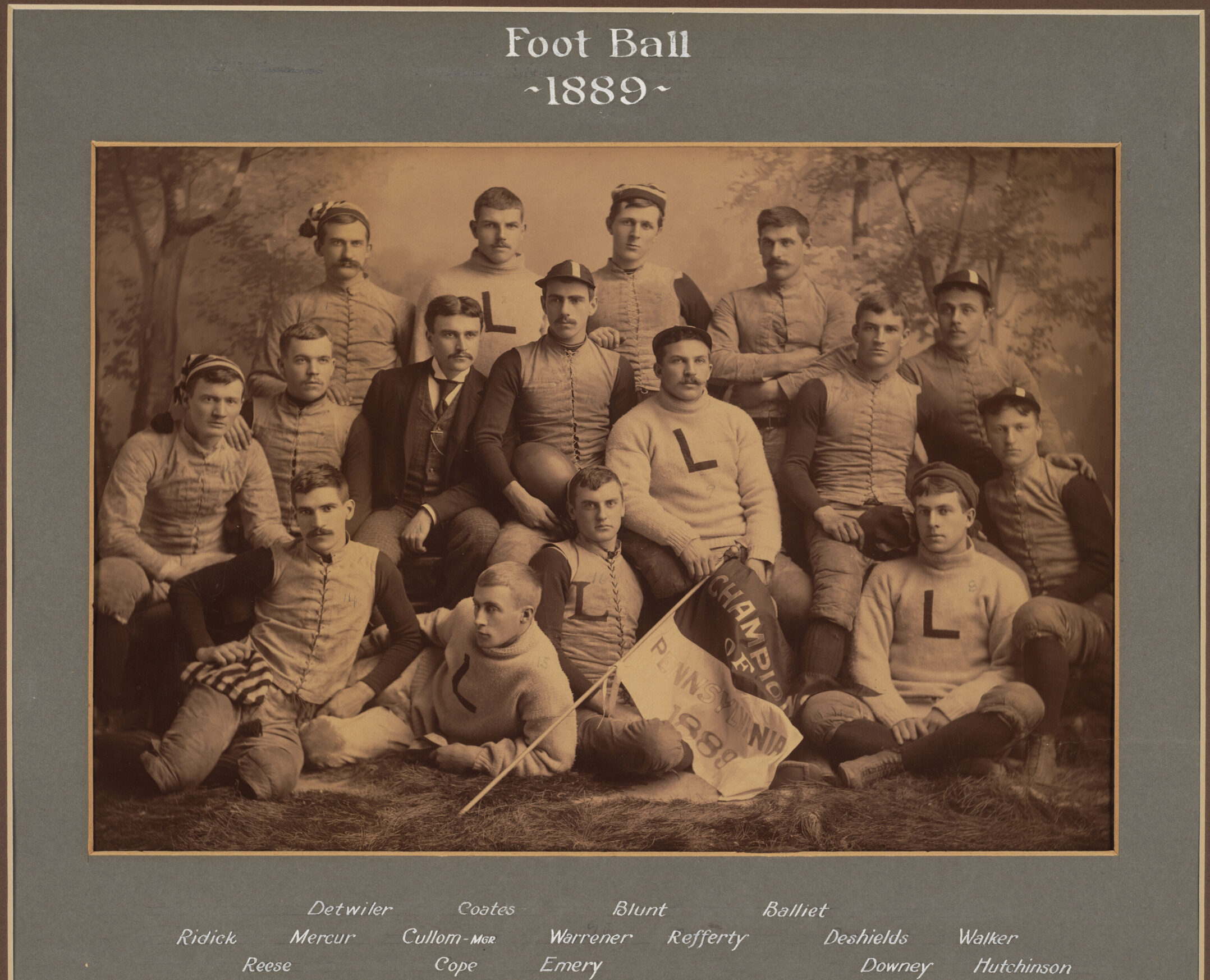
On Nov. 11, 1889, Lehigh’s football team stood on a field without modern amenities and specialized playbooks and defeated the Penn State Nittany Lions 106-0 — marking Penn State’s largest loss and Lehigh’s greatest score difference in history.
Today marks the 136th anniversary of the blowout. Since then, the game of football has evolved, particularly on the offensive end.
According to the Preserve in Lehigh Library’s Digital Special Collections, football in 1889 was different from the pass-heavy offenses prominent today. The forward pass had yet to be invented, which meant all 18 touchdowns during the game against the Lions were scored on the ground.
Lehigh’s success in the ground game that day can be attributed to the offensive scheme used by coach J.S. Robeson: “The Flying Wedge”. This tactic consisted of all the offensive players getting into a “V” formation and storming down the field in one large mass. Players would elbow, stomp and charge at defenders during plays, according to Lou Pratto’s “Penn State Football Encyclopedia.”
The Flying Wedge was dangerous, as many players suffered serious injuries and died as a result of the play, according to NPR. By the early 1900s, the scheme and its variations were banned by the Intercollegiate Athletic Association due to pressure from then President Theodore Roosevelt.
But in Bethlehem in 1889, the Mountain Hawks were unstoppable.
By the end of the first half, Lehigh had already amassed a 58-0 lead. When the lead increased to 106, Robeson and the game official agreed to stop the contest five minutes early.
Although Lehigh was in complete control on both sides of the ball, their dominance was amplified by circumstances on Penn State’s sideline.
The Nittany Lions were coming off of games against Swarthmore College and Lafayette College, with the latter being played two days prior. Three of their players didn’t show up to the game until the end of the first half, as they were returning from attending a funeral in Philadelphia, according to the encyclopedia.
When the game started, Penn State had nine men on the field, two short of the 11 maximum proposed by Walter Camp in 1876.
Lehigh football’s offensive coordinator Dan Hunt said the magnitude of this score is still a point of pride within the Lehigh community and for the team itself.
“No matter when it happened, we have that record,” Hunt said. “You can’t help but be proud of that.”
Hunt said if the 1889 Lehigh team were able to see what this year’s team was accomplishing, they’d be shocked at the strides the sport has made.
In today’s game, Hunt said both college and professional football has implemented player safety measures, better equipment and advanced play designs.
“I think (the 1889 team) would be kind of blown away at the formations, the spreading the field out, all the different motions and using different people to get the ball to be opening to them,” Hunt said.
Historically, teams often consisted of only 12 players, with each playing both sides of the ball. Competing in every down with minimal helmets or pads meant the team would take more of a beating than today, according to the encyclopedia.
Sophomore running back Jaden Green said he doesn’t think he could have played in that era.
“Being a smaller running back, I would take a lot of hits and it would probably do pretty bad things to my body,” Green said.
Lehigh Athletics Archives Manager Rob Kaufman, ‘69, said the game has evolved, moving with changes in sports culture.
“I think the football team and our other athletic teams have kind of moved with society,” Kaufman said.
Kaufman said changes in Lehigh’s home field helped to spark that evolution, as the team’s home games are now played at Goodman Stadium, a venue that holds 16,000 people. He said before, the teams used to play in makeshift carved-out areas.
Since the game, Penn State leads the all-time matchups against the Lehigh football team by a tally of 16 wins to six losses. However, the legacy of Penn State’s largest loss continues to live in the Nittany Lion record book.
3 Comments
Love this story. I like to remind my Penn State friends of this record.
BTW, was Richard Harding Davis on this team?
Hi Bob! RHD was at Lehigh for only two years, 1882-1884. He played in the first varsity team and scored first goal against Lafayette…
I wouldn’t call Taylor Stadium a “makeshift carved-out area.” It had a capacity of 20,000 and hosted Lehigh’s home games from 1914 to 1987.
Comment Policy
Comments posted to The Brown and White website are reviewed by a moderator before being approved. Incendiary speech or harassing language, including comments targeted at individuals, may be deemed unacceptable and not published. Spam and other soliciting will also be declined.
The Brown and White also reserves the right to refuse the publication of entirely anonymous comments.