



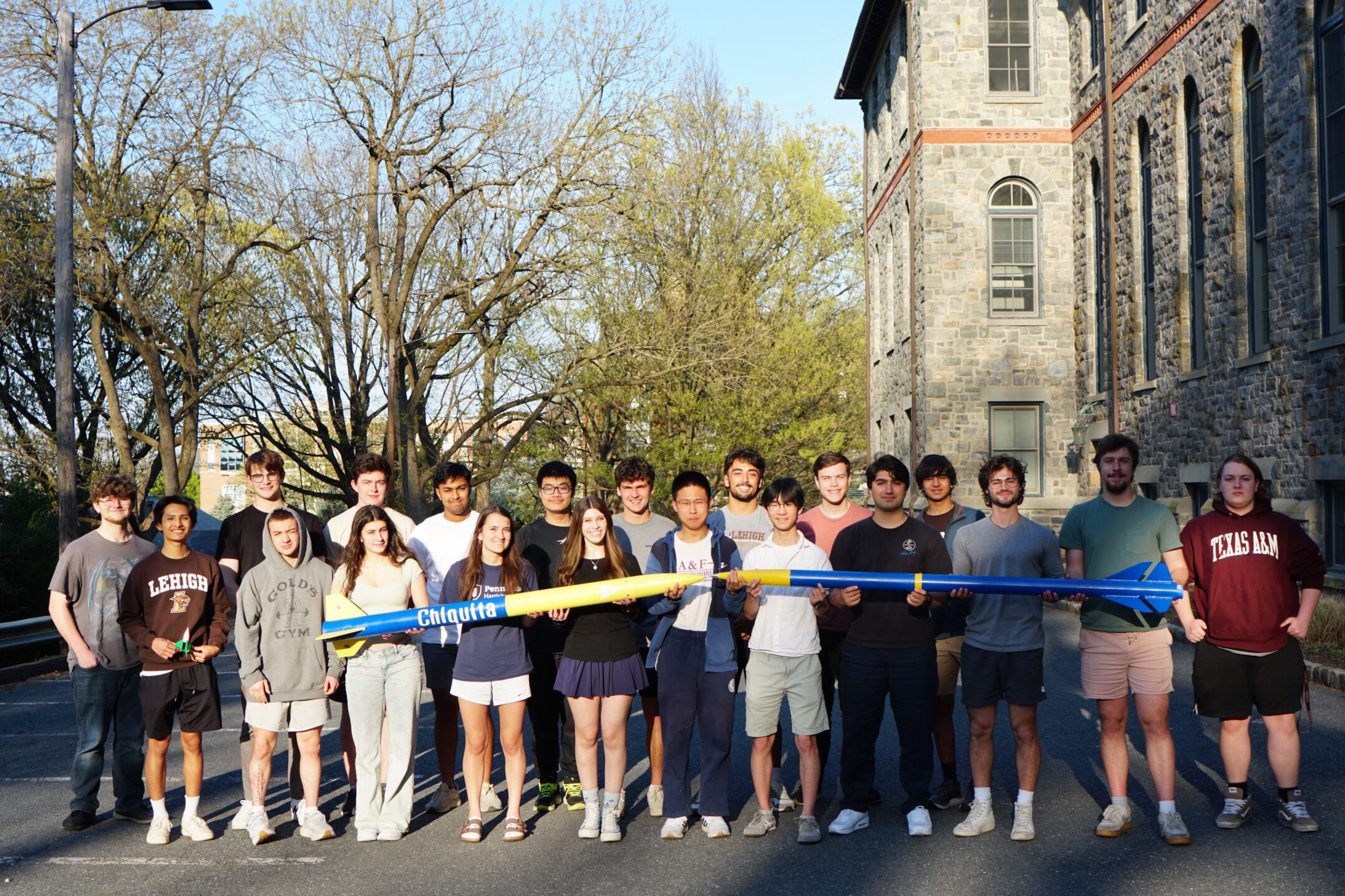
The Lehigh University Rocket Association has a simple way of describing their club: “We blow stuff up.”
LURA, an engineering club started by Keegan Gagnon, ‘26, in the spring of his sophomore year, designs and assembles rockets. In less than two years, the club secured its own lab on Mountaintop Campus.
Gagnon, the club’s president, founded LURA to pursue high-powered rocketry within the three National Association of Rocketry certification levels.
A certification is earned by successfully launching a rocket that meets a level’s specific criteria, with each level corresponding to the rocket’s motor power. As members advance, they can work with stronger motors and build more advanced rockets.
Today, the club has grown to about 40 members from multiple colleges and majors.
After noticing there wasn’t a rocket club on campus during his first-year, Gagnon chose to create one, but he and other founders quickly ran into a major roadblock: insurance.
Gagnon learned three previous attempts to form a rocket club had failed due to insurance challenges. He said coverage is essential for a club that works with controlled explosions.
To overcome the issue, the founders worked with the Case Western Reserve University Rocket Club to navigate the process of obtaining National Association of Rocketry insurance, eventually earning approval from the Student Senate.
“In that initial semester when founding the club, doing that was one of the biggest things to push us ahead of all those other groups that tried and failed in the past,” Gagnon said.
Once established, the founders focused on increasing student accessibility. To keep costs down, they developed a Level 1 rocket kit that costs $80 less than typical options.

Gagnon said the group will use materials from Staples and other affordable options to keep costs low so there’s more room for entry for new members.
The group also breaks down the rocketry process to newcomers who may not feel confident in math or physics, working to create a welcoming environment for all majors.
LURA now includes students from a wide range of academic backgrounds. Dontae Hoose, ‘26, a founding member, said since the club began, Level 1 certification flights have had over a 90% success rate.
Hoose also said a major draw is the level of personalization in members’ projects.
“The main goal is when someone comes to a meeting, we say, ‘Hey, what do you want to do?’” he said. “We don’t want to have it be a one-size-fits-all thing.”
That flexibility appealed to Davis Gardner, ‘28, who joined after attending a meeting last semester.
Gardner, an environmental engineering major, said he realized there’s a lot more to basic rockets than what he first expected.
“You can get very involved with it,” he said. “It’s one of those rabbit holes that just keeps going.”
Gardner now leads Level 1 certification efforts.
Around 40 to 50 students attended the club’s first meeting — an exciting turnout for the executive board that also posed a challenge because not everyone is able to earn certifications at once. Gardner said the solution was to split those interested in groups of 10 to 12.
Each month, one group of students works closely with Gardner to design and assemble their Level 1 rockets, using the software OpenRocket to simulate flights, CAD software for modeling and tools in Wilbur Powerhouse for laser cutting and construction.
“I knew nothing about electronics or anything with rocketry electronics, so I’ve learned a lot, and I know that there’s a lot of kids in the club who are in the same position as me, so I’m also excited to teach them how this works,” Gardner said.
Level 1 rockets typically fly around 1,500 feet, so the club travels two hours each month to the Maryland Delaware Rocketry Association launch site to safely set them off. Gagnon said the group goes as often as possible to help certify more members and teach rocketry fundamentals.
The club meets twice a week, once in Wilbur Powerhouse to work on design and once in Building C on Mountaintop, where they use their newly assigned lab. Gagnon said the dedicated space has allowed the club to expand their projects and develop more rockets than in previous semesters.
Before receiving the lab space, he said the group was often working out of the back of aerospace and mechanical engineering Professor Terry Hart’s car.
Hoose said LURA recently applied to compete in the International Rocketry Engineering Competition in Midland, Texas, in June. About 150 other schools are expected to compete in the 10,000 foot altitude category.
Gagnon said attending the competition has been a goal since he founded the club and preparing for it has opened new future possibilities.
He said it’s been exciting to see how far the club’s grown since his sophomore year.
“(People were) saying ‘Oh, it’s not going to work,’ to now where it’s a full 40-person team that’s making over 10 rockets a month — it’s pretty incredible,” Gagnon said.
Comment Policy
Comments posted to The Brown and White website are reviewed by a moderator before being approved. Incendiary speech or harassing language, including comments targeted at individuals, may be deemed unacceptable and not published. Spam and other soliciting will also be declined.
The Brown and White also reserves the right to refuse the publication of entirely anonymous comments.