



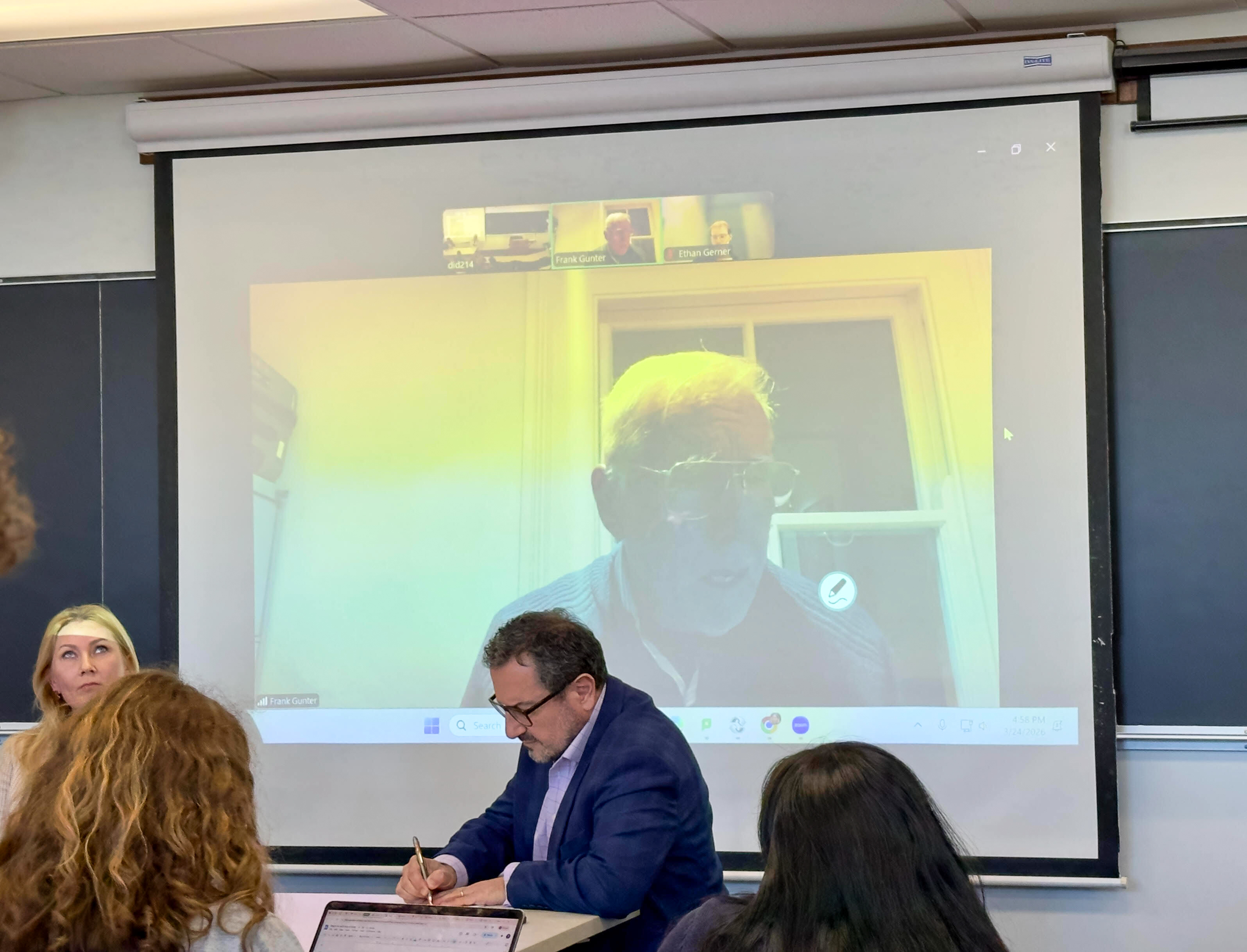
On March 24, the Department of International Relations and the Lehigh University United Nations Partnership hosted a faculty teach-in on the developing war with Iran.
International relations professors Dinissa Duvanova and Arman Grigoryan, along with recently retired economics professor Frank Gunter, led the discussion at the Rauch Business Center. More than 50 students and community members attended.
Professor Jaimie Bleck moderated the event and opened with remarks from each panelist.
Grigoryan began by questioning the justification for the war. He said U.S. officials have yet to provide a clear explanation for why military action was necessary. He referenced Secretary of State Marco Rubio’s statement that the U.S launched strikes preemptively amid concerns of an imminent Israeli attack on Iran because they were worried Israeli attacks would threaten American troops.
However, Grigoryan said diplomatic options still appear viable, noting there’d been no clear indication that negotiations had collapsed.
“There has been no credible argument that negotiations have broken down, in fact on the last day before the war, there was signaled willingness to accept the zero enrichment standard and even relinquish the existing Iranian stockpile” he said.
Duvanova said she approaches the conflict by examining who stands to gain and lose. She said social media has increasingly framed U.S. involvement negatively, including narratives linking the war’s timing to domestic political issues.
She also discussed the economic impact of rising oil prices.
“That 70 (to) 80 extra cents per gallon that we are paying at the pumps right now is essentially equivalent to a tax imposed on us consumers,” Duvanova said. “The only exception is that this money does not go to the government, but to the pockets of the oil companies, so there is a clear interest.”
She said oil-producing countries, including Russia, are benefiting from higher oil prices, which are helping fund Russia’s war in Ukraine and contributing to broader global economic consequences that negatively affect many countries.
Gunter argued the conflict is part of a decades-long struggle, citing events such as the 1979 seizure of the U.S. Embassy in Tehran, the 1983 Beirut barracks bombing and the Oct. 7, 2023, attacks.
Drawing on his experience, Gunter said Iranian involvement has long affected U.S. military operations.
“When I was in Iraq, in 2005, we believed that about one-third of improvised explosive devices that were killing my friends — who were killing other marines and soldiers — were manufactured in Iran and provided to their militia forces that they were supporting in Iraq,” he said.
Gunter said three and a half weeks in, the campaign could be considered one of the most successful in modern military history, pointing to significant damage to Iran’s naval and air capabilities. He also said he doesn’t expect an economic shock comparable to 1974 or 1979, citing alternative oil pipelines in Saudi Arabia, the United Arab Emirates and Iraq.
He said he doesn’t believe there has, or will be, an oil shock because of the number of alternative pipelines available.
When talking about long-term outcomes, Duvanova said the most desired result would be regime change.
“The most desired outcome would be (a) regime change, to end the Islamic Republic and allow Iran to build a secular, democratic state,” Duvanova said.
The event concluded with a student Q&A session. Grigoryan emphasized the importance of engaging in discussion about global conflicts.
“I think it’s important for the university community to be involved in conversations of such importance,” Grigoryan said.
Comment Policy
Comments posted to The Brown and White website are reviewed by a moderator before being approved. Incendiary speech or harassing language, including comments targeted at individuals, may be deemed unacceptable and not published. Spam and other soliciting will also be declined.
The Brown and White also reserves the right to refuse the publication of entirely anonymous comments.