



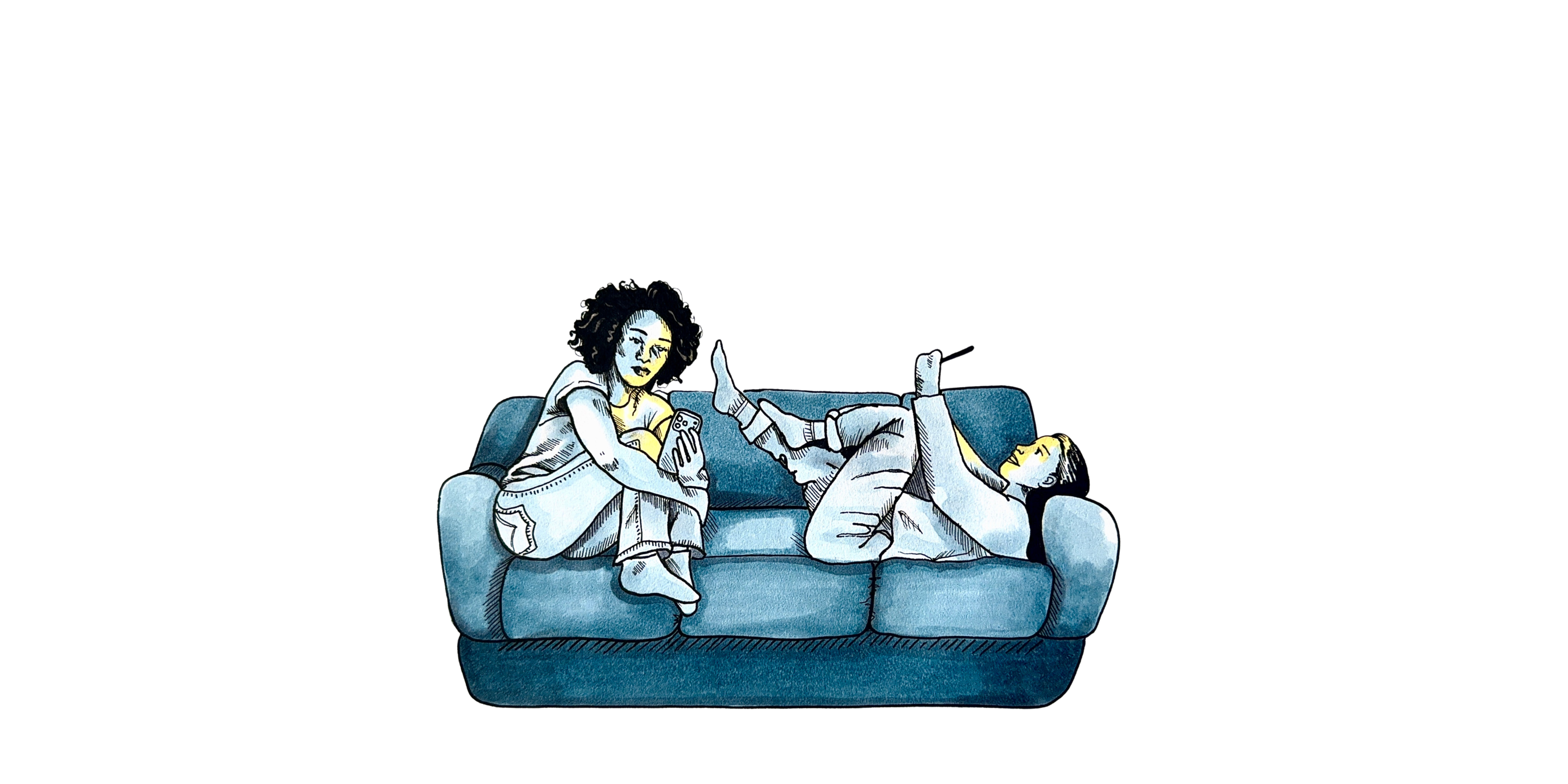
If you’ve been at a friend’s house recently, you’ve probably noticed a pattern: sitting on the couch or at the kitchen table without interacting. Heads are down, scrolling through social media feeds, broken only by the occasional laugh or moment when gossip briefly cuts through the silence.
This isn’t healthy, and we need to stop pretending it is.
We’ve started to confuse proximity with closeness. Simply being near each other doesn’t really count as meaningful interaction. It’s often just a way to avoid having a real conversation.
Sadly, it’s becoming the norm among Gen Z.
In one viral TikTok video, the caption reads, “hey do you wanna come over and hangout?” Two girls sit in the same room, one scrolling in bed and the other sipping a drink across the room. Both are completely silent, noses buried in their screens.
In another, a girl explains how someone can come over and they end up doing nothing but sitting together, both scrolling on their phones with the TV playing softly in the background. She describes that as enough, they’re simply appreciating each other’s presence.
These videos are meant to be funny because they’re relatable. That’s exactly the problem. What’s missing is effort.
Real connection requires active participation from both people. It means asking questions, responding, listening and pushing through awkward moments. Instead of embracing those pauses, we avoid them, even when they could spark conversation.
Even with tight schedules and short breaks between classes, it’s easy to fall into this habit. You run to a friend’s house, quickly grab a snack, sit on the couch and scroll again.
Our phones make that avoidance effortless. The second a conversation fades, it gives us an immediate escape, with no need to stay fully present.
Pulling out a phone becomes a subtle signal: there’s nothing left to say.
Over time, that signal gradually turns into a pattern. When it does, expectations for relationships shift. We stop requiring depth, and being physically together starts to feel like enough.
It isn’t.
Not every quiet hangout is a problem. For people who are already close, sitting together without talking can feel comfortable. But there’s a difference between comfort and disengagement.
When both people are absorbed in their phones, attention is no longer shared. You’re just sitting next to each other, alone.
That absence matters. Conversations grow shorter. Attention spans weaken. Being fully present takes more effort than it should, and we’re getting used to low-effort relationships — ones that don’t ask much, but also don’t give much back.
When we accept this as normal, we lower the standard for what friendship should be. Without real effort, we begin to accept distance as natural and end up missing moments that truly matter.
Technology doesn’t need to disappear. But it does need boundaries sometimes. Put the phone down when you’re with someone. Let silence push you into conversation instead of away from it. Choose presence, even when it feels uncomfortable at first.
Friendship isn’t built through shared Wi-Fi and the occasional glance up from a screen. It’s built through jokes, complaints, stories, even disagreements. Those moments take attention. Because without them, time together starts to feel empty, even when the room is full.
Proximity alone isn’t enough. If we keep treating it like it is, we’re not just changing how we spend time together. We’re redefining what connection looks like — and not for the better.
Comment Policy
Comments posted to The Brown and White website are reviewed by a moderator before being approved. Incendiary speech or harassing language, including comments targeted at individuals, may be deemed unacceptable and not published. Spam and other soliciting will also be declined.
The Brown and White also reserves the right to refuse the publication of entirely anonymous comments.