



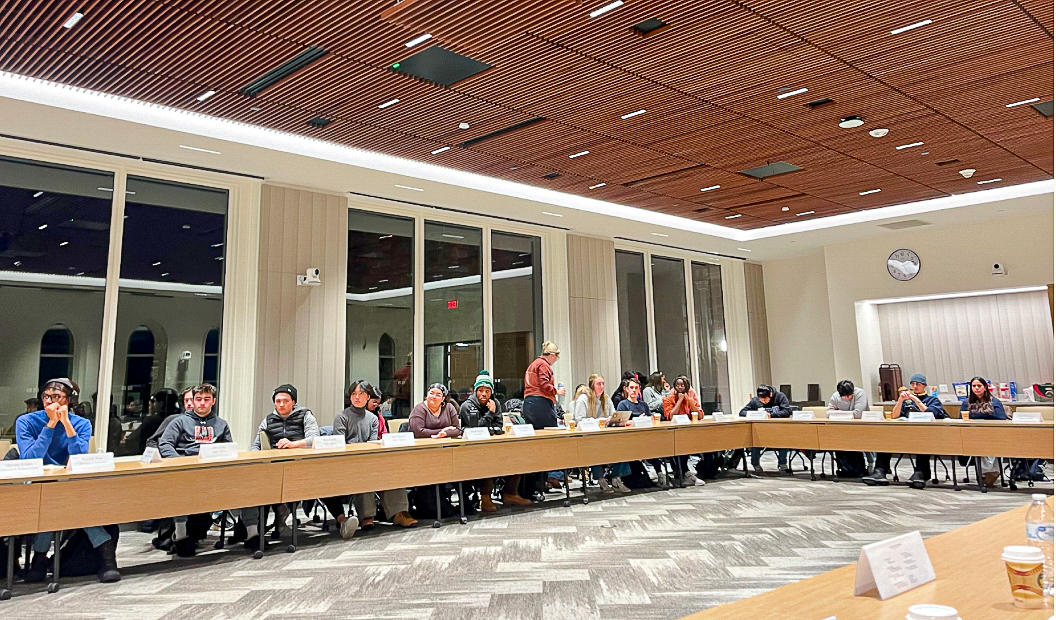
Lehigh’s Student Senate has elected a new president, Drew Smith, ‘27, as the organization prepares for internal transitions that could reshape its structure.
The Student Senate serves as the primary representative body for the student population, meeting with administration and allocating budgets for clubs. In recent years, Smith said concerns about its effectiveness have prompted both internal and external calls for reform.
He also said the organization’s failure to adhere to its founding documents has hindered its effectiveness.
“We have come to prioritize the status quo within the Senate, as opposed to the systems that have been set out for us over the past 38 years of the Senate,” Smith said. “A major culture shift will be focused on realigning our priorities with the core fundamentals of organized elected representation.”
Smith said the Senate has also faced backlash from many students who feel it hasn’t adequately addressed their needs. He introduced a proposal to dissolve the current Senate and rebuild the organization.
“(Dissolving) provide(s) the opportunity to step up in a more meaningful way to enact the changes that I and many others, both inside and outside of Student Senate, want to be made so that we can better represent the needs and wants of the students,” Smith said.
Alongside discussion of dissolution, the Student Senate is pursuing changes aimed at improving systems that directly affect students, including course registration, club funding and campus transportation.
Smith said the current system for funding clubs is inequitable and relies heavily on past precedent, making it difficult to adjust to evolving student and university needs. He also said a major overhaul of the system to better support student life and ensure all groups receive adequate funding is one of his top priorities.
Student Senator Ibtihal Gassem, ‘27, said a key reason for restructuring is a longstanding disconnect between the Senate and its constituents.
She said many students are unable to explain how the Senate serves them and said the group plans to focus more on policy-based solutions to rebuild trust with the student body.
“If students don’t even know what we’re doing, then clearly there’s a problem,” Gassem said. “Clearly, whatever work we are doing is not impactful and is not reaching a wider audience of students.”
Another concern is internal inefficiency.
Mariana Roldan, ‘28, the newly elected vice president and chair of the diversity and inclusion committee, said proposed changes include reducing the number of committees from nine to six and consolidating executive positions to streamline operations.
“Our structure doesn’t let us really be the most efficient,” Roldan said. We want a lot of committees to focus more on policy change.”
She said the proposed committees are Allocations and Auditing, Civil Rights, Facilities and Services, Academic Affairs, Club Affairs and Programming.
Roldan said Allocations and Auditing would oversee club finances more closely, including requesting receipts and ensuring funds are used as intended. Civil Rights, she said, would address student concerns, while Academic Affairs would focus on issues such as course registration and syllabus availability before registration.
Club Affairs would implement updated processes for inactive organizations seeking to maintain Senate recognition, and Programming would plan and oversee Senate events.
Roldan said these changes are intended to promote more action-based solutions for students while improving efficiency and increasing the Senate’s visibility on campus.
While restructuring has broad support among senators, Smith said the proposal to dissolve the Senate remains divisive. He said no official vote has been held, and dissolution would require approval from 75% of the body.
“It could go either way,” Smith said. “In a soft internal poll, there were a large number of individuals in favor of it, a substantial group who were against it, many on the fence, and many who could be persuaded either way.”
As discussions continue, the future of the Student Senate remains uncertain. However, Smith said there’s a consensus that change is necessary to strengthen the organization’s effectiveness and rebuild trust with students.
Comment Policy
Comments posted to The Brown and White website are reviewed by a moderator before being approved. Incendiary speech or harassing language, including comments targeted at individuals, may be deemed unacceptable and not published. Spam and other soliciting will also be declined.
The Brown and White also reserves the right to refuse the publication of entirely anonymous comments.