



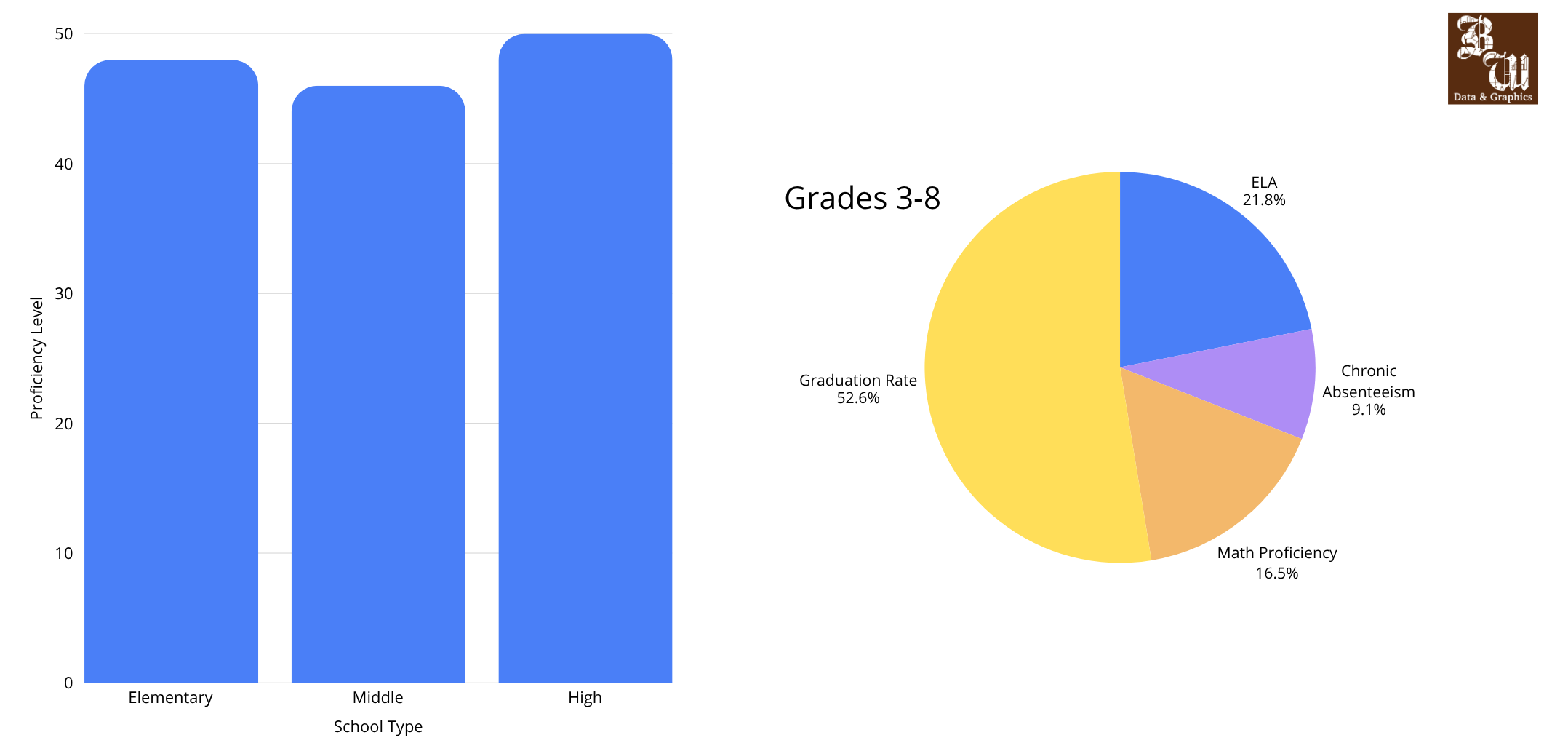
More than half of Bethlehem Area School District’s 11th grade students scored under proficiency level on the Keystone exams, according to recent data from the Commonwealth of Pennsylvania.
This data caused concern for school board administrators, educators and local elected officials.
Keystone exams are yearly general knowledge exams, specific to Pennsylvania public schools.
According to the Commonwealth of Pennsylvania’s website, they measure high school juniors’ knowledge in algebra, biology and literature.
Pennsylvania public school students in third through fifth grade are also required to partake in Pennsylvania System of School Assessment standardized testing.
Literacy scores derived from Keystone exams in the Bethlehem Area School District have been steadily declining since 2022, falling from a 54.6% overall proficiency rate among high school juniors, to 50.4% in 2025.
The district also saw a 5.7% drop in English language arts proficiency from 2024 to 2025 from eighth graders’ standardized test scores.
According to the Associated Press, this trend is not new or isolated.
Michael Dunstan, chair of the English department at Freedom High School, said Bethlehem’s declining literacy rates follow suit with national reports.
He also said the root of the problem is multi-faceted.
Dunstan said the disruption of in-person learning during the COVID pandemic has likely played a role in falling scores, that interruption is just one factor. He identified academic fatigue and lack of incentive among students as other possible reasons for the downward trend.
“As a teacher, it’s really frustrating having to deal with some of the decisions that are being made by the Department of Education in terms of the actual test itself,” Dunstan said. “There’s a lot of test fatigue that these kids go through. (Students) are asked to write six constructed responses in one or two days, depending on how we, as a district, decide to expedite the test (and) we’re limited in our flexibility to be able to do that.”
Dunstan said reaching a level of proficiency was once a requirement to receive a high school diploma.
As of 2023, however, the Commonwealth of Pennsylvania altered the requirements, declaring students could also successfully graduate by pursuing a different “pathway to graduation.”
With proficiency no longer being a necessity for high school matriculation, the incentive for students to score at a certain threshold is lower.
Dunstan also said part of the challenge is meeting students of all learning levels and backgrounds where they’re at in their reading journey.
He said he once asked his classroom to raise their hands if they had grown up in Bethlehem. Dunstan said only half of the students’ hands went up.
“They didn’t (all) come through the Bethlehem system, so trying to piece together their needs can be very complicated as well,” he said.
Justin Amann, Bethlehem City Council member and executive director of the Foundation for the Bethlehem Area School District, said the root of the trend may be correlated to the lack of funding for public schools and their struggles to offer specialized support to students that need it.
“It doesn’t matter what a child brings in their backpack, or as our superintendent has eloquently said — their ‘invisible backpack,’ and the issues we don’t even see,” he said.
But Amann said it’s the job of an educator to make sure all students walk out of school ready for college or a career. He said he appreciates Bethlehem public schools that – unlike charter schools – aim to meet every student where they are.
He also said, however, he has seen a rise among Bethlehem school children that need special education or additional English language support.
Dunstan said the drop in proficiency rates hasn’t impacted his belief in the school’s educators and their teaching strategies. He said he’s really proud of the district’s teachers.
“For our students, the bar’s being set high for them,” he said. “They’re given challenging texts. We’re not asking them to shy away from them, but we’re giving them the tools that they need and the reading strategies they need to approach these complicated texts.”
Kimberly Harper, supervisor of literacy and humanities for the school district, said in the last decade the district has shifted the way they teach students to read.
Harper said Bethlehem Area School District teachers now teach science-based literacy, which differs from traditional balanced reading by focusing on the foundational skills to decode language and complex texts, according to the Stanford Report. With this new learning approach the school district hopes to improve their literacy rates.
She said this method helps students strengthen their reading and oral language comprehension skills early. Harper said science-based literacy focuses on vocabulary, background knowledge and reading comprehension, which are the ultimate goals.
She said this teaching method also enables students to extend their literacy skills to all academic disciplines, ranging from algebra word problems, to statistics and lab report writing.
“We really want to make sure that when a kid gets a text in front of them, they’re not making guesses,” Harper said.
Dunstan and Harper said at Freedom High School, English teachers underwent a three-year long professional development training program, Keys to Literacy, to enhance their vocabulary and literacy teaching skills. Harper said the shift to the Keys to Literacy program began in 2016, with educators’ start dates for the trainings being staggered across years.
Dunstan said the last two teachers in his department completed their training this year.
He also said the school district formed a literacy task force at the end of the 2025-2026 academic year and continued work throughout the summer.
Dunstan said Freedom High School has recently implemented these trainings. He said he hopes they’ll develop student success, both in the classroom and on standardized tests.
Harper said the school district has required this three-year program for all teachers in grades four through 12, in line with Pennsylvania’s new structured literacy training requirements.
She said Bethlehem Area School District specifically selected three trainings for teachers to undergo through the Keys to Literacy programs: key comprehension routine, key vocabulary routine and keys to content writing.
Each of these trainings are designed for Pennsylvania education systems.
“It’s twofold, in that the trainings help our teachers support students in reading and writing on complex texts, but it also helps our students have a more consistent experience across the day,” Harper said.
Comment Policy
Comments posted to The Brown and White website are reviewed by a moderator before being approved. Incendiary speech or harassing language, including comments targeted at individuals, may be deemed unacceptable and not published. Spam and other soliciting will also be declined.
The Brown and White also reserves the right to refuse the publication of entirely anonymous comments.