



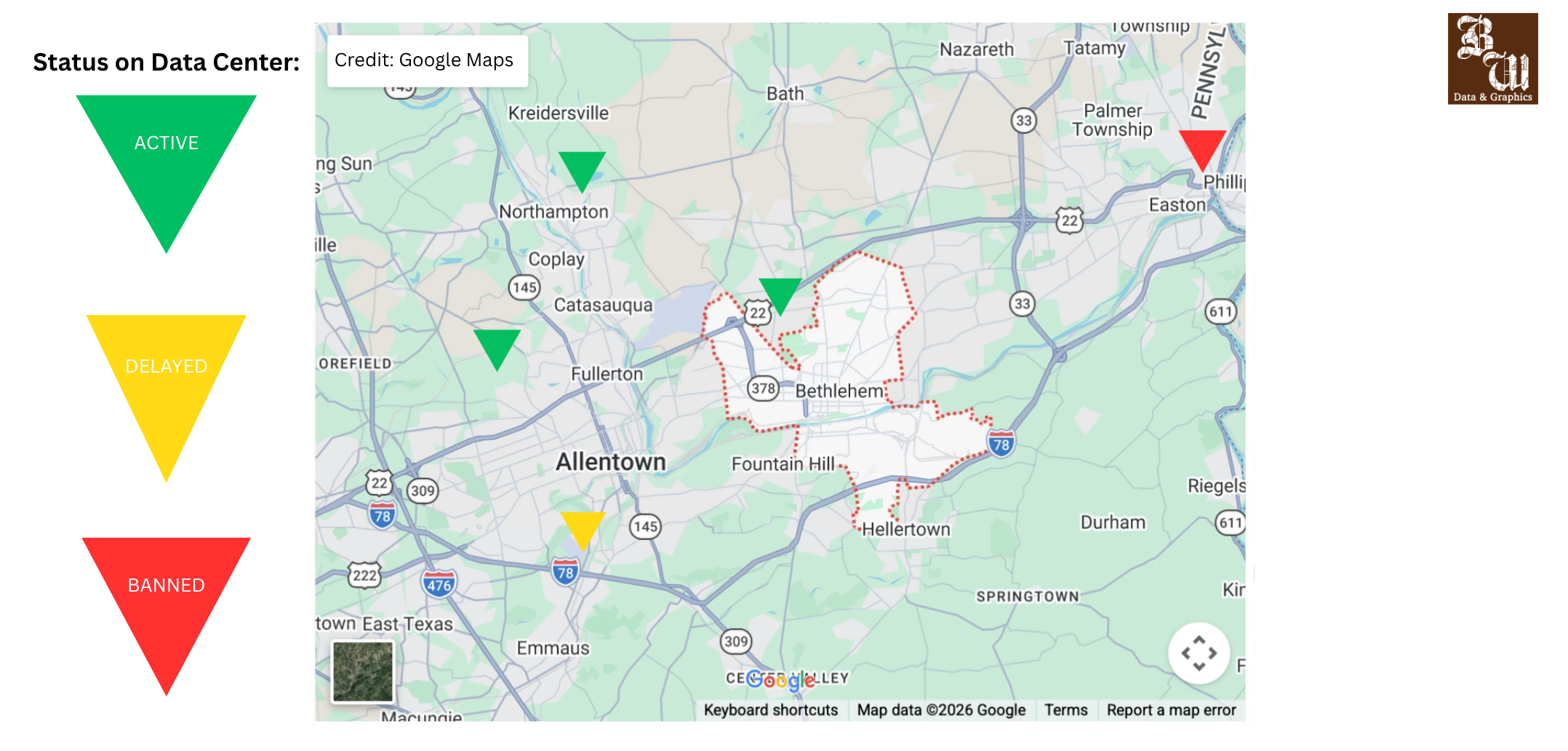
Pennsylvania Gov. Josh Shapiro signed an executive order on Aug. 18 requiring data center developers to meet the Governor’s Responsible Infrastructure Development (GRID) requirements that block irresponsible projects.
The order requires local approval before the Pennsylvania Department of Environmental Protection issues permits. The order also removes data center projects from the state’s Permit Fast Track program and prohibits nondisclosure agreements for data center projects.
Lehigh professors with backgrounds in community and urban development, electrical engineering and mechanical engineering discussed how the order will change how developers plan projects. This will also change how the state prepares its power grid for new demand and how municipalities participate in development decisions.
Javad Khazaei, a professor of electrical and computer engineering at Lehigh, leads systems-level research on smart grid integration and energy management for AI data centers.
Khazaei said the order primarily addresses the rapid growth of data centers in Pennsylvania and their associated demand for electricity, water, land and infrastructure.
According to the Commonwealth, in the last year, more than 100 data center projects have been proposed in Pennsylvania, pending approval.
Khazaei said there’s a limit to the total number of data centers that can be installed in an area, depending on the utilities, transmission and available capacity.
From recommendations to requirements
Valerie Holt, a teaching associate professor of mechanical engineering and mechanics, studies community impacts of data center development.
As part of Lehigh’s National Science Foundation graduate training program, Solutions in Energy Electrification and Delivery , Holt leads an interdisciplinary graduate course involving problem-solving around a complex community energy challenge.
In the course, a group of graduate students investigated a broad range of community impacts of data centers, including water, power, environmental, employment and policy impacts in Pennsylvania.
Holt said the group examined Shapiro’s introduction of his Governor’s Responsible Infrastructure Development (GRID) plan.
“One of the things that, as a group, we’d discussed how important those GRID recommendations were, but how (as recommendations versus requirements) they were basically unenforceable,” she said.
Holt said the order takes the plan’s requirements and puts enforcement behind them by making them mandatory.
The executive order addresses energy affordability, environmental protection, workforce and economic development, transparency and community engagement.
“(The order) puts some of the authority back to the municipalities to be responsive to their communities in terms of how things are developed or not within their local borders,” Holt said.
She said the order allows municipalities to review data center proposals within the scope of their zoning and ordinance restrictions before the state decides whether to grant a permit or not.
Holt said the order also protects residents from a broad range of local impacts that put a burden on community members.
She said the previous data center development models favored non-disclosure agreements and that led to problems with transparency.
The order makes non-disclosure agreements impermissible for all agencies under the Governor’s jurisdiction.
“It shows responsiveness to community concerns about a lack of transparency,” Holt said.
She encourages people to read the executive order in its entirety.
Professor of practice in political science, Karen Pooley, conducts research through Lehigh’s Small Cities Lab, focusing on alley housing, urban heat, transportation planning, air quality and greenspace.
Pooley said with any development, there’s a mix of benefits and negative implications, as well as community reactions. She said communities’ leading concerns revolve around how these developments will impact residents’ quality of life and their surrounding environment.
“Some of the transitions caught people by surprise,” Pooley said. “The landscape looks a lot different when you go from rolling green hills to a million-square-foot trucking facility.”
The question of local impact extends to who has authority over the location of these developments.
Bethlehem has its own rules around what can be built and where. Pooley said its municipalities have to allow for all kinds of development in the community, as per the commonwealth’s rules.
“Ultimately, the entity that’s going to decide where a data center gets to go in the city of Bethlehem is the city of Bethlehem,” Pooley said. “It’s going to be a big fight holding onto local control over those kinds of decisions.”
Khazaei said data center development also affects the infrastructure connecting individual projects to Pennsylvania’s power grid.
The Federal Energy Regulatory Commission defines grid reliability as “the power grid’s ability to consistently deliver a stable and continuous supply of electricity without sudden interruptions.”
“For developers, there’s going to be a systematic change,” Khazaei said. “There would be a need for a holistic and system level design. Developers need to consider electric grid capacity, transmission, distribution upgrades, reliability, water ability and the timing of infrastructure investment.”
Khazaei is currently working on a National Science Foundation project to study how to safely integrate multiple data centers into power grids.
He said developers will have to look at the electric grid flexibility to find the optimal number and placement of the data centers that would have the minimum impact on the grid’s reliability.
“Right now, since these data centers consume a large amount of power, we have to first look and see where the grid flexibility is and how we can expand the grid, so they can handle this amount of power,” Khazaei said.
He also said he expects the changes to take time. However, he said they will ultimately bring more resilience to Pennsylvania’s power grid.
“For example, the grid might have reliability to support 100 gigawatts of power in a specific area in Pennsylvania, but it may not handle 100 gigawatts of power very quickly,” Khazaei said. “So we have to consider all of those when we are looking at data center integration into the grid.”
He also said he thinks these changes will have a positive impact because they will assure the electric grid of Pennsylvania is resilient and can handle as many data centers as possible.
“We’ve been following this closely, and I think Pennsylvania possibly could take a leadership role in how to do this well because the attention to local contextual impacts (is now supported by the order),” Holt said.
Pooley said she hopes the executive order will make developers think more creatively about the energy use of a data center, which could lessen community consequences.
She also said more stringent rules and requirements will lead data centers to be better run in terms of environmental and energy impacts.
“This is a huge topic,” Pooley said. “Very front of mind. The volume is loud. The temperature is hot. Today it’s data centers, and tomorrow it’s the next thing that we’re trying to grapple with how we fit into the places we live.”
Comment Policy
Comments posted to The Brown and White website are reviewed by a moderator before being approved. Incendiary speech or harassing language, including comments targeted at individuals, may be deemed unacceptable and not published. Spam and other soliciting will also be declined.
The Brown and White also reserves the right to refuse the publication of entirely anonymous comments.