



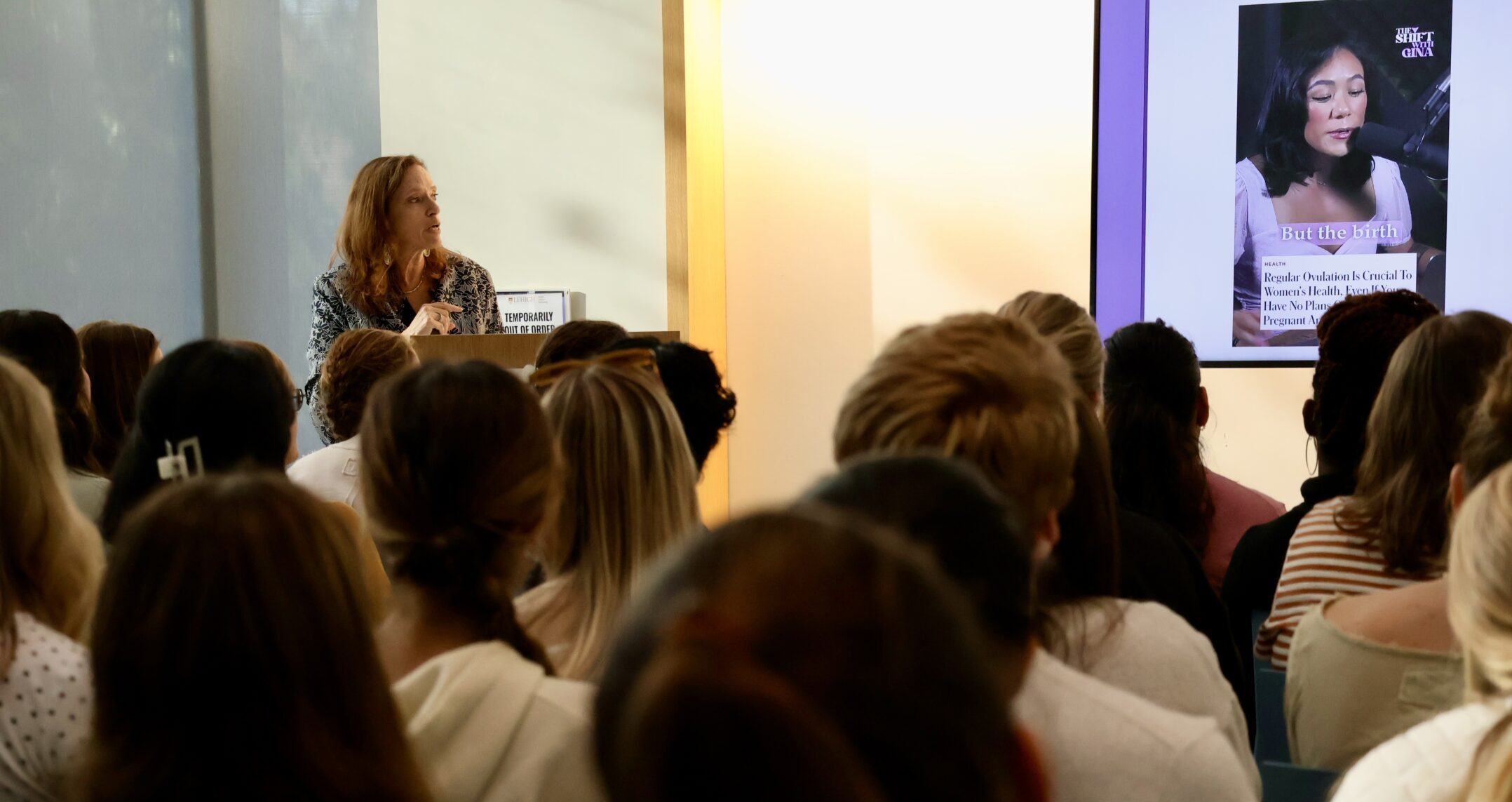
Lehigh’s Sexual and Reproductive Health Power Lab hosted its inaugural speaker called Pronatalism and Reproductive Autonomy in an Era of Low Fertility, led by Laura Lindberg, a professor at Rutgers School of Public Health, on Oct. 7.
The founding of the lab
Created in February 2025, the Sexual and Reproductive Health Power Lab was conceived just off Lehigh’s campus, in Lit Coffee Roastery & Bakeshop.
The lab was founded by four College of Health professors: Joanna Mishtal, Fathima Wakeel, Lisa Lindley and Tracy Nichols, who were all concerned about the policy changes made in the Trump administration. They felt these policies were targeting the autonomy of women and gender diverse people.
We really came together because though we are in different fields, we all had an interest in sexual and reproductive health, Wakeel said. “We all came together for that shared mission.”
The lab’s values center around truth, justice and research, but its work goes beyond these principles.
“Knowledge and values are essential to meet any challenge,” Nichols said. “We believe you also need creativity, you need laughter, you need friendship. The power lab is rich in all of these attributes. While our mission is serious, we don’t always have to be.”
It was with these values in mind that the four professors decided to join forces and utilize their research skills in a battle against misinformation. With that idea, the lab was born.
Those same values were reflected throughout Lindberg’s talk.
A discussion of pronatalism
At Rutgers University, Lindberg is the director of the Sexual and Reproductive Health, Rights and Justice Concentration.
Outside of Rutgers, she serves as a research director for Youth Reproductive Equity, which is dedicated to advancing equitable access to sexual and reproductive health resources.
Lindberg began the talk by saying we can’t turn to the news now without encountering some version of the idea that Americans aren’t having enough babies and that the population is declining.
She said America has now entered an era of pronatalism.
Lindberg described that pronatalist policies strive to increase and incentivize childbearing. Pronatalism has two key beliefs: fertility rates are too low and more childbearing is needed.
She made a clear distinction that pronatalism is not just encouraging people to have babies, but also constraining alternative options, such as the idea that childbearing can be optional.
“When fertility is framed as a matter of civilizational survival, reproduction can be cast as a patriotic obligation,” Lindberg said.
She also said this “demographic crisis,” referring to the decrease in birth rates, is highly gendered, and is quickly becoming a problem of reproductive autonomy.
“Women are blamed for the demographic problem, and women’s autonomy is being proposed to be restricted as the possible solution,”Lindberg said.
Lindberg discussed the three approaches that pronatalism has adopted in recent years.
The first approach is changing desires to get women to have more children. The second is to shift information that people receive about childbearing. The third is to constrain access to contraception and abortion.
Lindberg discussed how the pronatalism movement is focused on changing both the formal and informal discourse around having children.
Formally, this includes efforts focused on sex education in schools, specifically shifting required content from contraception to the value of childbearing.
She added that this discourse is especially visible on social media, but has also entered mainstream media and political rhetoric.
“In this version of reproductive autonomy, freedom is being defined less as having meaningful options, and more as choosing the natural option,” Lindberg said. “Contraception and abortion are made to seem less authentic, less healthy and less morally acceptable.”
Recent court decision connection
She then framed these movements in terms of the “Dobbs era,” which refers to the period in the U.S. after the Supreme Court’s June 24, 2022 decision in Dobbs v. Jackson Women’s Health Organization.
This case held that the U.S. Constitution doesn’t grant the right to abortion. This was the court case that overruled Roe v. Wade. Lindberg refers to the era that the U.S. is currently in as the “post-Dobbs era.”
“One of the striking things about the post-Dobbs period is that abortion didn’t disappear,” Lindberg said.
She noted that clinician-provided abortions increased 21% after the Dobbs decision in 2022, following decades of decline.
“It’s not that Dobbs didn’t have an effect, but as a tool to increase the birth rate, banning abortion has turned out to be very weak,” Lindberg said.
She said that childbearing is not framed as a private decision, but as something that serves the interests of the state.
Reproductive care accessibility and interest
The event did not just attract students from the College of Health.
Charlie Keenan, ‘28, a neuroscience and health, medicine and society major in the College of Arts and Sciences, attended the event. She shared that she has an interest in public health and access to reproductive healthcare.
“As far as college campuses go, we have limited access to reproductive care,” Keenan said. “The fact that these talks are happening and the power lab is now created means we are going in the right direction for Lehigh to be one of the campuses that can offer better resources for people.”
Wakeel said that since the lab first started in 2025, it has grown, and the team is hoping to continue building their infrastructure in the coming years.
Mishtal said when the lab was first starting, she saw a lot of interest from students in sexual and reproductive health, rights and policies. Currently, the lab is made up of both doctoral students and undergraduate students.
“There was this natural vision for me, for us to come together to harness the interest, but also spark interest,” Mishtal said.
Students and health services
As Lindberg’s talk about how pronatalism is shaping reproductive health and autonomy came to a close, she left the audience with questions to motivate change.
“Do you know where a Lehigh student can get contraception?”
“Do you know where a Lehigh student can get an abortion?”
“Do you know what services are being offered for student health?”
“And what isn’t, and why, and what steps need to be taken to change that?”
“You are the experts in your own circles; own that,” Lindberg said.
When Mishtal, co-founder of the lab, asked Lindberg to speak at Lehigh, she knew that Lindberg’s work would match the mission of the lab, but also be relevant to Lehigh students.
“I believe (the talk) brought pieces together that students might be thinking about separately,” Mishtal said. “Students, and people in general, might not make a connection between reproductive rights, restrictions, and declining fertility, or pronatalist push. I think these are areas that we have to think about together.”
She added that with complex conversations such as this one, perspectives must be shifted.
“We need energy to also think beyond, and say we know there are sexual and reproductive health inequities,” Mishtal said. “And there’s more than one thing that we can do, and there are different ways that people can contribute.”
Nichols, also a co-founder of the lab, echoed Lindberg’s point about the importance of education. She said she hopes the event encourages students to vote, and emphasizes how the education students are receiving here at Lehigh can help them enact change in whatever field they go into.
Moving forward with research projects
The team currently has two projects they are working on.
One study, “Pregnancy Prevention Method Use Among US College Women Before and After Dobbs,” was published last month.
Lindberg left the audience with a reminder that knowledge and education are a tool for change.
“Do more than be sad, do more than get angry, take action,” Lindberg said. “At a time when science is too often dismissed, distorted for politics, I want you to recognize the power of your education.”
For Lindberg, that power comes from the ability to understand and evaluate information, especially at a time when these topics have become polarized.
“You will be leaving here with that same capacity,” Lindberg said. “You’ll be able to read a research paper, evaluate a study’s methods. You’re going to know the difference between correlation and causation, between evidence and assertion. This is not a small thing. In today’s environment, this is not just a power. It’s your superpower.”
Comment Policy
Comments posted to The Brown and White website are reviewed by a moderator before being approved. Incendiary speech or harassing language, including comments targeted at individuals, may be deemed unacceptable and not published. Spam and other soliciting will also be declined.
The Brown and White also reserves the right to refuse the publication of entirely anonymous comments.