



According to the BBC, some of the world’s leading artificial intelligence executives warn of a future in which humans lose control of the technology they created.
Lehigh students, however, see a different possibility — a future shaped by AI’s potential to improve lives.
AI industry leaders, including OpenAI CEO Sam Altman and Anthropic CEO Dario Amodei, have raised concerns about the dangers of unchecked AI development, warning that without proper regulation, the technology poses an existential threat to humanity.
Avneet Kaur, ‘28, the AI Club’s vice president, said he doesn’t believe these recent claims are reputable. He thinks they’re serving more as a publicity stunt for AI companies to garner attention ahead of their public offerings.
“I don’t think that AI is going to kill us all,” Kaur said. “I don’t think that’s likely anytime soon.”
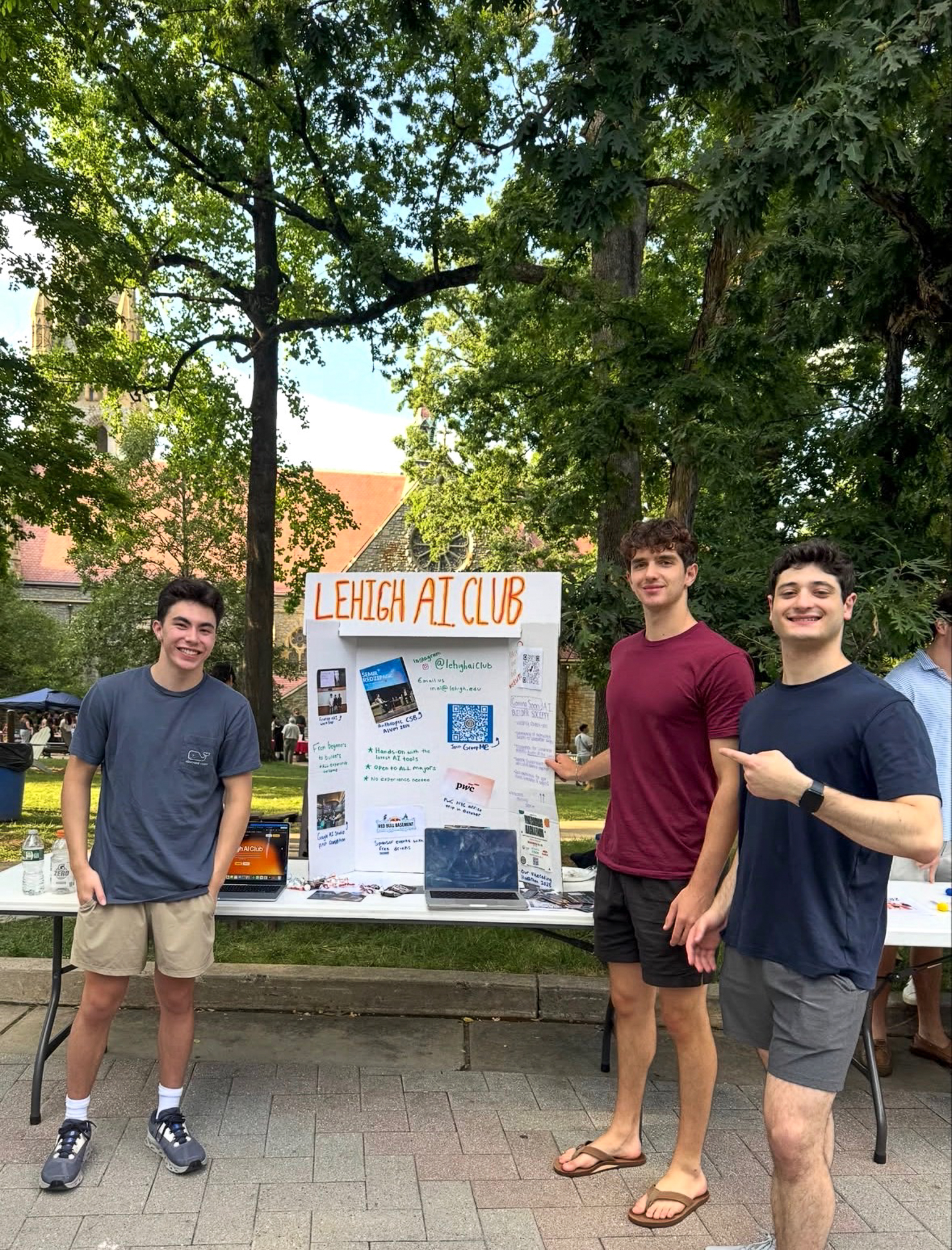
As conversations about regulation and the potential consequences of AI continue, Lehigh’s AI Club is approaching the technology with a different perspective. Its members are focused on exploring how AI can benefit the Lehigh community and the world beyond campus.
The club is facilitating AI education through the launch of its Builder Society, a place for students to turn their ideas into real products using AI tools.
Though the club didn’t require applicants to bring project ideas, every applicant arrived with a concept they wanted to explore.
Topics ranged from an AI mock-interview tool for engineering consulting to an herbal tea directory for users to explore which teas help with common health issues.
The 46 applicants chosen for the Builder Society come from a range of majors and disciplines, with participants across every college at Lehigh. Their goal is to engage students outside of the technology and computer science bubble.
The applicants were also provided Claude Enterprise accounts through Lehigh, which they can use to bring their ideas to life.
Jolie Goldstein, ‘28, AI Club president and aspiring software engineer, has reservations about AI’s capabilities, but she’s still hopeful.
She said it’s not easy to try to enter a field where AI is on the rise.
“It’s definitely scary, but that doesn’t change the fact that that’s what I want to do,” Goldstein said. “I think it’s also just a shift in perspective — now it’s the soft skills and the translation and the things that go in between writing the code that are important.”
She also said the Builder Society is very hopeful about the future landscape of AI. For her, this subset of the AI club is about learning through doing.
Goldstein said AI Club’s goal is to create a community of people who want to creatively problem-solve with AI.
Some members of the club have some skepticism surrounding AI, including Advait Shrikhande, ‘28, AI Club research chair, who said there’s potential for AI to cause harm alongside innovation.
“I think it’s a complicated reaction because initially you think about the fact that this technology seems to be hurting in a lot of cases more than helping,” Shrikhande said.
He said users have to consider that AI companies may be overselling their technologies’ capabilities in order to increase their initial public offerings.
According to the Associated Press, Elon Musk, a co-founder of OpenAI, sued the company and its top executives, claiming the company diverted from its original goal to make more money. The suit was unsuccessful.
Shrikhande and other AI Club executive board members believe regulation and development are an equally important part of dialogue as use and exploration.
“I think (the recent claims) just reaffirm that we need to be careful about how we’re developing these technologies,” Shrikhande said. “I want to be on the side of it that is calling for more safety and more regulation rather than less.”
To address the recent news headlines, the AI Club and the Society of Engineering Ethics are hosting a joint event to discuss the risks and ethical issues AI poses, as well as the growing uncertainty surrounding AI.
Shirkhande said the goal of AI Club is to provide a framework for understanding new developments on the AI frontier and a forum for discussion, not to shape people’s views.
“We’re not trying to instill fear in people; we’re using it as a way to show that it’s just a tool that needs to be leveraged and learned about, especially as students.”
Sethu Chandra, ‘28, AI Club’s alumni relations chair, said there’s a lot of uncertainty surrounding AI’s capabilities and future, especially for those less familiar with the technology.
But Chandra doesn’t share that sentiment.
“I personally believe that it (AI) can be used as a force for good, and I’m very optimistic about the outcomes that I’ve seen so far, and I have hope for the future,” Chandra said.
He also said an example of AI being used for good is the recent innovations in the fields of healthcare and robotics that are helping to accelerate medical advancements.
The AI Club executive board believes that a lack of education causes uncertainty regarding AI rather than actual ambiguity in the industry, which is what they’re trying to combat.
Chandra thinks every student should learn about AI.
“AI isn’t magic, it’s just a large language model that works off of preexisting data, which means that by virtue it cannot produce anything original, so no matter how meticulously you prompt it, it’s not going to be able to produce something that isn’t like it just already exists,” he said.
Kaur said one of the main goals of the club is to teach students how to use AI to enhance their work, rather than to replace learning.
“Many students are using AI for everything,” Kaur said. “Something that I worry about is cognitive atrophy, which is the idea that if we keep outsourcing our thinking, we stop practicing it ourselves.”
Comment Policy
Comments posted to The Brown and White website are reviewed by a moderator before being approved. Incendiary speech or harassing language, including comments targeted at individuals, may be deemed unacceptable and not published. Spam and other soliciting will also be declined.
The Brown and White also reserves the right to refuse the publication of entirely anonymous comments.