



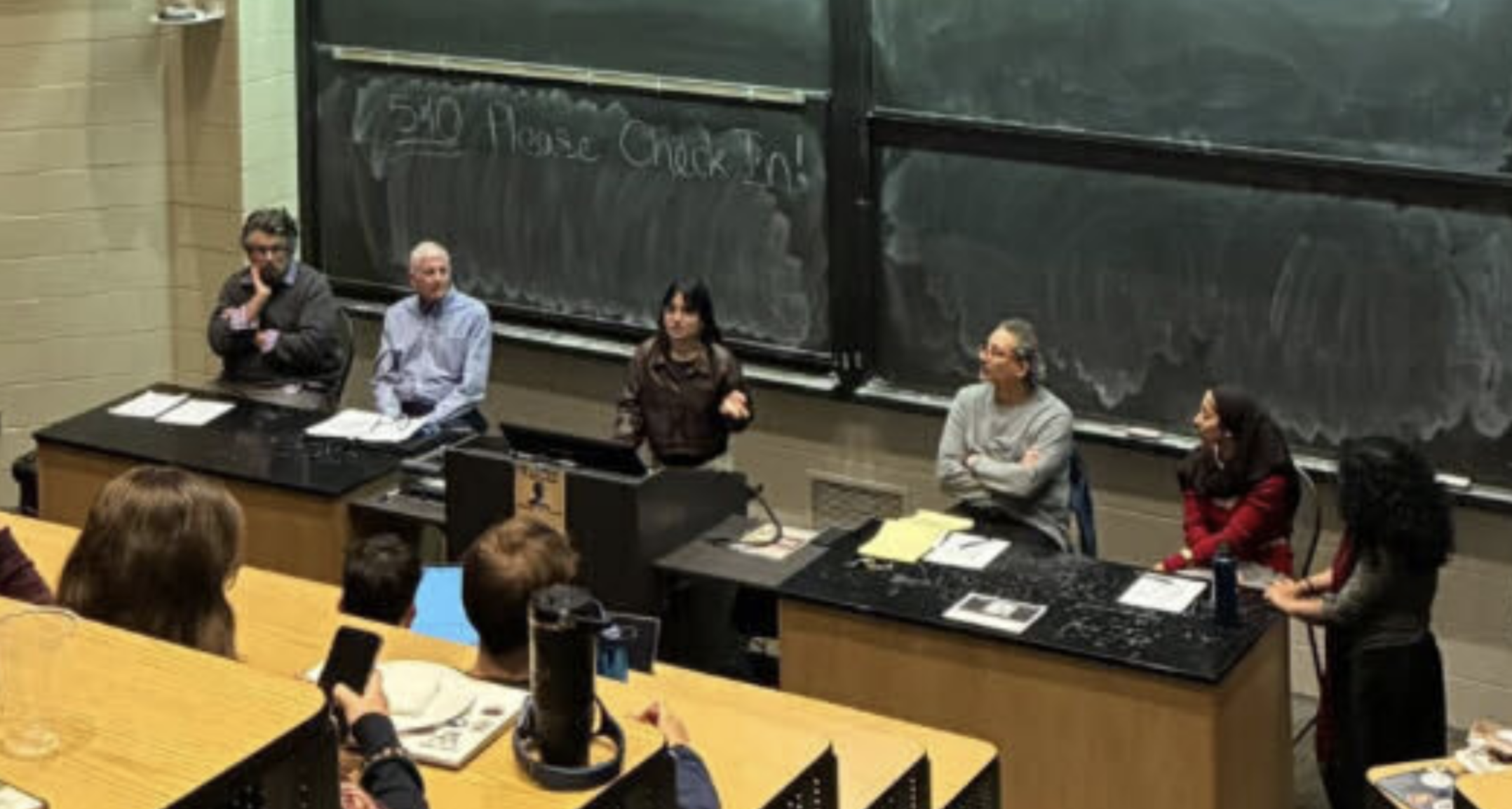
In reaction to Lehigh’s invitation to bring former President George W. Bush to campus on Oct. 29, the Student Political Action Committee hosted a panel discussing his legacy regarding media, censorship and democracy on Monday.
The event welcomed Brian Fife, professor and chair of Lehigh’s political science department, Brian Creech, professor and chair of Lehigh’s journalism and communication department and Faramarz Farbod, professor of political science at Moravian University.
The event aimed to discuss the legacy left behind by the former president and his administration, as well as how many of his post-9/11 policies led to today’s political climate.
“I would like to say there hasn’t been a day or week of my adult life as a political citizen thinking about these issues that haven’t been, in some way, informed by or formed by things that happened during the Bush administration,” Creech said.
Creech told the story of Judith Miller, a former New York Times journalist. She reported on the state of Iraq in the 2000s, and its basis on false, leaked information from White House officials. She kept the names anonymous in her reporting, which landed her in jail for 85 days.
The purpose of telling the audience this analogy was to highlight the control government officials gained over U.S media during the Bush administration.
“(Miller) had good, chummy relationships with folks in that administration,” Creech said. “But Judith Miller also exists within a media framework that had been disciplined into compliance in the wake of 9/11 anyway.”
Creech said much of post-9/11 journalism depends on having familiar relationships with elites, and toeing the line in order to not lose access to information sources.
Farabod said that mainstream media in the U.S., since it’s largely bankrolled by corporations, will always be subservient to the government and the narrative it wishes to push. He said they are only able to fully do their job during significant political divides between elites.
Another topic discussed by the panelists was how media and wording was manipulated to justify Bush’s and other presidents’ actions.
One example given was the usage of the term “enhanced interrogation techniques,” used by the Bush administration and mainstream media to refer to torture methods.
“So much of what we understand to be the back and forth of democratic politics, democratic liberation, even just media reporting, media opinion and media spectacle, has become a supercharged act of stage-craft,” Creech said.
Creech said the lack of clarity during the Bush administration on a public relations level lended itself to the lack of accountability for the war crimes committed by the U.S. after 9/11.
He says democratic discourse within the media began presenting two opposing opinions and letting viewers figure it out, rather than finding where accountability should be placed.
Farbod said when it comes to bridging political divides and democracy, different understanding of events and misunderstandings between groups of people can be bridged through critical conversation.
However, if divides are based on more critical things, such as interrogations of political powers and violence, it may require more systematic changes.
“(Bush) went around West Asia and demolished sovereign states, so this is beyond undermining democracy,” Farbod said.
A lasting imprint from the Bush administration has been the USA PATRIOT Act, a piece of legislation introduced in October 2001 that greatly expanded the search and surveillance powers of federal law enforcement.
Farbod said after he criticized the state of Israel in 2002, the FBI supposedly went to Moravian University, then known as Moravian College, and requested access to his email communications, including those from the prior six months.
Because of the PATRIOT Act, which allows federal agencies to conduct such activities without notifying the person, Farbod said the only reason he found out was because a student of his had overheard the conversation in the information technology center.
“These are aspects of post-9/11 restructuring of the relationship between the government and the people that are detrimental to privacy, democratic processes, deliberation, all of this,” he said.
Creech said the reason behind much of the discomfort surrounding the upcoming event on campus has to do with the fact that it could be an opportunity to properly reckon with the legacy of the Bush administration, but Lehigh has refused to fully engage with this idea.
The conversation with the former President is closed to all media, and all questions need to be pre-submitted with no transparency on how they will be selected.
Fife said hosting a figure like Bush on Lehigh’s campus is beneficial as places of higher education are the best spaces of civil discourses, and the pressure to make it a more democratic space falls on students.
Creech said more student activism on the campus would be healthy for Lehigh.
“Can we do a better job? Undoubtedly,” Fife said. “But I don’t think we’ll do a better job unless there’s more input from the students.”
Comment Policy
Comments posted to The Brown and White website are reviewed by a moderator before being approved. Incendiary speech or harassing language, including comments targeted at individuals, may be deemed unacceptable and not published. Spam and other soliciting will also be declined.
The Brown and White also reserves the right to refuse the publication of entirely anonymous comments.