



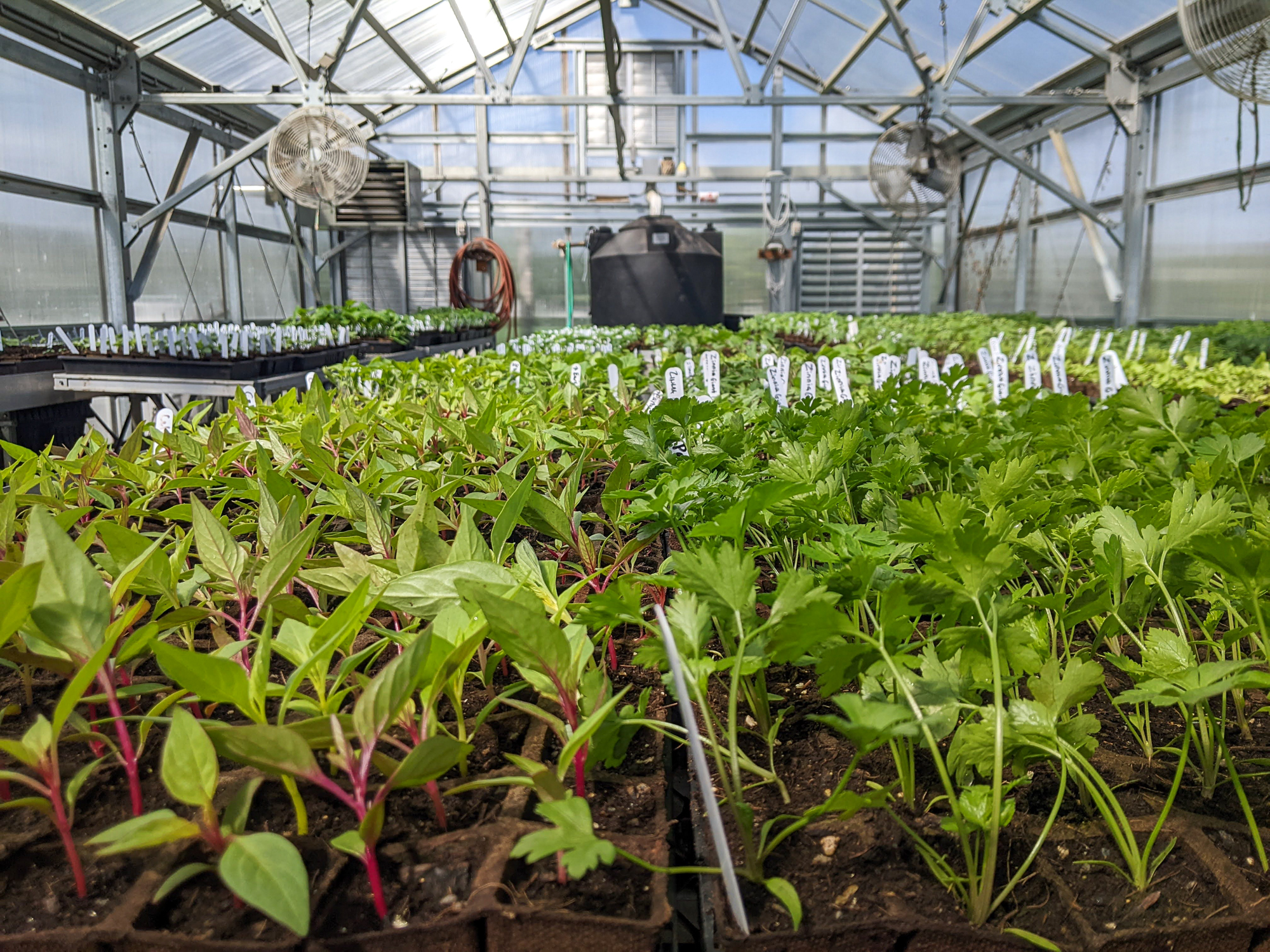
Every Wednesday from 10 a.m. to noon, volunteers at West Bethlehem Emergency Food Pantry gather to serve fresh produce and groceries to Lehigh County residents in need.
Supplied with food from Second Harvest Food Bank, the U.S. Department of Agriculture and other local agencies, the organization partners with local farms for fresh produce as well.
Johanna Reisteter, a volunteer with the West Bethlehem Emergency Food Pantry since 2017, and others help the Monocacy Farm Project with its harvest season by bringing the produce back to the pantry.
The food pantry is one of many organizations that have increased access to organic, locally grown produce for the Lehigh Valley. According to Buy Fresh Buy Local Lehigh Valley’s 2026 Lehigh Valley Food System Assessment, agricultural sales increased by 49% in Lehigh County from 2017 to 2022.
The Monocacy Farm Project is another part of the Lehigh Valley’s local agriculture efforts.
The project was founded in 2013 by the School Sisters of Saint Francis, a Catholic women’s order, who started the farm in accordance with Franciscan values of caring for both the earth and their community.
Shelby Carr, co-manager of the Monocacy Farm Project since 2021, said growth has been exponential.
Carr said last year they distributed around $15,300 worth of produce to Lehigh Valley’s emergency food systems.
While the numbers are down from 2024, when the project received funding from the Local Food Purchasing agreement that was cut at the beginning of 2025, Carr said they’re on track to surpass their 2025 figures this year.
The Monocacy Farm Project has three main programs: a food access program in partnership with the emergency food system, a “Pick Your Own” program where community members are invited to pick their own produce on a pay-what-they-want system and educational programs run at elementary through high-school levels.
Carr said the purpose of their programs is to not only give economically disadvantaged people access to fresh produce, but to encourage sustainable land stewardship as well.
“It’s so important to have access to local produce,” Carr said. “It’s better for you, it’s better quality; you’re not eating something that came to you shipped from 1,000 miles away and was probably picked unripe.”
Reisteter said incorporating local organic produce into their food options is a welcomed change for the people they serve.
She said as the food pantry is experiencing a decrease in canned produce received, fresh produce from local farms has helped.
“We get to have them try things they’ve never had before and offer suggestions on how to cook it or different ways they can eat it,” Reisteter said.
Reisteter also said the pantry has been able to serve an average of 100 households, equivalent to around 300 clients, including children, adults and seniors, over the past few months.
In September, they fed 131 households and 467 individuals.
According to Buy Fresh Buy Local Lehigh Valley’s 2026 Lehigh Valley Food System assessment, parts of Allentown, Bethlehem and Easton are classified as low-income, low food access communities using the U.S. Department of Agriculture’s classification framework.
Cuts to SNAP benefits in November 2025 also placed additional strain on local food banks.
Reisteter said the food pantry has increased the amount of produce received from Monocacy monthly as the number of people visiting the pantry has increased.
According to the Institute of Food Science and Technology, the global food chain is currently under pressure from a combination of climate change effects, economic disparities, international conflicts and lingering effects from the COVID-19 pandemic.
Dan Hunter, The Seed Farm incubator program manager, said he’s waiting for the prices of locally grown agriculture and highly-mechanized produce to equalize as global food systems are disrupted.
The Seed Farm, located in Emmaus, is a project aiming to support sustainable farmland preservation while bringing up new generations of farmers. The Seed Farm is working to get their operations in place so they’re ready for the increase in local production.
He said the main challenge has been translating the interest of people at farmers markets and other similar events into an actual customer base.
“We still exist in this environment where people have to really want the suite of benefits that’s material and forward-looking of buying local,” Hunter said.
Carr said the Monocacy Farm Project has adapted as climate change makes weather more unpredictable, buying certain seeds such as melons and cucumbers from growers further south that are more able to withstand hotter summers.
According to Buy Fresh Buy Local’s report, annual temperatures in Pennsylvania have increased 1.2 degrees Fahrenheit from 2000 to 2023, with an expected rise of 6.7 degrees Fahrenheit by mid-century. Length and severity of summertime droughts are also expected to increase.
Heavier rain during winter and spring is expected to increase flood risks. Hunter said in 2018, heavy flooding wiped out crop yields across the Lehigh Valley.
The same report says regenerative and local food systems are crucial to building a climate-resilient food network.
“The more local and close to home your food system is, the stronger it is,” Carr said. “Our (national) food system is so large and sprawling; you’re getting food from thousands of miles away and that makes it more vulnerable to these disruptions.”
She said local food systems make it so you’re eating more seasonally, making individuals less reliant on global food networks.
Hunter said The Seed Farm’s principal mission is to bring up the next generation of organic farmers in the Lehigh Valley.
He said the farm works with federal, state and county-level programs to ensure they’re farming in a way that’s friendly to the soil and watershed system, hoping to serve as a model for other Lehigh Valley producers.
“There’s a lot of increased support that’s accumulated over the last two decades in the Lehigh Valley,” Hunter said. “Both from purchasers, distributors and the consumer base and the farmer education assistance that’s available as well.”
Comment Policy
Comments posted to The Brown and White website are reviewed by a moderator before being approved. Incendiary speech or harassing language, including comments targeted at individuals, may be deemed unacceptable and not published. Spam and other soliciting will also be declined.
The Brown and White also reserves the right to refuse the publication of entirely anonymous comments.