



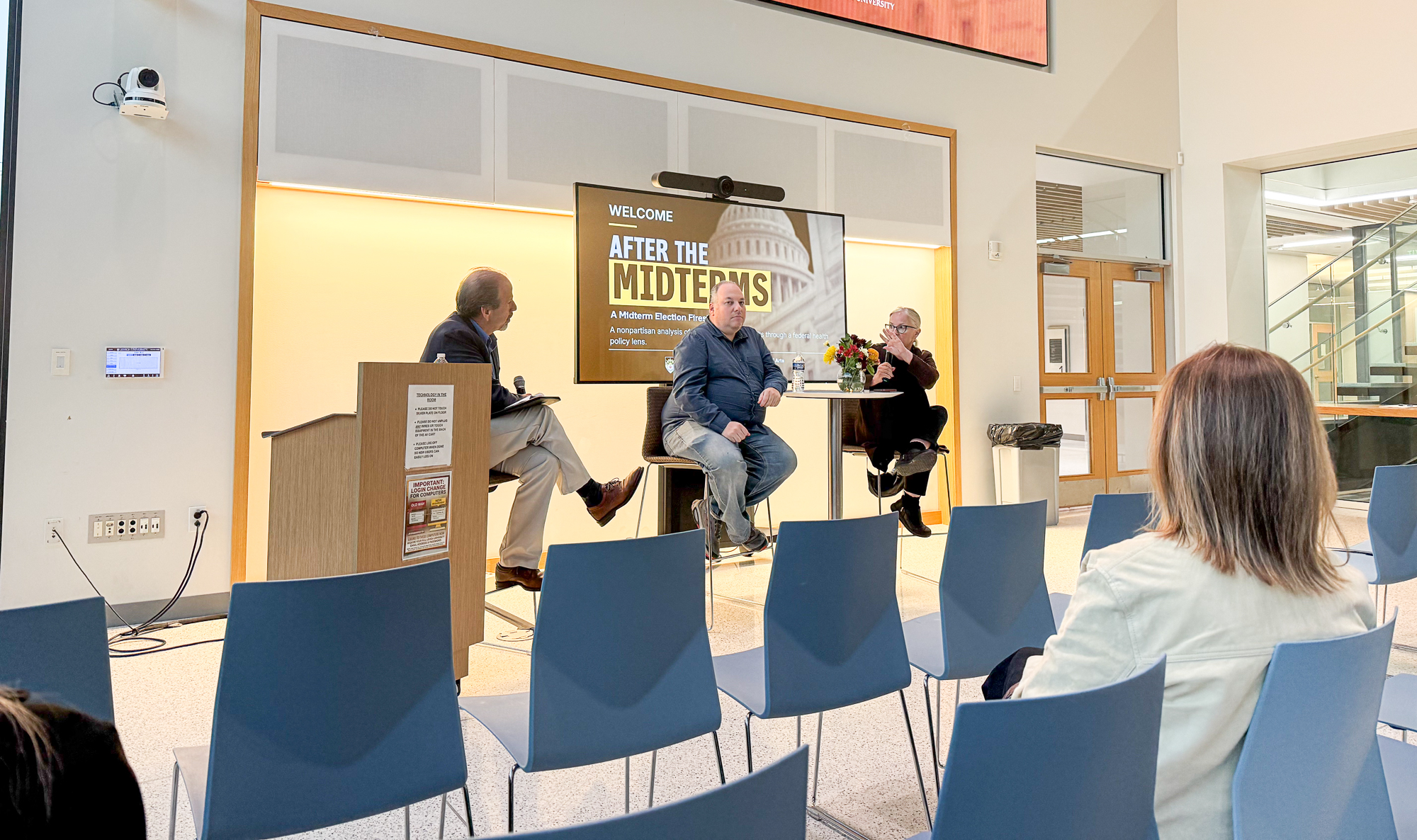
Former U.S. Rep. Susan Wild (D-PA), said the first 100 days following the 2026 midterm elections will be the “magic window” for Democrats to demonstrate their priorities and deliver their promises.
On Tuesday during a discussion with Adrian Shanker, a former health official for the Biden administration, the two discussed how the midterm elections shape federal health care policy.
Moderated by professor of political science Christopher Borick, the discussion focused on the potential effects of the Democratic “blue wave,” including efforts to restore Medicaid funding and Affordable Care Act subsidies, expand prescription drug price negotiations and reinstate support for global health programs, like the U.S. Agency for International Development.
Wild and Shanker said bipartisan action may be possible but major changes to the health care system are unlikely to happen immediately in the new congressional session in January.
Medicaid, ACA subsidies and bipartisan priorities
Wild said Democrats’ immediate health care priorities would likely include reversing Medicaid cuts and restoring subsidies for people purchasing insurance through the Affordable Care Act.
She said she doesn’t expect Congress to move directly toward a sweeping proposal such as the original Medicare for All plan proposed by Senator Bernie Sanders (D-VT). Instead, she expects Democrats to initially focus on restoring existing programs and coverage.
Wild also said the Trump administration might agree to some health care reforms if Democrats put forward proposals with sufficient support. She said the administration may be more willing to compromise on certain issues following the election results and the loss of the Republican majority in the U.S. House and Senate.
“Democrats are going to be able to get things done with President Trump because he always likes to be on the side of winners,” Wild said.
Shanker also identified prescription drug costs and pharmacy benefit manager reform as potential areas for bipartisan action. He said lawmakers could expand Medicare drug price negotiations to additional medications.
He also identified restoring funding for HIV programs, including the President’s Emergency Plan for AIDS Relief, commonly known as PEPFAR , as a possible area of agreement.
The program was established under former President George W. Bush to address the global HIV/AIDS crisis. Wild discussed her experience working on its reauthorization while serving on the House Foreign Affairs Committee.
Wild said she hopes lawmakers will restore a longer authorization period. She said PEPFAR is an example of a health policy initiative that historically received strong bipartisan support.
Despite the possibility of agreement on some issues, Shanker said Democrats may struggle to maintain a unified legislative agenda.
“I think that Democrats aren’t good at falling in line behind something,” he said. “There’s an old saying that Republicans fall in line, Democrats fall in love. And I think that’s gonna be a problem for Democrats right now.”
He said divides within the Democratic party could impact legislative priorities and progress in the new term, even with the party’s new congressional majority.
Federal agencies and public health oversight
Wild and Shanker also warned that the Trump administration can and will likely continue shaping health policy through executive action.
Specifically, she said she expects the Trump administration to keep pushing for restrictions on access to gender-affirming health care.
Shanker said the impact of changes to federal public health agencies and recent funding cuts will extend beyond the next congressional term. He said reducing these consequences would require Congress to restore funding to medical institutions for research, which Shanker said will take time.
Following the speakers’ analysis, Borick opened the floor to questions.
Joanna Mishtal, professor and chair of the department of community and population health, asked about the removal of federal data related to gender and grant cancellations affecting women’s health research.
“There’s this huge scrubbing of data and so (much of it has) to do with women’s health,” she said. “It’s clearly challenging.”
Shanker said Congress could use requests to the U.S. Government Accountability Office to examine why grants were canceled and how those decisions were made. He said congressional oversight could bring attention to decisions that might not receive widespread coverage.
Wild also explained Congress has different options for reviewing proposed and finalized federal regulations. Under the Congressional Review Act, lawmakers can review certain finalized rules but must wait until a rule is finalized before using that process.
Medical research and global health funding
Wild said restoring federal funding for medical research, including support for the National Institutes of Health, should be a priority for the next Congress.
She said reductions in research funding have gravely impacted cancer research, in particular studies pertaining to rarer cancers.
“Now the Trump administration has gutted entire institutes, centers and offices, and left shells of what was once there,” Wild said.
Shanker pointed to the 21st Century Cures Act as an example of bipartisan support for medical research. He said Republicans played a role in advancing the legislation.
The discussion also veered to the future of the U.S. Agency of International Development and how changes to foreign aid could affect students interested in global health careers.
In response to a student’s question from the audience, Wild said lawmakers could pursue efforts to restore some foreign aid programs. She said the issue could receive attention from incoming House Foreign Affairs Committee leadership, although some lawmakers may oppose spending money abroad while domestic needs remain high.
Shanker said he doesn’t expect the U.S. Agency for International Development to return in its previous form but does believe a new program could be created in its place.
He doesn’t, however, expect major changes while Trump remains in office.
Comment Policy
Comments posted to The Brown and White website are reviewed by a moderator before being approved. Incendiary speech or harassing language, including comments targeted at individuals, may be deemed unacceptable and not published. Spam and other soliciting will also be declined.
The Brown and White also reserves the right to refuse the publication of entirely anonymous comments.