



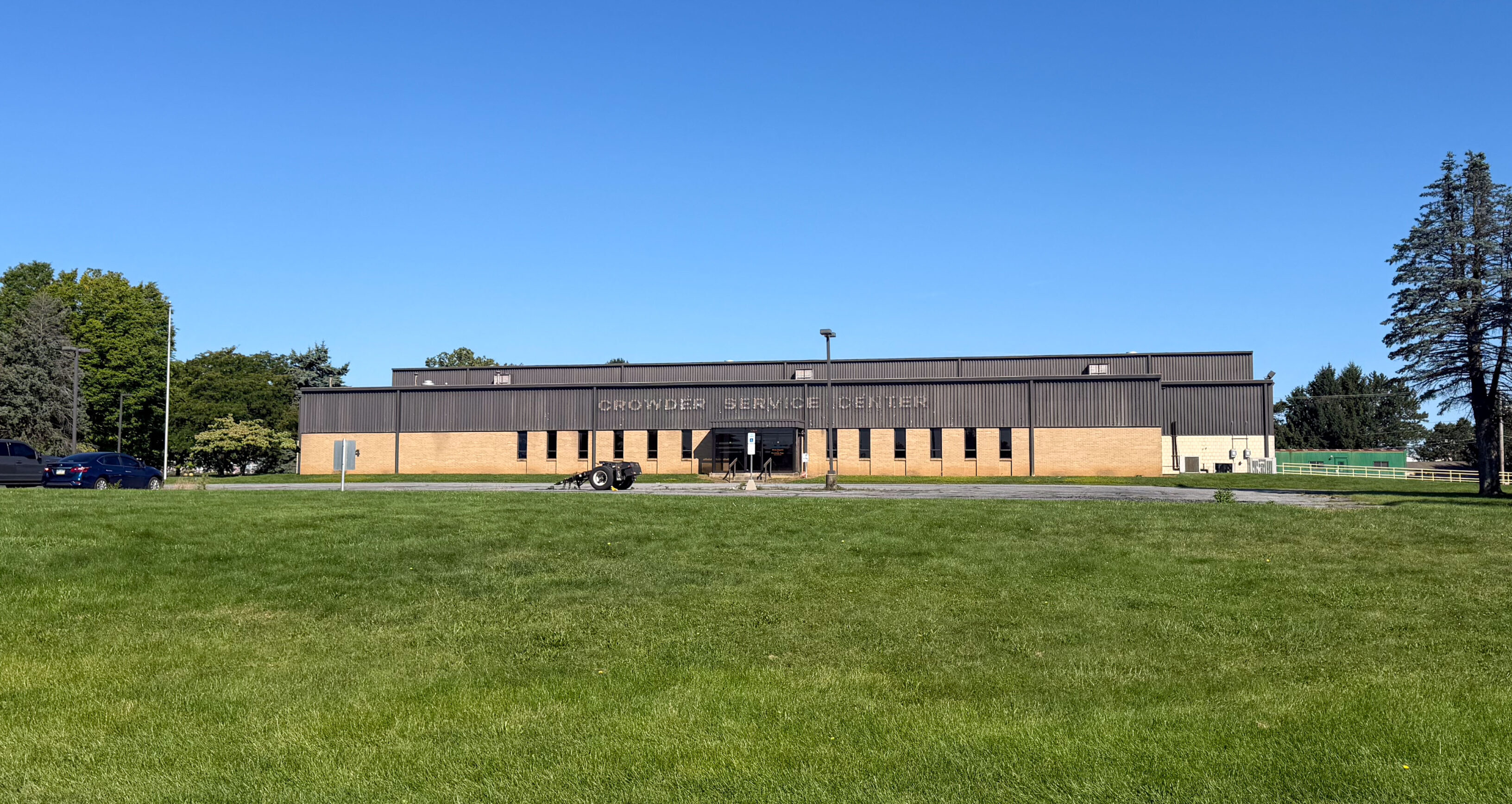
A 120-megawatt data center proposed for 2184 Industrial Drive has been approved for development, following the Bethlehem Planning Commission’s unanimous approval of its land development application on Nov. 12. For two hours at the meeting, residents voiced concerns around the resulting environmental impact, energy demands, proximity to homes and ties to the Department of Homeland Security.
The proposal, submitted by Boyle Construction in partnership with Paxos and data center consultant Tensor IQ, would replace the former industrial building at 2184 Industrial Drive with a two-story facility containing approximately 131,180 square feet across two floors.
According to a representative of Boyle Construction at the meeting, the project is designed to support up to 120 megawatts of electrical demand, with natural gas generators, a substation, rooftop cooling equipment and supporting infrastructure.
The application was submitted before Bethlehem adopted its new data center zoning regulations. As a result, the project is being reviewed under the city’s previous zoning ordinance. This permits data centers in the site’s Planned Industrial district.
Under the newly adopted regulations, the property would not qualify because of its zoning designation and proximity to residentially-zoned property. The new regulations also establish a 1,000-foot separation requirement from residential areas.
According to the city’s zoning records, every portion of the property falls within 1,000 feet of residentially zoned land. The nearest residential lots are approximately 200 feet away across Route 22.
Why the commission voted Nov. 12
Several residents asked commissioners to postpone the decision until additional studies on the proposed facility’s energy and environmental impacts could be completed and reviewed publicly.
One resident asked during a developer’s presentation what would happen if electricity consumption or environmental impacts exceeded the developer’s estimates.
“I’m confused why you have to vote today when they aren’t prepared with anything,” the resident said. “We are given words like ‘predict,’ but nothing has actually happened yet.”
The attorney advising the Planning Commission said the municipality’s planning code imposed a deadline for action on the application. According to the attorney, that deadline would expire before the commission’s next scheduled meeting, meaning the commission needed to act Nov. 12 unless the developer agreed to an extension.
City staff also acknowledged that the developers could not meet every provision of the newer ordinance, particularly the required distance from residential properties. Staff said the applicant developers had worked to comply with as many of the new standards as possible.
The developers were also required to comply with the city’s Nov. 11 review letter, which included additional requirements concerning stormwater, permitting, fire suppression, landscaping and documentation.
Inside Boyle Construction’s plan for the facility
Dylan Panabeno, vice president of operations at Boyle Construction, said to commissioners at the meeting the project is an industrial use that does not require a zoning variance.
He said the development team had spent approximately two years working on the proposal, incorporating design changes in response to concerns raised by city officials.
“We live here,” Panabeno said. “We have worked here for decades. We care about the community, we care about the environment, and we can show you what a data center can look like with those things in mind.”
According to Panabeno, the three natural gas turbine generators stored beneath the data center would provide approximately 20% of the facility’s electricity at all times. He said the generators would increase output to supply up to 100% of the facility’s power requirements during grid stress or a power outage.
The remaining electricity would come through the electrical grid.
Panabeno said the developers anticipate approximately $86 million in power infrastructure upgrades. He said a substantial portion would involve a substation upgrade that was already necessary, with the developers agreeing to shoulder its cost.
The project would also require a new natural gas line, which the development team said it would fund.
Energy, water consumption and cost concerns
Attendees questioned how the additional demand would affect the regional grid, and whether the projected infrastructure improvements would be sufficient.
Lindsay Mitchell, a journeyman lineman who said he works on the construction and maintenance of the electrical grid, challenged claims of limited cost increases.
“I would like to see a specified plan of how much grid you are actually going to upgrade and to what point,” Mitchell said. “The distribution costs that we already pay are going to go way up.”
Panabeno said the facility would use a closed-loop cooling system, which he said would not require additional water consumption for cooling. He estimated that the building itself would use approximately 20,000 gallons annually for bathrooms and cleaning.
According to Panabeno, the generators would require approximately 45 million gallons of water. He said the water would be used in the emissions system and would evaporate rather than enter the sewer system.
Panabeno said the system would be more efficient than conventional data center cooling systems, using approximately 30% less power for cooling.
Bethlehem resident Grayson Carponetti asked if the cooling method would really make a difference.
“You’re still using 45 million gallons of water,” Carponetti said. “You’re still hurting us. We could avoid all of that.”
Noise pollution and nearby property values
Residents who live near the proposed facility are concerned about noise pollution.
Panabeno presented the findings of a sound study commissioned for the project. He said existing sound measurements at the site reached approximately 71 decibels during the day and 72 decibels at night, largely because of traffic, the nearby airport and surrounding industrial activity.
He said generator silencers, sound blankets around rooftop chillers and sound-attenuating materials around the generator enclosure will be installed at the facility. Panabeno said this will ensure its noise emissions would remain below 55 decibels at the property line.
According to Merck, 90 decibels is the mandatory federal standard, but protection is recommended for anything more than very brief exposure to sound levels above 85 dB. Decibels are measured on a logarithmic scale, meaning that a 10-decibel increase is perceived as approximately twice as loud.
Brett Baker, who lives directly across Route 22, raised concerns about the potential effect on residential property values as a result of low-frequency vibrations and noise pollution.
“What will my property value be when this data center goes up?” Becker asked. “It’s been studied that data centers lowered property values.”
A working paper by University California, Berkeley, Harvard University and Monash University found that large data centers were associated with an average 3% decline in housing values within three miles over five years. The study estimated a 7.2% decline for properties within one mile.
Evan Chess, a Bethlehem resident, said he lives approximately 400 feet from the proposed facility. He called the neighborhood’s experience when Route 22 expanded, saying five neighboring families lost their homes and his own property lost approximately 25 feet of backyard space and the trees that had previously blocked highway noise.
“My house was the last one to be spared,” Chess said. “This just adds to the sound that we already have.”
DHS and the project’s intended use
The project’s references to the Department of Homeland Security prompted residents to question the facility’s intended purpose and whether it could eventually be considered critical infrastructure.
Under Bethlehem’s existing ordinance, developers must provide one deciduous or evergreen tree for every 4,000 square feet of impassable surface. Panabeno said the proposed building, generators, electrical infrastructure and security requirements limited where trees could be planted.
City planning staff said the developers had cited Department of Homeland Security recommendations and guidance to justify their inability to meet the full tree requirement. Staff requested that the developers submit the specific DHS documentation so the city could review the justification.
Owen Levanuler, a Bethlehem resident, questioned why the developers were invoking DHS guidance for landscaping while providing little information about the facility’s relationship with federal agencies.
Levanuler also raised questions about the company Tensor IQ and its capacity to offer adequate consultation for a data center of this scale.
He said he was concerned the developers could eventually characterize the facility as critical infrastructure serving government, military or health care entities, which could complicate efforts to shut down the facility or subject it to local oversight if problems arise.
“If this data center got passed or didn’t get passed, they will try to argue that this is critical infrastructure,” Levanuler said.
Joel Atinson, a Bethlehem resident, also raised concerns about the Department of Homeland Security’s involvement and controversies surrounding enforcement operations.
Tensor IQ CEO Jonathan Alkai told commissioners that he had spent 16 years working in the federal government, including on the formation of the Transportation Security Administration and Department of Homeland Security.
He said the project would be able to shut down when necessary, and the company intended to establish public reporting on noise, heat and other operational information. Alkai also said the facility was expected to create approximately 110 jobs.
Three waivers approved
Commissioners considered three separate waiver requests. The first concerned the permitted slope for fill. The developers requested permission to use a 2.5-to-1 slope in one location where the original ordinance requires a three-to-one slope.
The second concerned driveway width. The city’s engineering department had reviewed a request for entrances measuring 100 feet along Avenue B and 120 feet along Industrial Drive, exceeding the ordinance’s 35-foot maximum.
In an Oct. 28 memorandum, the city’s Department of Public Works supported the waiver. They said that narrower entrances would not provide sufficient room for larger vehicles to enter and exit safety. The department recommended approval subject to city engineering requirements, including accessible curb ramps and crosswalks.
The third waiver concerned the requirement to plant one tree for every 4,000 square feet of impervious surface.
City staff said developers unable to plant the required trees could make a payment in lieu of planting them, with the money going toward tree planting elsewhere in Bethlehem. This compromise will require developers to pay $1,100 per tree, with the total estimated cost at approximately $400,000.
The commission approved all three waivers unanimously.
During the vote, members of the audience shouted objections as commissioners attempted to continue.
The chair warned that police could be called if order was not restored.
After the waivers passed, commissioners voted unanimously to approve the land development application, contingent upon the developers meeting the conditions outlined in the city’s Nov. 11 review letter.
Comment Policy
Comments posted to The Brown and White website are reviewed by a moderator before being approved. Incendiary speech or harassing language, including comments targeted at individuals, may be deemed unacceptable and not published. Spam and other soliciting will also be declined.
The Brown and White also reserves the right to refuse the publication of entirely anonymous comments.