



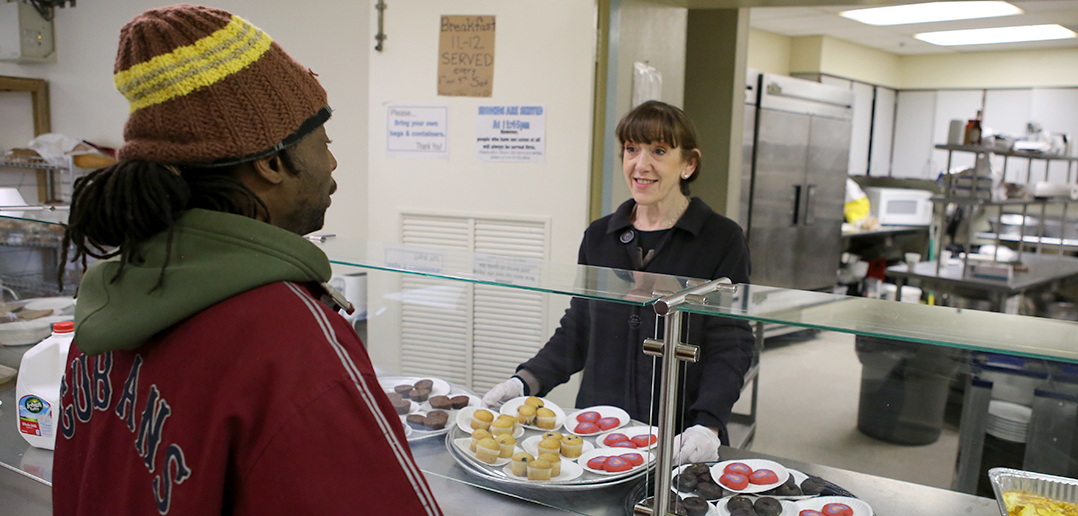
Veronica Martinez sifts through cans at New Bethany Ministries, helping to sort leftovers after a crowd leaves the food pantry. An earphone humming in one ear, she wears a pale brown sweater under her apron, the result of a clothing donation a few weeks before.
Martinez is young, and her demeanor is mellow. She reveals none of the food collection havoc she just dealt with, and none of the chaos of the four children who wait for her at home. Her voice is firm, repeating, “When God puts you somewhere, he wants you to be there.”
Martinez’s time at New Bethany Ministries was two-pronged. One, she is a client of the organization. Two, she worked there for four weeks in December, a component of the program she is enrolled in that secures her with cash assistance from welfare. Martinez is one of the 21.6 percent of south Bethlehem residents who live below the poverty line — those who rely on food pantries, soup kitchens and food stamps to sustain themselves and their families.
“Food — and being able to get that food — is so important,” said Fiona Byrne, food pantry coordinator at New Bethany Ministries. “It’s our basic need. And there’s a huge number of people who lack that need on the South Side.”
Food insecurity: the basics
Living below the poverty line typically is an indicator of food insecurity — a lack of access to enough food for a healthy lifestyle. According to a study by a Lehigh sociology professor Judith Lasker, almost two-thirds of south Bethlehem residents are food insecure.
The study reports that there are a multitude of factors contributing to this situation, including low income or unemployment, lack of education, lack of transportation and a high number of children.
Whatever the cause, the effect is severe: Those who cannot eat cannot operate. And Lasker found that those who cannot operate can sink deeper into a detrimental chronic state, such as homelessness, mental illness or unemployability.
These states are all part of a cycle, and each one can be the cause or effect of another.
“Even with the addition of C-Town, the new grocery store on the South Side, Bethlehem is still defined as a food desert,” said Elena Martin, a Lehigh junior who works with local food pantries.
A food desert is an urban area with a lack of affordable and quality foods, an added challenge for an area already struggling socioeconomically.
The help – and the struggles within the help
Bethlehem has a number of organizations attempting to combat food insecurity. New Bethany Ministries provides a food pantry and soup kitchen for the poor, homeless, and mentally ill in the area. The food pantry serves over 360 households a month, and the soup kitchen feeds around 220 people a day. The Hispanic Center, another community organization with a food pantry, serves about 50 people a month.
These are just two of 17 like organizations, but since they span across both sides of Bethlehem, getting to these locations without a car can be very difficult.
To get funding from the federal government, organizations first need to demonstrate the need is there: that people are hungry. Once an initial grant is given, a whirlwind of technicalities must be addressed — how to receive donations and additional funding, attaining enough space and proper utilities, and ensuring food quality.
“We try to give our clients balanced meals,” Byrne said as she hauls a box of butter into a freezer, sliding it next to endless bags of frozen onion rings. “What makes that difficult is we can’t really control what we get. We don’t have much freezer space, but we have so many French fries.”
“And people will take anything they can get,” Martinez added.
One of the aims of a food pantry is to give people a financial buffer so the money they would have spent on food goes toward housing or medication. Most food pantries have a policy of one collection every 30 days, with each collection lasting approximately three days.
That leaves 28 days unaccounted for, and 28 days of foodlessness.
Instead of facing the stigma of going to a soup kitchen, many choose to stock up on cheaper products like canned vegetables, soups and meat.
This is especially problematic when it comes to dealing with chronic diseases like diabetes, obesity, and cholesterol and sodium issues.
“It’s hard to put restrictions on food in terms of nutrition-value, because we don’t want food donations to go down and we don’t want people to go hungry,” said Sherri Penchishen, the director of Chronic Disease Programs at the Bethlehem Bureau of Health. “But if a person with diabetes is relying on food pantries, they’re getting exactly the type of foods we’re telling them not to eat.”
The numbers behind food insecurity
The study done by Lasker reported only 11 percent of south Bethlehem residents have a college education. Without that degree, it can be impossible to make enough money to exercise a healthy lifestyle.
Lasker found that 48 percent of residents make below $1,500 a month. The average American income, as stated by the federal census in 2011, is $3,769 a month.
Though people like Martinez can become involved in programs that enable you for higher education, qualifying for such an opportunity requires working at minimum wage for an extended period of time.
“Where is the quality of life in $7.50 an hour?” Byrne said. “Our clients who are working are doing so for very few rewards, just to achieve basic survival.”
The study by Lasker reported that nutrition deprivation has detrimental effects on mental health. Anxiety can spike, depression can deepen and stress can soar once individuals cannot attain the nourishment they need.
This creates the chronic states that are so hard for those affected to get out of. Hunger coexists with the deterioration of all different aspects of life, pushing individuals toward drug abuse, alcoholism and homelessness, Byrne said.
“It’s all circumstance,” Byrne said. “Some of them just don’t get out of it. And if you already have hunger and then throw in mental illness, or drug abuse – that’s because they want a vacation from their lives. They’re not going to the Caribbean, to Spain, to London or France. They want to get out of their current situation and away from where they are. So we do what we can to make where they are a little easier.”
Note: a sidebar to this story about initiatives to put healthy food options in more Lehigh Valley markets can be found here.
Comment Policy
Comments posted to The Brown and White website are reviewed by a moderator before being approved. Incendiary speech or harassing language, including comments targeted at individuals, may be deemed unacceptable and not published. Spam and other soliciting will also be declined.
The Brown and White also reserves the right to refuse the publication of entirely anonymous comments.