



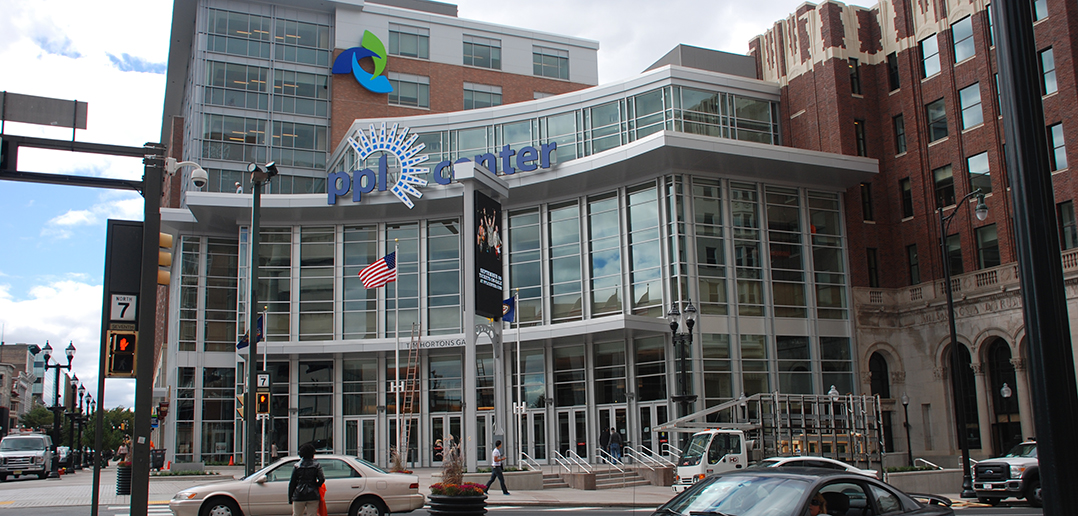
The $177 million PPL Center at Seventh and Hamilton streets in Allentown, which opened in September as part of Mayor Pawlowski’s plan to revitalize the downtown, has already been nominated for two prestigious worldwide awards.
Home to the Lehigh Valley Phantoms minor league hockey team, as well as chain restaurants Chickie’s and Pete’s and Tim Hortons, the PPL Center has hosted concerts by The Eagles, Tom Petty and Rascal Flatts. The location and the 10,000-person seating capacity have extended the reach of the event center to the Philadelphia region and make it a desirable venue for major acts.
But Michael DeCrosta, a sociology graduate student and Bethlehem local, called the efforts a prime example of gentrification, or the act of development to the point of local displacement.
“I’m always wary of developers having too large of a hand in revitalizing an urban downtown area like Allentown,” DeCrosta said.
As a sociology student, DeCrosta said he thinks in terms of race and class. By developing upper-class condominiums, corporate offices and expensive restaurants, he said Allentown is creating a “white space.”
“A minor league hockey team may be the whitest thing ever,” he said.
In a city where nearly half the residents identify as Hispanic, critics of the development worry that the efforts don’t reflect the local population.
“To really bring a city back to life, you have to reflect the people that live in the city,” said Erika Sutherland, Spanish professor at Muhlenberg College and director of a Hispanic immigrant advocacy group. “It has to involve the people that live and work and pay taxes in the city.”
Proponents of the development say there is a need to attract people who don’t live in the city to the downtown in order to raise tax revenue and bring in money. Julio Guridy, the president of the Allentown City Council, said the vision for the new development includes creating employment for residents and bringing more people to the city that are employed.
“The problem is we have a city that has a significant number of people whose income is below the poverty level,” he said. “Because of that, we want to make sure we have a middle class to sustain the city as well.”
Guridy said that by bringing more professionals to the city, they are bringing in tax revenue, which he said would assist in revitalizing the whole city.
Sutherland said she understands this mentality. In order to have successful development in an economically depressed area, you need to get money from outside of that area.
“You need real money and you need customers that are willing to spend money,” she said.
But concerns remain about what the development is doing for Allentown residents.
The city government boasts about the jobs it is providing for residents, DeCrosta said, but he said those jobs are far from ideal. He said many of the jobs being created for Allentown residents are server positions.
“That’s not the sort of thing you want to tout as, ‘this is how we’re going to make our working class better,’” DeCrosta said.
Ce-Ce Gerlach is a key organizer for Jobs for Allentown, a resident advocacy group that is currently advocating for a more equal development process in which the majority of the new jobs are given to Allentown residents.
Gerlach said she is pleased that the arena is providing jobs, but there are many issues with the jobs available. She said the majority are part-time, and many are on-call. If people are only working event nights, she said, that means they could be working once a week or even every other week. While a lot of people are just thankful to have a job, many are underemployed, she said. She said because of the types of jobs that are being offered to Allentown residents, the development is not addressing the income gap.
“They’re working as a box office employee when they’re capable of being the supervisor,” Gerlach said.
Gerlach said at a meeting about the development, Jobs for Allentown members suggested that new companies post every job from CEO down, and someone said, “I doubt you’re going to find someone of that caliber here.”
Gerlach said Allentown has plenty of qualified residents, but there is a perception problem.
Guridy said they have created more than 2,000 new jobs with the development in the last several years. He said residents have benefited from the development, but it’s something to continue working on. The available jobs are service jobs primarily and a lot of the corporate offices are bringing their own employees.
Guridy said different jobs require different types of skills and if residents have those skills, they have to compete with others in and outside of the city like anywhere else.
Other concerns over the development include how it will affect the surrounding communities, including locally-owned businesses.
Gerlach said the development is supposed to create a trickle-out effect into the communities.
“But if you look at the history of economic development, that’s not what happens,” she said.
Gerlach said the trickle out effect does not happen organically. It requires economic programs and policies.
Sutherland said her main concern is that the city government is not reaching out to residents and local businesses. She said the city should encourage local businesses both by word and financial support to clean up their restaurants and have menus offered fully in English.
But she said she assumes that is not going to happen.
“People will come to the arena, see a show, eat there and leave, and have limited interaction with local businesses,” Sutherland said.
Guridy said the development would help some of the local businesses. The revitalization will make it so people can wander through the city, he said. The idea is for people to come to a game at the arena and see shops that interest them in the area.
“If the downtown is dying, the whole city will die,” he said. “If you redevelop your downtown, people will stay, spend their money and use the services available.”
The concern is whether this redevelopment is considering the local residents or if it is pushing them out.
“The city leaders always seem to be looking backwards instead of looking forwards,” Sutherland said. “They are clinging to how it used to be, but the city is still alive, we’re still here.”
2 Comments
As President Lincoln paraphrased John Lydgate’s quote, “you can please some of the people all of the time, you can please all of the people some of the time, but you can’t please all of the people all of the time”.”
interesting that some of the people all of the time ends up being middle class white gentrifiers…
Comment Policy
Comments posted to The Brown and White website are reviewed by a moderator before being approved. Incendiary speech or harassing language, including comments targeted at individuals, may be deemed unacceptable and not published. Spam and other soliciting will also be declined.
The Brown and White also reserves the right to refuse the publication of entirely anonymous comments.