



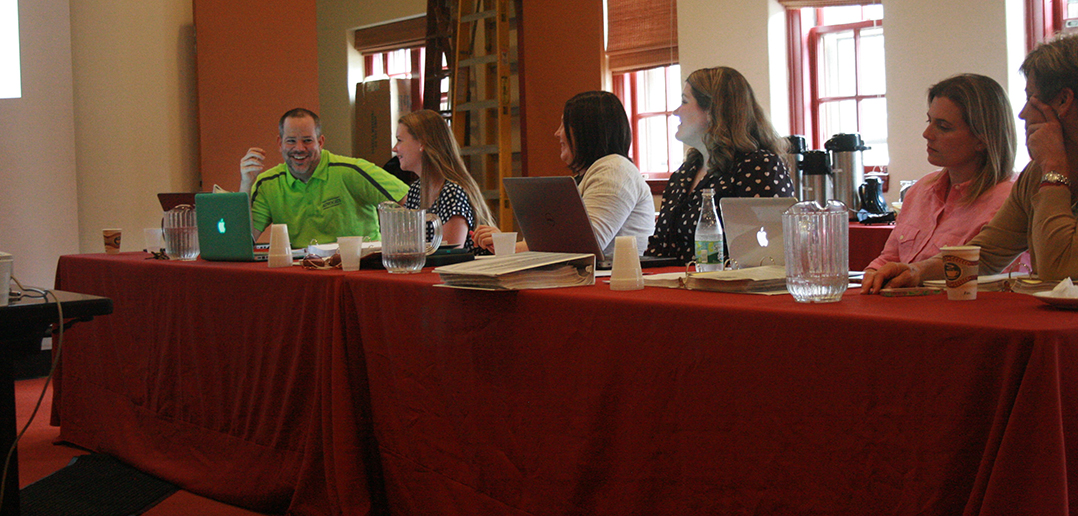
It’s that time of year again. With the end of the semester approaching, Greek men and women are preparing for the season of accreditation. According to the Office of Fraternity and Sorority Affairs website, accreditation is the annual assessment process of Greek chapters, where all facets of chapter operations are reviewed.
“It is a key process in the development and maintenance of chapter standards,” the website states. Each accreditation presentation is facilitated by a panel of faculty and students chosen to provide an open and well-rounded assessment of chapters. A Brown and White reporter sat down with a group of panelists to discuss their involvement, experiences, and memories with the accreditation process.
Q: What does a typical accreditation panel look like?
Tim Wilkinson, senior assistant dean and director of the Office of Fraternity and Sorority Affairs: Right now, the way accreditation is set up, there are three faculty and staff members on the panel, and then a Greek student and a Greek alumni member. Those panels rotate, and some years I chair every panel, but this year I’m acting as a resource for these panels. Each panel does around four to eight accreditation sessions a year. This way it can be ensured that someone can give a consistent perspective on the session.
Q: How did you get involved with the accreditation process?
Holly Taylor, assistant director of the Office of Student Conduct: I was emailed by Stephanie Burke, of the Office of Student Leadership and Development, and she was looking for volunteers. Since I am not Greek, but obviously work closely with Greek-affiliated students from the conduct side, I thought it would be an awesome way to see what the good things that are happening and give back to the Dean of Students staff that I work with.
Brendan McCullagh, vice president of administration of the Interfraternity Council: I believe people in various Dean of Students offices recommend certain students that they feel would be a good representative on the panel that could accredit other students. Stephanie Burke contacted me and asked if I wanted to volunteer and participate in the accreditation process from the student perspective. I think it’s great that people from so many organizations and departments are chosen to panel accreditation sessions. It helps break the misconception that it’s only the administration assessing chapters.
Rita M. Jones, director of the Women’s Center: I saw a call for volunteers for the accreditation sessions, and I thought it would be a good idea to come and get a better sense of the process and particularly to meet more students. I hope to help students, as we go over their presentations and reports, to achieve more depth in involvement, rather than breadth.
Wilkinson: From my perspective, our office oversees the process. So I’ve been involved with accreditation since I started here. It begins with Stephanie Burke and the Office of Student Affairs staff brainstorming potential panelists. People like Holly and Brendan, who I think have a good and unbiased perspective, as well as a good understanding of the in’s and out’s of Greek life.
Q: What are some of your favorite, or impressive, accreditation presentations you’ve seen in the past?
McCullagh: This is my second year doing this, and I think the most impressive presentations are the ones that do not do activities specifically for accreditation itself, but they do activities because you can see that they actually care about what they’re involved with. It’s very easy to tell when an organization is doing something just to impress the administration, or if they actually advocate for the activity.
Taylor: I sat on a panel on Monday that was impressive because they didn’t just have their executive board speak out – they had general members speak ranging from new members to seniors. They spoke as to what their personal experiences had been. That was just as cool, if not cooler than, say, listening to the treasurer talk about their financial report.
Wilkinson: I would say, for me, having sat in on around 300 accreditation panels that I would just echo what Brendan and Holly had said. I enjoy when certain organizations are really excelling, as well as, when other organizations are really working through some challenges. I think people don’t really understand how much of an opportunity it is for chapters to come in and talk about the flaws and challenges they have. It’s also great to see the entire chapter involved in the process. I’ve seen some really interesting presentations and some really heated back-and-forth’s between chapters and panels, but I think that speaks to the passion of both our students and panelists.
Q: Do you have any interesting or funny stories to share about past accreditation experiences?
McCullagh: I remember one last year specifically where one organization to show their appreciation or agreement to one brother’s thought or contribution, they would all snap at the same time in support. It added a “lighter” atmosphere to the room, and still supported each brother who said something.
Wilkinson: I can think of one time when a student was presenting and kind of mumbling along, and an alumni panelist—not on purpose—sort of snapped at him to speak more clearly to the panel. You could see that then the student, who still worked through it, had a look of terror on his face the rest of his part of the presentation. We have to remember that this is a really tough process for students and it takes a lot of courage to stand up and present in front of us. It was just kind of funny to see how the alum didn’t mean it to be harsh, but gave the student a good scare.
Q: What is your favorite part about being on the panel?
Taylor: Learning about the organizations and also meeting new students is a great part about being on the panel. I don’t generally meet many members of the organization—if it’s a conduct meeting I generally only interact with the executive board or specific individuals.
McCullagh: Definitely getting to know other organizations on a more specific level. We get to experience chapters on a general level with philanthropy events, but when we get into the process you can see the inner workings, like their housing points system.
Q: If you could give a suggestion to those students and organizations who are going to be involved with accreditation process in the future, what would it be?
Taylor: They should come to a panel before you sit in on one. That way you can get a better understanding of what is going on.
Wilkinson: I’d say just to be honest. I think sometimes chapters come in thinking they need to say what the accreditation committee wants to hear. What we always say to groups is that you may disagree with our recommendations, or you may have done something differently than you were advised to and that’s OK. Just like making mistakes some years is OK, too. We expect groups to be honest when they have “hiccups” and to be honest when they excel.
McCullagh: I’d definitely say it’s quality over quantity. Accreditation reports can often be upwards of 100-200 pages, and that’s not what people are looking for. If you can be concise and get your points across, that’s all they really want. Second, if you had troubles conduct-wise, or troubles functioning in the community this year, address them and how you’re going to learn from them. It’s great when chapters talk about the steps they will take to make change and how they’ll continue to strengthen your chapter.
Comment Policy
Comments posted to The Brown and White website are reviewed by a moderator before being approved. Incendiary speech or harassing language, including comments targeted at individuals, may be deemed unacceptable and not published. Spam and other soliciting will also be declined.
The Brown and White also reserves the right to refuse the publication of entirely anonymous comments.