



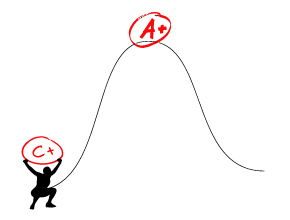
Grade curving, which is the practice of scoring exams based the relative exam scores of students in the class, is used by professors at Lehigh.
While a bell curve is the traditional method of grade curving, some professors add points to students’ grades in alternative forms.
Cameron Wesson, the associate dean of the College of Arts and Sciences, said Lehigh Registrar Emil Gnasso does not curve any scores received in any courses. Grade curves also are not governed by the college or university. He said if professors chooses to curve, they must do so in a fair manner.
Wesson said there is no standard practice or policy regarding curving within the college. He said curving is applied on a professor-by-professor basis, so it is a personal decision. Some professors choose to curve and some do not.
“The grades belong to the faculty member who’s teaching the course,” Wesson said.
He said each of Lehigh’s departments could have their own policy on curving if they wanted. Gnasso wrote in an email that some departments have policies on curving and others do not.
For the departments that lack their own policies on curving, Wesson said individual professors within the department can each have their own policy on whether they curve and how they curve.
He said there is no mandate from anyone that curves are good or bad, nor that curves should or should not be applied.
Wei-Min Huang, the chair of the mathematics department, and David Vicic, the chair of the chemistry department, wrote in emails that neither department within the College of Arts and Sciences has a specific policy on curving. Vicic said individual professors are free to curve as they see necessary as long as the curves are appropriate and fair.
David Johnson, the associate chair of the mathematics department, wrote in an email that when he started teaching at Lehigh in 1984, students did not register for particular sections of a course. Instead, he said the registrar assigned students to sections based on the list of courses they provided. He said this made consistency and similarity even more important across sections within a course. Johnson added that 4 o’clock exams guarantee uniformity because students take the same exam at the same time.
Johnson said grading is also uniform, with the entire staff of a given course dividing up each exam and assigning specific graders to specific problems, which the assigned graders grade on every student’s test. He said homework and quiz grading are more individualized, but the department still works to ensure there is uniformity in the averages of those assignments.
Johnson said the department assigns each course to a professor teaching the course who is considered the “course coordinator.” He said the coordinator’s job is to agree on the syllabus, schedule, assignments and exams with other faculty members within the course. He said some things, such as teaching styles and timing, vary between professors and sections, but the rules and expectations for all students taking the course are the same.
Johnson said the department usually designs exams so there is no need for a curve.
“The reason for that is primarily so that students really know where they stand in the course,” he wrote in an email.
Johnson said that does not always mean average scores are between 75 and 80. He said each exam is compared to what was given the previous semester and a certain performance standard has to be met for each. He said the courses that do curve usually do so at the end of the course rather than on individual exams.
Johnson said if a curve were applied, it would only be applied in the upward direction. He confirmed that a score of 90 percent would score at least an A-.
Mark Chen, a professor of advanced organic chemistry and organic polymer science, said he likes to ensure grades actually differentiate things such as achievement and ability in his classes. He said grades in his classes are not dependent on one exam.
Chen said to get a better gauge, he assesses performance on one exam to set the bar for the next exam based on his classes’ ability. He said some of the problems he assigned in his fall class were adapted from a similar class he had taken at Harvard. He said the exercises were difficult, but students learned from these difficult problems.
Chen said he generally designs tests with the intention that the average student scores around 70 percent before curving. He said some of his exams are harder than others, so if they were absolute scores in that regard, most students would receive an F on the exam. He said average scores depend on the material, the semester and the students taking the class.
He said he believes his policy on curving is mathematical and fair. Just like average scores, curving varies depending on the material, the semester and the students enrolled in the course.
He said the difficulty of different professors’ classes isn’t standardized, so that is where the universal practice of curving comes into play. Chen said every professor is different and every department is different, and people have different philosophies on grading.
“You don’t want to ever place the bar so high that everyone will fail and then you have to feel out if they actually learned anything,” Chen said. “But then also you don’t want the bar to be so low that there’s no differentiation and everyone is acing the exams.”
Katrina Zalatan, the associate dean of the College of Business and Economics, wrote in an email thatFsa the faculty is responsible for grading and she did not know of any policy specific to curving scores in the college.
Robert Thornton, the economics program director, said the department does not have a policy on curving. He said the department tries to keep scores balanced, but sometimes some courses will outperform others. He said grading is relative.
“Instructors are pretty much their own contractors,” Thornton said. “Standards are strict but fair.”
Gregory Tonkay, the associate dean of undergraduate studies in the College of Engineering and Applied Science, wrote in an email that Lehigh has no official policy on how grades relate to percentage scores or on the use of curves. He said every professor is able to use whatever measure they wish to come up with a final assessment of the student’s performance.
“A, A- is excellent. B+, B, B- are good, etc.” he wrote. “Those are the definitions faculty have to use when assigning grades. It is up to them to define the specifics of what translates to excellent, good, etc.”
Mayuresh Kothare, the chair of the chemical and biomolecular engineering department, wrote in an email that there is no official policy on grade curving within the department. He said most faculty try to grade their classes based on the overall class performance, so if class average is low, it doesn’t automatically mean everyone will get a low grade. He said it works the same way with a higher class average.
“There is no pre-determined algorithm for the distribution of grades, nor is there a pre-determined average GPA for the class grade,” Kothare wrote in email.
Comment Policy
Comments posted to The Brown and White website are reviewed by a moderator before being approved. Incendiary speech or harassing language, including comments targeted at individuals, may be deemed unacceptable and not published. Spam and other soliciting will also be declined.
The Brown and White also reserves the right to refuse the publication of entirely anonymous comments.