



This winter’s mild weather didn’t just bring warmer temperatures and less snowfall to campus than in previous years. It also brought bugs.
“There’s been a lot of gnats,” said Dean Snyder, an employee for Rid-Et Pest Control. “They’ve been all over, but that’s normal for this time of year.”
Rid-Et Pest Control serves as Lehigh’s primary pest control service. Although the company is on campus twice a week throughout the year for pest-related service calls, Snyder said spring marks their busiest time of year. During the week of April 17, he reported 22 service calls for bug-related issues on campus.
Snyder said there are more bugs in the spring because this is when their eggs hatch. This year’s mild winter is also responsible for the rise in the amount of bugs because a long winter will normally lower their population. Because temperatures were higher than usual through December last year, the bug populations were able to reproduce longer.
Snyder said gnats and bees were the main reason behind service calls in the spring, with stink bugs responsible for most calls in the fall.
Although the university does pay for pesticides, Snyder said his company does not apply one product to every residence hall immediately.
“We don’t put pesticides down unless it’s necessary,” Snyder said. “We put monitors out, and if we see a problem then we address it on a case-by-case basis.”
These monitors, which Snyder said are placed in the kitchen areas of all residence halls, allow him to determine which product is necessary to use.
“Let’s say I come across a roach,” Snyder said. “This way, I know what kind of chemicals to use to prevent roaches from getting out of hand. If I were to find ants, I’d have to use something completely different.”
Katy Kresge, an associate director of the Office of Residential Services, said one important way to prevent bugs from getting inside is for students to make sure their window screens are closed.
“This is especially important at night, because the bugs are attracted to light,” Kresge said.
Kresge also recommended students keep their rooms clean and avoid leaving any food out for an extended period of time.
These bugs, however, aren’t just a nuisance for students — they can, quite literally, be a pain. In the last year, the Health Center has treated 29 cases of bug bites, said Christina Finley, the administrative coordinator for the Health and Wellness Center
“We see all patients that make appointments, but we would treat different bites in different ways,” Finley said.
She said most bites can be treated with a topical cream and few appeared inflamed. Most insect bites are treated with medication to prevent itching.
Finley also said several students arrived at the Health Center unsure of the type of insect that had bit them. She said although gnats have been showing up in large numbers in the residence halls for the past two springs, they are not the culprit.
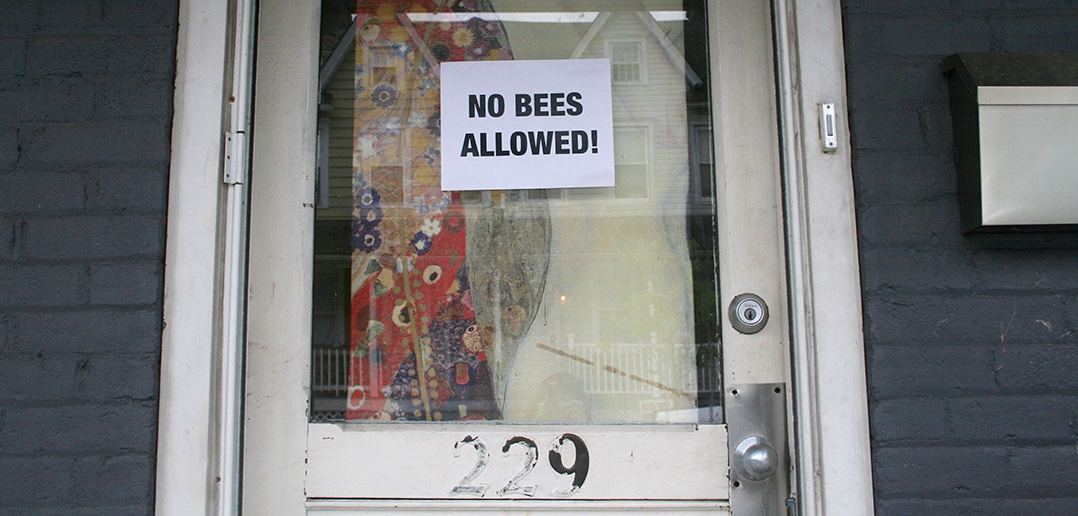
While students on campus are assisted by Rid-Et, off-campus students must navigate the season without this service. Although landlords can help provide tenants with pest-control services, not all students who live off campus have this luxury. With wood bees and hornets buzzing past pedestrians, several students have decided to call attention to the problem.
Signs have been placed on doors and telephone poles with slogans with images of bees in army hats, or the bugs with the “no” symbol around it. The signs themselves do not faze the bees, which Snyder said typically remain active for the next month or so before easing off with the arrival of summer. Similarly, the gnats are especially active at the beginning of spring and the end of summer, when they can be seen impeding students’ vision as they try to make their way up the UC Front Lawn.
Snyder said the bug population at Lehigh is consistent with the area, and the university is not experiencing a greater amount of them, despite the high number of service calls in the past few weeks.
“Other than that, I’d say this is just a normal cycle,” Snyder said.
2 Comments
I can’t think of a less interesting brown and white article topic
You article’s topic may not be the best but your copy is very nice. I love your writing style.
Comment Policy
Comments posted to The Brown and White website are reviewed by a moderator before being approved. Incendiary speech or harassing language, including comments targeted at individuals, may be deemed unacceptable and not published. Spam and other soliciting will also be declined.
The Brown and White also reserves the right to refuse the publication of entirely anonymous comments.