



Lehigh’s alma mater mentions the “breast of old South Mountain,” but between the 1950s and 2011, no one knew just how far Lehigh’s land on the mountain reached.
In 2011, when the earth and environmental science department was moving from Williams Hall to the new STEPS building, associate professor Robert Booth discovered a piece of land that, almost a hundred years prior, made Lehigh different.
Today, Lehigh refers to this land on North Mountain Road as the “Lost Forest.” However, from the early- to mid-1900s, the land was simply split up into Lehigh’s arboretum, a botanical garden dedicated to growing trees, and a tree plantation.
The purpose behind this land usage was clear: to prevent the decimation of all forests in Pennsylvania and to discover what would best grow on Pennsylvania soil.
“At the time Lehigh was founded there was this emerging realization that trees are actually not an infinite resource,” said Stacey Kimmel-Smith, assistant director of Library and Technology Services. “There were concerns about reforestation and what it would take to make the forest something that would be sustainable. Experts were talking about a possible wood famine.”
Lehigh’s fifth president, Henry Drinker, was also the president of the American Forestry Association at the time. During his presidency, Drinker hired Lehigh’s first biologist, Robert Hall. Hall was responsible for teaching forestry classes to civil and mining engineers.
What Hall needed most for these classes was a forest to teach in. In 1908, Hall started growing the Lehigh arboretum with these classes.
“He started an arboretum that was considered unique to Pennsylvania at the time,” Kimmel-Smith said. “He tried to get one of every tree native to Pennsylvania, some trees from Europe, some trees from elsewhere in the U.S. I think that it ended up being around 3,000 trees and it really put Lehigh on the map, forest wise, in a lot of ways.”
After the arboretum was established, Hall also started growing the tree plantation. Hall experimented with trees that would aid in reforestation in the tree plantation, Kimmel-Smith said. He planted the species in different combinations to see how they grew together so that others in Pennsylvania could decide what could be grown best.
After a few years of working with these growing forests, Hall was removed from the project around 1915, and it was handed to someone more high-profiled.
“It was taken away from him,” Kimmel-Smith said. “He had done all of the work himself. All of the planting, all the hard labor. He was not a large man, he was fairly short, and he did it all outside of his normal responsibilities as a faculty member. So he was really hurt by this.”
Researchers at Lehigh used these two forests for several years, but once the World Wars began they were eventually forgotten about. By the 1950s, there were no records of the forest being used at all.
In 2011, Booth found a herbarium, which is a collection of dried, pressed plants, in the basement of Williams Hall. From this discovery and with the help of Ilhan Citak, the librarian of archives and special collections, Booth eventually rediscovered the boundaries of the Lost Forest.
Since its rediscovery, Booth has been leading and assisting research for those interested in the forest.
“We have been using the forest basically since we rediscovered it in 2011 and it’s a great place for student-driven research projects, particularly because of its rich history, proximity to campus and its really high diversity of trees,” Booth said.
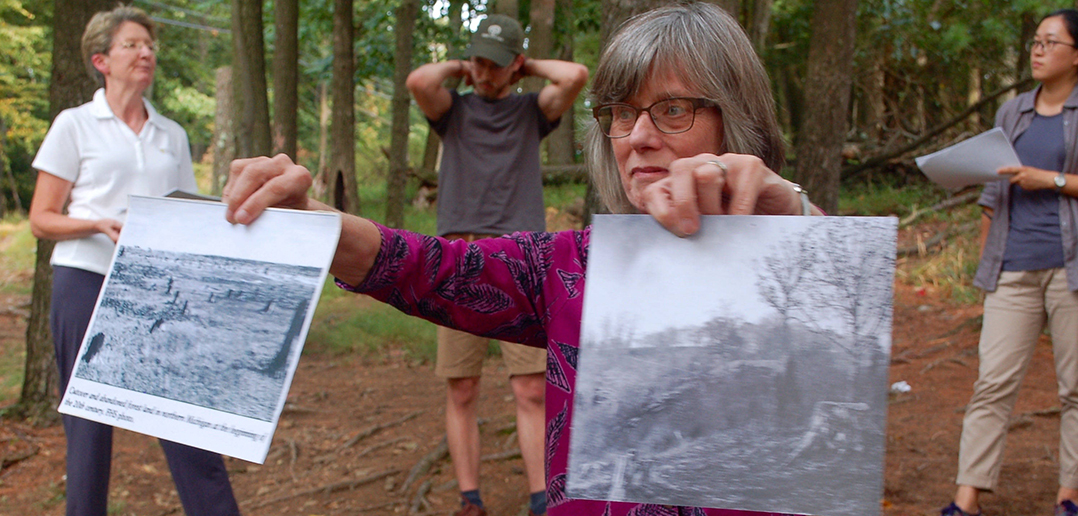
Five years later, LTS led a 5×10 event Sept. 20 led by Bob Mason, ’15G, in the earth and environmental science department and Kimmel-Smith, a group of about 50 students and staff walked the trails in the tree plantation.
Mason, who is researching the impact that the deer overpopulation has on the Pennsylvania forests, pointed out the different specimens of trees to those on the tour. These included a sugar maple, linden, tulip poplar, sassafras, red oak, beech and black birch trees.
“I wanted to see the woods, I wanted to get outside,” Lauren Dodgen, ’20, said. “I thought that it was really neat that they went through all the different types of trees, because I didn’t know all of them.”
Mason also discussed invasive species as well as dying species, such as the white ash tree, which is becoming infested with the emerald ash borer insect. Kimmel-Smith said Lehigh has worked to save this species from extinction by inoculating 200 of the trees that have historical significance to Lehigh.
As attendees walked the tour, Mason and Kimmel-Smith also pointed out several facts that are not well-known on Lehigh’s campus. These included bike and walking trails that run through the woods in the arboretum and the plaque that marked where Bethlehem Steel’s land ended and Lehigh’s began, before the land was sold to Lehigh for its Mountaintop campus.
“I enjoyed noticing the trails around here, more than the trees,” Oliwia Krupinska, ’20, said. “I didn’t know that Lehigh had so many trails, so it’s really nice for biking and running and any kind of outdoor sports.”
LTS held this 5×10 event to share the history of the Lost Forest with students. There are still parts of it that are yet to be surveyed, including the majority of the arboretum. Lehigh’s Earth and Environmental Science department has been working to resurvey the land that was forgotten for more than 50 years.
“Our history is amazing and our history with trees is a very good history,” Kimmel-Smith said. “The amount of time and effort we put into managing trees and making this a beautiful campus is worth pointing out and worth people appreciating it. When you walk around campus, there are so many different species of trees, and until I started this project I didn’t realize how much there was for us to enjoy.”
1 Comment
Should have made mention of the groves of spreading chestnut trees fron the early 1990’s. It would be nice to label a majority of trees with names on plastic instead of brass which might be stolen.
Comment Policy
Comments posted to The Brown and White website are reviewed by a moderator before being approved. Incendiary speech or harassing language, including comments targeted at individuals, may be deemed unacceptable and not published. Spam and other soliciting will also be declined.
The Brown and White also reserves the right to refuse the publication of entirely anonymous comments.