




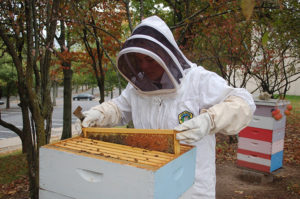
Several years ago, Andrew Januszak opened a bottle of honey harvested by local beekeeper. When he tasted the honey, he could taste all of the different aromas from the area it was harvested — all of the different trees, plants and flowers.
“My reaction to that was amazing, it was exquisite, because I never made that connection to the bees and all the local plants and trees,” said Januszak, the senior computing consultant for LTS and adviser for the beekeeping club. “To me that’s what helped me understand just how integral bees are to the environment, ironically through food.”
The beekeeping club was started in the spring of 2014 by Katherine Ballen, ’16G, when just a few students kept a single hive going.
After taking over the club in the spring of 2015, Januszak has helped more students understand the important role honeybees play in the environment. Now, with about 30 students involved and two hives to care for, the club has continued to grow.
Their main focus is on the survival and reproduction of honeybees in the two hives that are by Lehigh’s Iacocca Hall.
As one of several pollinating species, honeybees are an important part in the production of fruits and vegetables as well as the reproduction of many other plant species.
“A lot of our food would disappear if the pollinators would disappear,” Januszak said. “The bees in the local area are important because they obviously pollinate a lot of our local plants. They play a key role in the life cycle of those plants, so without them those plants would not exist because they would have no way to reproduce.”
For the students who are afraid of bees, club president Sabrina Fineberg, ’19, assures that the hundreds of bees in their two hives are “chill.” Fineberg is the only club member to ever be stung, and it was only when she accidentally sat on a bee.
The club’s vice president Dani Gyory, ’19, said there is no reason for students to be frightened by their bees, and the risk of getting stung was one she was willing to take.
“It’s a personal choice what you’re willing to do,” Gyory said. “For me, I was very willing to go up, but I guess there are people who are very scared of them. I think you have to be willing to take that risk. It’s one thing if you’re allergic, you shouldn’t be going up, but if you’re willing enough to go up and learn about them and you’re interested, then you should.”
The responsibilities involved in beekeeping vary. They mainly do a lot of upkeep in the hives, which involves regularly checking if the queen bee is reproducing well. They decide this by the number of eggs laid in the hives. They also treat the bees when they have mites, which are parasites that weaken the bees and kill them.
“We’re pretty much just trying to help (the bees),” Fineberg said. “Providing a home for them, taking care of them, especially treating them for mites. I think it’s all super important.”
Bees are suffering from colony collapse disorder (CCD), which according to the Environmental Protection Agency, means a large number of working bees disappear from the hives. They leave behind only food and a few nurse bees to care for the young bees and the queen.
Although CCD is not the only cause of the decline in bee population, it has contributed to their new listing on the U.S. Fish & Wildlife Service’s endangered species list. Fineberg said the cause of CCD and the overall decline is not yet determined.
“There are all kinds of theories of why bees are dying, and no one honestly knows why,” Fineberg said. “We know that certain pesticides are really bad for them, so that’s one of the theories why. I don’t know if people can explain the entire colony collapse disorder with that, but it is frightening.”
Fineberg also believes people don’t appreciate bees until they hear about them in the media and only consider their danger when they will soon be gone.
To get the word out about the importance of bees, Fineberg focuses on educating children of younger ages.
“There are a ton of kids that I babysit for who are terrified of bees,” Fineberg said. “So their parents have asked me to talk to them and show them pictures of the hives to show them that they are really important and they have other purposes than just to sting.”
Januszak also said some of his goals for the club include educating Lehigh students about the importance of bees, becoming more of a presence on campus and the community and making Lehigh’s campus a more pollinator-friendly place.
Another responsibility of the beekeeping club is harvesting the honey that is produced in the hives. Fineberg said they try to harvest whenever the bees are producing the most honey but refrain from it in the winter months, as the honey is the bees’ main food source.
Right now, the club is selling the honey they gather for a donation toward the club. With the growing number of club members, they do not have enough equipment for most of the members to take part in the beekeeping. If they are able to purchase more veils and gloves, more students can join in the beekeeping experience.
1 Comment
Wonderful!
Where can we buy the honey?
Comment Policy
Comments posted to The Brown and White website are reviewed by a moderator before being approved. Incendiary speech or harassing language, including comments targeted at individuals, may be deemed unacceptable and not published. Spam and other soliciting will also be declined.
The Brown and White also reserves the right to refuse the publication of entirely anonymous comments.