



Feeling sluggish and struggling to find the motivation to get out of bed, Lauren Miller, ’18, finds it difficult to attend class during the winter.
Although she has had fluctuations of depression since middle school, Miller said she sees her depression occur more frequently during the winter than during other seasons. This time of year, Miller is one of many who struggle with Major Depressive Disorder with a Seasonal Pattern.
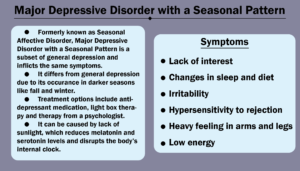
Formerly known as Seasonal Affective Disorder, this affliction occurs to people during the fall and winter months due to shorter days or lack of light.
“During the winter, I sometimes have to give myself the extra push to get up,” said Miller, who serves as the vice president of Lehigh’s chapter of National Alliance on Mental Illness. “Thankfully it has never affected my school work, but I have missed classes.”
Doctoral intern Alyssa Boer said because Seasonal Affective Disorder is a subset of depression, the symptoms are the same as general depression. The primary difference is it’s seen in darker seasons. It is also seen more in northern places. Symptoms include a lack of interest, and changes in sleep and diet.
There are three kinds of treatment for Major Depressive Disorder with a Seasonal Pattern. These include antidepressant medication, therapy from a psychologist and light box therapy.
Light box therapy involves sitting in front of a box of light in the morning for about half an hour. Dr. Shamell Brandon, a staff psychologist at Lehigh, said consultation with a doctor is important before light box therapy because it can make a person jittery afterward if not used appropriately. Brandon said the light box should be at 10,000 lux, causing it to emit a power level of light.
Brandon said the symptoms should scale back once the season changes to spring.
“If it goes throughout the year, it’s more likely not seasonal depression and could be something else,” Brandon said. “So it will remit eventually, but getting treatment when it is flaring up is highly encouraged.”
Because of the stress from school work and all that comes with being a college student, Miller said students might think what they are feeling is typical. She said if students are still feeling sad every day, they should seek help.
“Being at college makes it harder just because college students are usually not aware of their emotional states,” Miller said. “So, they might brush off these feelings of depression or think that it is something typical of all college students to feel.”
Paul Asadourian, ’17, the president of the Peer Health Advisers, said students need to keep both physical and mental health in mind this time of year. Peer Health Advisers try to direct students in the right direction and offer educational programs about health.
“Lehigh has this reputation of a work hard, play hard school, and that can kind of get out of hand,” Asadourian said.
He said this unofficial motto can take a toll on students. Peer Health Advisers try to help students through events like bringing in therapy dogs and the De-Stress After Dark programs during exams. Asadourian said events like these can help students’ health in college by taking their mind off of school work for an hour.
National Alliance on Mental Illness, Peer Health Advisers and the Counseling and Psychological Services center want to help reduce the stigma around mental health. They want to make it more of a discussion topic at Lehigh.
“We are constantly told to take care of our physical health but no one really tells us to take care of our mental health,” Miller said. “It could be so much better. There is so much to improve on, which we can do through funding.”
Miller said the kind of help needed for Major Depressive Disorder with a Seasonal Pattern depends on the person. She said students may feel more comfortable talking to a peer, a family member or a close friend. Crisis hotlines are also available if students need someone to talk to.
She added that Lehigh’s counseling center is a good resource, and she encourages students feeling depressed to go there. Miller said she hopes that if a student talks to a peer that the friend would push them to seek help.
“Especially with college students, they think they are stronger than they are,” Miller said. “So sometimes they need this little push to start to get help.”
1 Comment
Keep in mind whom you victimize when you say there is a stigma to mental health issues. You may then choose to stop.
Comment Policy
Comments posted to The Brown and White website are reviewed by a moderator before being approved. Incendiary speech or harassing language, including comments targeted at individuals, may be deemed unacceptable and not published. Spam and other soliciting will also be declined.
The Brown and White also reserves the right to refuse the publication of entirely anonymous comments.