



Wiretapping originated during the Prohibition Era. Julian Sanchez, a senior fellow at the Cato Institute, said originally it was legal to wiretap without a warrant because it was equivalent to “overhearing a conversation.”
In 2010, technology was evolving with the widespread use of pagers and email, which forced the laws to change to require a warrant for wiretapping. In 2017, technology has expanded even more.
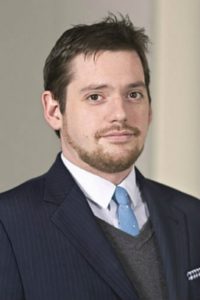
Sanchez, who specializes in electronic surveillance and civil liberties, spoke at Lehigh on Thursday as the keynote speaker for the 2017 Tresolini Law Lecture.
The focus of the lecture was electronic surveillance and the Fourth Amendment, which has been a hot topic of recent political discourse.
The Tresolini Law Lecture is an annual event hosted by the political science department in honor of former professor Rocco J. Tresolini. The event has brought nationally recognized legal scholars, public intellectuals and U.S. and state Supreme Court justices to Lehigh.
Sanchez discussed the ethical arguments against electronic surveillance by drawing a distinction between the two most common objections.
Before recent technological advancements, most people had thought of privacy as the physical intrusion of space. However, electronic surveillance also opens the door for the exposure of personal secrets, which Sanchez said is potentially a more dangerous violation of privacy.
Sanchez described how the psychological effect of wiretapping is used to exercise control over the population by having the conscious feeling of always being watched by the government.
Mike Horgan, ’16, ’17G, was one of the students in attendance. He said before the lecture, he hadn’t realized how much of the past was influenced by electronic surveillance.
“I always thought of it as a tool that I trusted the government having because they would use it to protect us and the whole ‘If you have nothing to hide, what does it matter?’ argument,” Horgan said. “But I see now where the other side of the spectrum is coming from when they talk about the possible misuse of the surveillance powers.”
Horgan agreed with Sanchez that allowing the government to use electronic surveillance to keep us safe justifies a lot of what the government secretly does. However, both men think allowing the government to have absolute power is unnecessary.
Horgan thinks Lehigh likely uses some electronic surveillance on students, specifically through Lehigh email and Course Site.
“I know they reduce Wi-Fi to excessive streaming and professors can see if you clicked on a reading on Course Site,” Horgan said. “I don’t think any of these things are necessarily an invasion of privacy, and I don’t know if they monitor our browser history on their Wi-Fi and take any note to it or anything.”
Soraya Todd, ’17, also attended the lecture, and said she gained insight from Sanchez.
As a political science major, she comes across similar intellectual conversations daily. She said the lecture helped her understand an individual’s right to privacy.
“I used to be against government surveillance without our consent, however I do understand the importance of surveillance regarding counter-terrorism efforts,” Todd said. “It is an extremely complicated and controversial topic I want to learn more about. This lecture helped me to gain more insight and knowledge about the issue.”
As both Horgan and Todd noted, Sanchez wanted the attendants to think about how much privacy they value in their everyday lives and what level of surveillance they are comfortable with.
Comment Policy
Comments posted to The Brown and White website are reviewed by a moderator before being approved. Incendiary speech or harassing language, including comments targeted at individuals, may be deemed unacceptable and not published. Spam and other soliciting will also be declined.
The Brown and White also reserves the right to refuse the publication of entirely anonymous comments.