



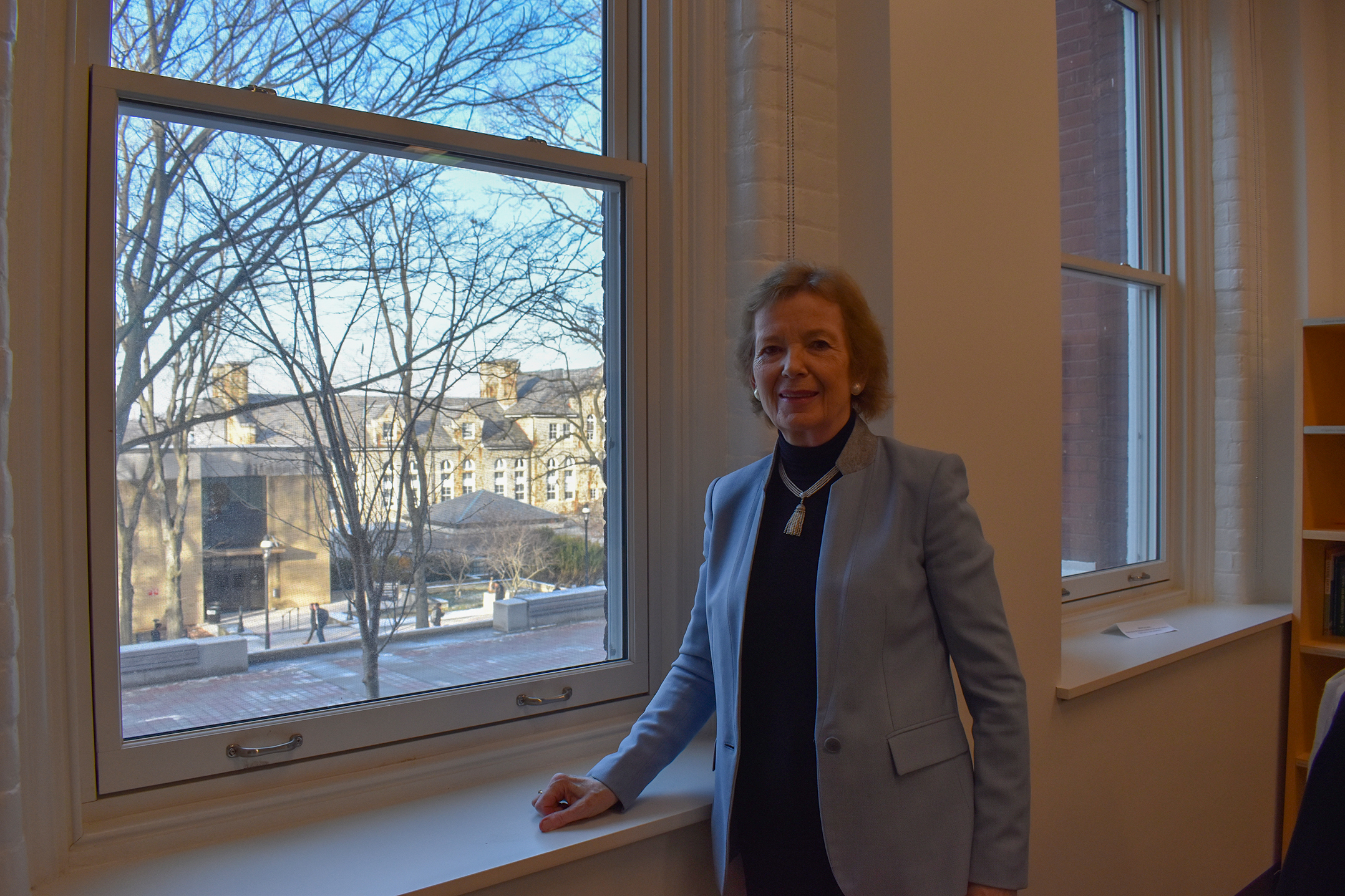
As UN High Commissioner for Human Rights from 1997 to 2002, Mary Robinson focused on dealing with human rights issues — gender, women’s empowerment and education, to name a few. Climate change never crossed her mind as a pressing human rights issue.
That is, until she spoke with those most affected.
When she visited African countries such as Rwanda, Liberia and Malawi, women told Robinson that “things were so much worse” because the seasons had changed. They couldn’t predict when the rainy seasons would come, or for how long. They didn’t know when to sow. They didn’t know when to harvest.
Entire livelihoods are forced to adapt to a less predictable environment because of climate change.
“It was an absolute eye opener, and I realized I had completely missed it,” Robinson told The Brown and White. “I then understood, when I read the science, that it was something that would become an existential threat in a way that was really serious, and that we needed to get on top of it because, otherwise, it would continue to affect those most vulnerable and least responsible (for it).”
Robinson came to Lehigh on Feb. 6 as the 21st Kenner Lecture speaker. She spoke to Lehigh and Bethlehem community members about her experiences as the first female president of Ireland, the former UN High Commissioner for Human Rights and an activist for climate justice. Earlier in the day, she also attended a roundtable meeting with a group of students interested in climate justice.
Following her experiences in Africa, Robinson formed her foundation, the Mary Robinson Foundation – Climate Justice. She said her foundation devised seven principles of climate justice, to which her work is connected.
Her evening lecture in Baker Hall focused on several climate justice issues, including the exploitation of fossil fuels, climate law, sustainable development and politics. She also spoke of environmental education and emphasized that students and universities play an important role in climate change solutions.
Robinson encouraged Lehigh students to be actively involved in making a calculated change for the climate justice movement.
“My generation failed,” she said during the lecture. “Your generation is in a different place — you know more, you’re ingesting it in a different way, you’re innovating and want the solutions.”
She used the example of Trinity College Dublin, where she is the chancellor. After a student movement pushed the administration to divest from the fossil fuel industry, it morphed into a movement for sustainability.
Lehigh has yet to divest from the fossil fuel industry and Robinson challenged the administration to consider the change.
“If you’re investing in the fossil fuel (industry), then you’re not really acting with accountability for the future,” Robinson said. “It’s a difficult process, but it’s a decision that universities have to make.”
Since President Donald Trump pulled out of the Paris Agreement, Robinson noticed more of an appreciation for climate justice across the nation.
“So many states and cities, business and philanthropies, universities and civil societies have made it clear that, ‘We are still in, we’re still going to fulfill the commitments,’” Robinson said.
In June 2017, Lehigh committed to uphold the Paris Agreement, which was designed to keep climate temperatures from surpassing 1.5 degrees Celsius above pre-Industrial Revolution levels. Robinson believes the United States could still meet the national targets President Barack Obama set for the reduction of emissions in 2015.
Graduate student Joe Lule said it is possible for influential groups within a community like Lehigh to make a difference in solving climate change problems with a more localized focus.
“With climate justice, especially now with (President Donald Trump) backing out of the climate agreement, universities like Lehigh have an obligation to push that agenda to fight against climate change,” Lule said. “The best option would be to look into localism and take that and promote the idea that cities are their own independent places that can develop their own climate strategy.”
Robinson also said seeing and understanding these issues from multiple perspectives is an important step in solving them. She said all nations must work together to enable a safer and productive future for all peoples.
During her speech, Robinson largely focused on the importance of empathy and fairness in solving climate justice issues, not just technological advances.
Her own motivations for advocating for climate justice came from a moral argument that arises from the issue — that wealthier nations must be the ones to reduce their fossil fuel emissions to prevent consequences of climate change and, at the same time, allow for emissions in poorer nations so they can escape poverty.
“One actually has to have a certain kind of empathy capacity to listen to (those affected) and a deep commitment to fairness to their values and treating them as your own, even though they’re different,” said Breena Holland, an associate professor of political science who attended the roundtable and lecture.
Robinson said all people will learn, if they haven’t yet, that climate change is a problem that needs an immediate solution. The effects on the vulnerable and marginalized will eventually impact all communities.
Quoting her fellow “Elder” Desmond Tutu, Robinson said people should try being “prisoners of hope” in a movement toward a more sustainable future.
“We have to work on what we have and we have to make it better,” Robinson said. “We have to be innovative, we have to be creative, we have to be insightful, we have to have that empathy.”
Comment Policy
Comments posted to The Brown and White website are reviewed by a moderator before being approved. Incendiary speech or harassing language, including comments targeted at individuals, may be deemed unacceptable and not published. Spam and other soliciting will also be declined.
The Brown and White also reserves the right to refuse the publication of entirely anonymous comments.