



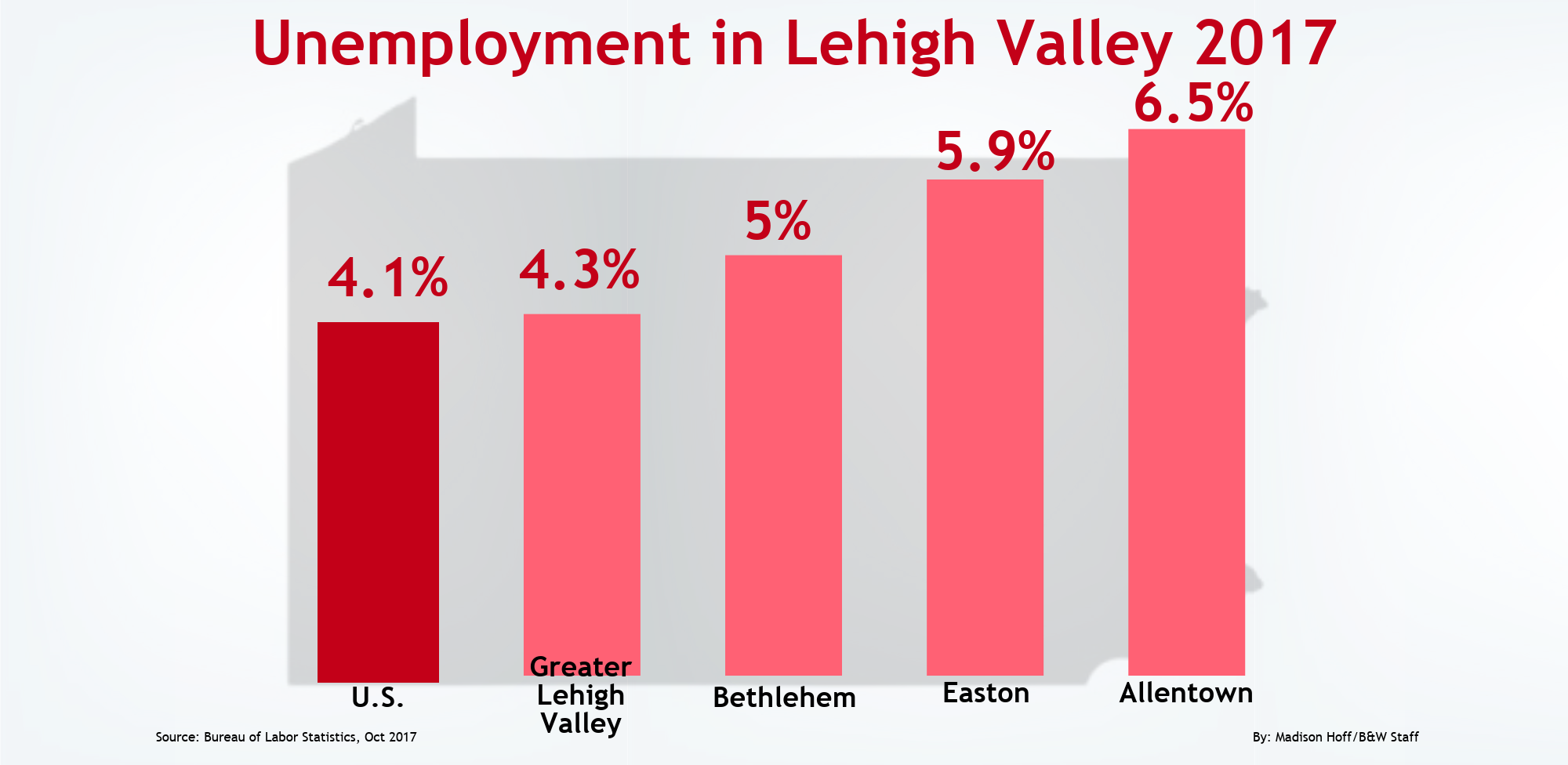
The Allentown-Bethlehem-Easton metropolitan statistical area — informally referred to as the Lehigh Valley — reports a 4.3 percent unemployment rate, falling just above the United States’ national unemployment rate of 4.1 percent as of October 2017, according to the Bureau of Labor Statistics.
The area’s three largest cities have unemployment rates that are more than 20 percent higher than the national average.
According to the bureau, Bethlehem’s unemployment rate as of October 2017 was 5 percent, while Allentown’s was 6.5 percent. Easton fell at a 5.9 percent unemployment rate.
The explanation for higher unemployment rates is not simple, but economists believe there are a few factors common to populated urban areas that explain why unemployment persists.
Allentown and Bethlehem have long boasted a large Hispanic population, and community advocates note that finding a job is more difficult for people whose first language is not English.
Meanwhile, local economists said the skills the economy demands have varied over the years. Before Bethlehem Steel Corporation shut down in the mid-1990s, the steel industry dominated the Lehigh Valley.
The number of manufacturing employees sharply declined in the early 2000s.
Irina Panovska, an assistant professor of economics at Lehigh, said when low-skilled workers of a certain industry are no longer needed, they are typically retrained, as their skills are not often transferable into a different sector.
Panovska said two industries with steady or increasing employment are healthcare and education — both of which generally require specialized education to receive the necessary certification.
According to the U.S. Census Bureau population estimates, the majority of those age 25 and older in both Bethlehem and Allentown have received at least a high school education. However, the number of residents with at least a bachelor’s degree is much lower, with only a little over a quarter in Bethlehem and about 15 percent in Allentown.
Lehigh professor of economics Thomas Hyclak said the unemployment rate tends to be higher for less educated people.
“Higher income and more educated people (of all races) tend to live in the suburban communities that are outside the city boundaries,” Hyclak said. “So essentially, the difference between the unemployment rate for the cities and the whole metropolitan area is reflecting the composition of the cities versus the population in the entire metropolitan area.”
Racial demographics
According to the 2010 U.S. Census, about a quarter of Bethlehem’s population and a little over 40 percent of Allentown’s residents are Hispanic or Latino.
Those who cannot speak English well, or at all, are put at a disadvantage when looking for jobs. Hyclak said some jobs, especially ones requiring employees to interact directly with customers, cannot hire someone without English-speaking skills.
The Spanish-speaking population has continued to rise since the devastation Hurricane Maria left on Puerto Rico in September 2017.
Mary Colón, the interim executive director of the Hispanic Center of the Lehigh Valley, said South Bethlehem has seen an influx of Puerto Ricans moving in with family members. Colón said she has seen more than 200 families move to the area since September.
She said a number of these new residents are professionals, including teachers and registered nurses, but because their certifications were completed in Puerto Rico, they are not valid in Pennsylvania. This has created a new group of unemployed individuals who are now working to become certified in their fields in the U.S.
When English is a second language, developing English-speaking skills becomes critical in finding employment and obtaining necessary certification.
The Hispanic Center offers free English classes to residents twice per week. The English classes serve not only to strengthen students’ basic knowledge, but also to teach them work-specific vocabulary.
“We try to gear them more toward employment skills so they can get through an interview,” Colón said. “So we develop that vocabulary, and we do mock interviews with them.”
Industry Skills
Colón said the former steel industry was once what attracted Latinos to move to the area.
Panovska said unemployment in the Lehigh Valley’s major cities might also be attributed to the area’s longtime dependence on Bethlehem Steel and the manufacturing business.
When Bethlehem Steel shut down and the manufacturing industry declined, workers were left with highly developed industrial skills that likely could not be applied to a job in another sector such as healthcare, where employment is on the rise.
Hyclak believes the Lehigh Valley was able to adjust well after the decline of manufacturing by shifting to service jobs and, most recently, distribution jobs.
Warehouses and trucking terminals populate the land along U.S. Route 22, Hyclak said, and the Lehigh Valley is becoming a large center for distribution because of its location relative to big East Coast cities.
Rosemarie Gonzalez, a manager at JobConnection Services in Allentown, hires residents for available positions at warehouses through job fairs such as those hosted by the Hispanic Center.
Gonzalez said warehouse jobs are on the rise, and soon it might be what the Lehigh Valley is known for nationally. She said more of her clients are becoming open to hiring Spanish-speaking workers, creating more opportunities for unemployed Hispanic residents.
Nancy Dischinat, the executive director of the Workforce Board of the Lehigh Valley, said lack of skills is one of the biggest barriers for unemployment.
She said the trade sector is also growing in the Lehigh Valley and earning a high school diploma is the best way to enter the trades.
Education
One of the Workforce Board’s goals, Dischinat said, would be for everyone in the Lehigh Valley to at least have a community college education.
“We constantly say that the new high school degree is an associate’s degree,” she said.
Education is emphasized at the Hispanic Center, as well. Colón said the employees encourage those who come to the center without a high school diploma to complete their GED diploma and afterward continue their education at a local college.
“The more educated our community can be, our community will also be healthier,” Colón said.
However, Panovska said a lack of education is not always the problem. Sometimes the issue is whether a person is developing the skills the economy needs through their education.
Finding work
The Workforce Board oversees the Lehigh Valley’s chapter of Pennsylvania’s state-run workforce system called CareerLink.
CareerLink helps connect residents seeking employment with employers through job fairs and provides services such as résumé assistance, computer training and mock interviews.
The Lehigh Valley’s main office is located on Union Boulevard in Allentown, but within the past five years, Dischinat said the board opened satellite offices in downtown Allentown, South Bethlehem and Easton to allow the residents of these cities to access career services without having to worry about transportation.
Dischinat said CareerLink partners with all of the employers from the Greater Lehigh Valley Chamber of Commerce.
CareerLink’s services aren’t limited to the adult demographic seeking work. CareerLink assists youths — which it defines as 16- to 24-year-olds — by working with local schools.
Dischinat said they hope to encourage young people to graduate high school and enter the workforce before they slip into the “relaxation period” that keeps them unemployed and dependent on their parents.
“We’re so invested in youth because that’s our pipeline,” she said. “And even if they’re not finding full-time jobs yet, they’re finding part-time jobs and we’re giving them skills training or making sure they complete their education, and we’re getting them ready for work.”
CareerLink employees visit schools each day, and Dischinat said their curriculum is based on skills they know employers in the area want. She said she hopes by placing an emphasis on helping youth find work, overall employment will improve in the future.
1 Comment
Another issue for the inner city in addition to the language barrier is the drug problem of many unemployed. Most companies drug test in addition to requiring fluent english. Good that the hispanic center is teaching english & perhaps they should drug test as well if they are trying to get people to be self sustaining contributors to society.
Comment Policy
Comments posted to The Brown and White website are reviewed by a moderator before being approved. Incendiary speech or harassing language, including comments targeted at individuals, may be deemed unacceptable and not published. Spam and other soliciting will also be declined.
The Brown and White also reserves the right to refuse the publication of entirely anonymous comments.