



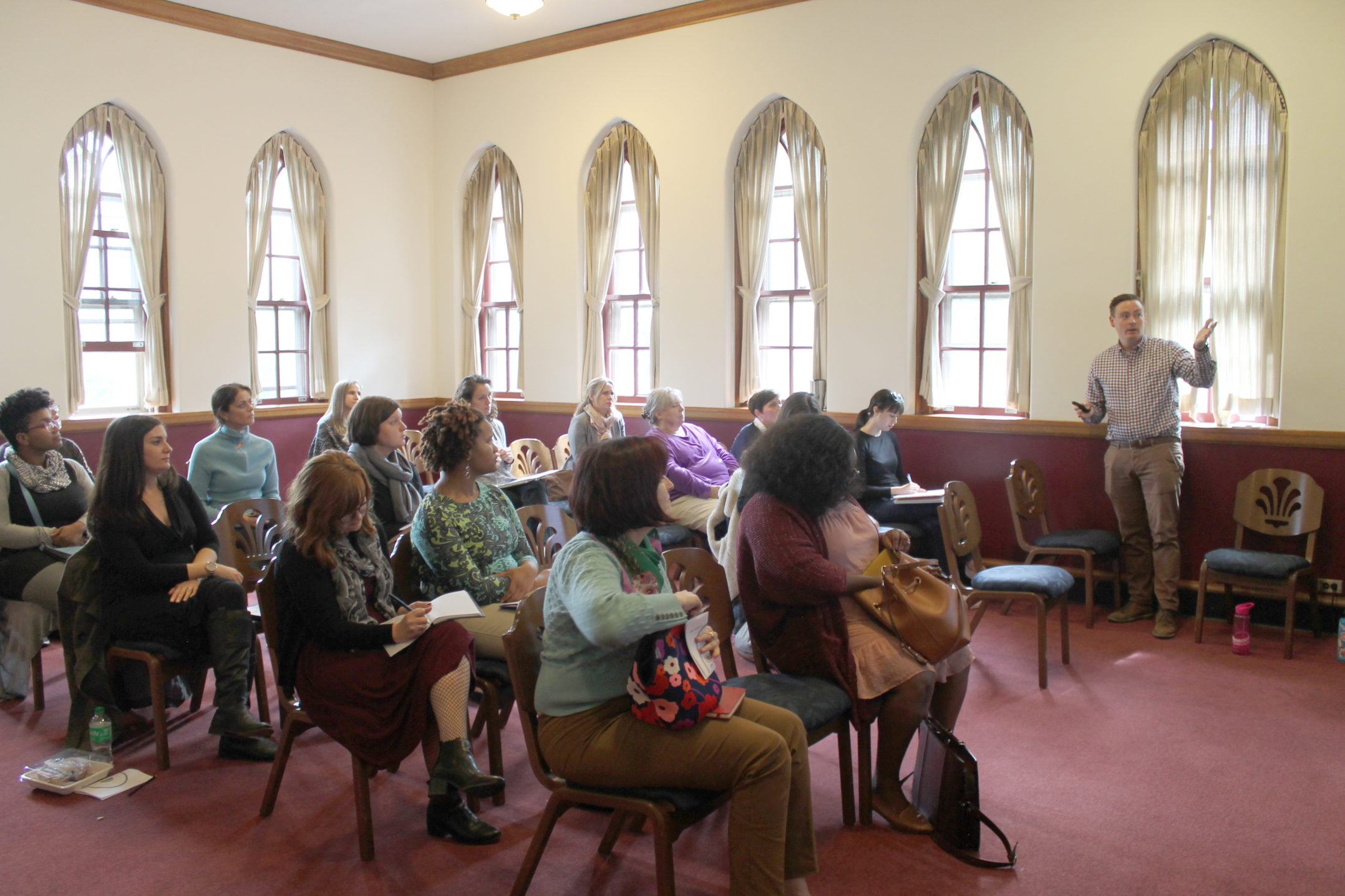
The Pride Center’s LUally program is changing its interactive training events to include more students and their experiences.
Intersections and foundations will be the focus of this year’s program, which has aimed to initiate dialogue on campus since 2016.
Foundation sessions review specific identities, such as asexual, or bisexual, pansexual, fluid and queer identities. They focus on specific elements of the LGBTQ+ community, talk about experiences and discuss how an individual can become an ally for the community.
Scott Burden, the associate director of The Pride Center, said intersection sessions delve into different overlaps between LGBTQ+ and other identities of those who have experienced forms of repression.
LUally hosted its first intersection session of the semester, “LUally Intersections: Intro to Intersectionality,” on Sept. 24 in the University Center.
The event started with a mask activity, in which participants were invited to share how they see themselves on one side of a mask and how the world perceives them from the other. They were then asked to notice differences and recognize internal responses.
During the session, Burden defined intersectionality as a way to consider the overlapping forms of systemic oppression that an individual might face, including white supremacy, immigration policy and the justice system.
“In our efforts to be advocates and to be allies for communities that find themselves on the margins, it’s important to be equipped with the knowledge,” Burden said.
Chelsea Gilbert, the director of The Pride Center, was a member of the team that created and implemented LUally, and she writes most of the curriculum as a facilitator of the program.
Intersectionality relates to Gilbert’s experience through both privilege and oppression.
“I’m a white cisgender woman, who is also queer, and so I occupy an interesting intersection,” Gilbert said. “My whiteness affords me a lot of privilege, my gender conformity and the fact that I’m cisgender affords me a lot of privilege, and yet I’m also constantly navigating what it’s like to be a queer woman, particularly a younger queer woman in a professional role.”
James Hamill, a former participant and now a facilitator of LUally, shares a similar viewpoint on intersectionality.
“When I go to a classroom, no matter what people know about me… I’ve noticed that it’s a lot easier for me to garner some kind of attention, focus and respect from my students, than potentially some of my colleagues of color, some of my female colleagues, because of the way they read me as a white guy,” Hamill said. “And so, although I might come out later as a queer person, I’m still vested with a lot of power and privilege as a result of these other identities.”
An upcoming event in this semester’s intersection series is “Exploring Disabilities,” which will review the experiences and needs of disabled LGBTQ+ people. Other sessions will focus on queer, transgender and intersex people of color as well as religion and spirituality, which will take place next semester.
About three-quarters of LUally trainings are requested and, therefore, customized to the department, organization, fraternity, sorority or residence hall that asked for it.
“Our thought process behind LUally is that we never stop learning,” Hamill said. “Whether we’re members within a particular community or allies to said community, there’s always space to grow — both in our knowledge, but also in our empathetic compassion to other people.”
2 Comments
“Whether we’re members within a particular community or allies to said community, there’s always space to grow — both in our knowledge, but also in our empathetic compassion to other people.” I hope this quote is meant to apply to everyone. All groups should understand that what they desire is not necessarily reasonable. Empathetic compassion is reasonable, item A on the agenda may not be.
It seems to me that the current Democratic/Republican split in our country needs to have tons more empathetic compassion on both sides. Our country needs leadership which it probably won’t get because such a person would be rejected by the left and right. The battle continues.
Robert, I’ve been reading you a long time now on this theme.
I think the problem — and the reason that we’re not seeing the mutual tolerance, if not understanding, that so many of us seek — is that at this point the views of life are mutually exclusive, so any time you start talking about anything serious you lack meeting ground — and meeting ground can no longer exist.
Removing the wealth-inequality problems and just talking about culture: I’ll say the problem started in the ’90s with the Republicans’ finding allies in the growing evangelical movement, which politicized itself to an extent, I think, that we haven’t really seen in religious movements in this country before. So we now have a Republican party that is not anything like the Republicans of the 1990s or before: it’s an evangelical movement that is specifically white supremacist, apocalyptic, patriarchal, and — you don’t have to scratch very far to find it — theocratic. There’s a libertarian strain running alongside it but it’s just a bit player in GOP politics now.
Meanwhile, the rest of the country’s gone along on the “open up” trajectory that started in the late 50s — increasingly diverse, increasingly open-opportunity, deeper and more open exploration of individual human experience, and increasingly nonreligious.
You wind up with one side saying “the entire society must be created in our vision” — because it is after all prophetic and evangelical — and the other side saying “it’s cool if you want to do your thing in your own lives and spaces, but you must recognize it as one choice among many equivalently-good choices, and allow others to live as they see fit” — which, in the end, is also “the entire society must be created in our vision”, because that is relativism, room for all to do their things. It’s just that the relativist’s vision leaves room for the evangelical (while being conveniently blind to all that evangelism implies), while the evangelical’s leaves no room for the relativist. Both have their surrounding dishonesties: the relativist does in fact want restrictions on all, and the evangelist wants the green from whoever’s got it when God fails to provide. But on the whole you’re still left with a specifically Christian patriarchal absolutism vs relativism.
And that is why it’s come to this. There isn’t much meeting ground to meet on. The liberals are generally more interested than the evangelicals in understanding the other side, but it’s not entirely one-sided. Still, understanding without the existence of negotiating room leaves you no better off in a day-to-day political sense. You’re still going to have a big fight over important things in life.
The interesting thing is the apparent role of the establishment clause in all this. Evangelical Protestantism seems to have topped out at around 20% of the US population — certainly big enough to make some noise, but not big enough to take over decisively, no matter how loud. It also strikes me as the lowest-entry-bar kind of religion we have: you don’t have to study for ages, you don’t have to tithe, you don’t have to change your dress or your eating habits, you don’t even really have to learn an unfamiliar theology, since we’re already baseline Christian, culturally, in this country; all you need is enthusiasm and the need for some kind of spiritual community, and a couple hours for church. Maybe not even that. So it seems that without the establishment of a state religion, no religion’s going to be overwhelmingly popular, and a theocracy is quite unlikely to take hold. Well done framers.
Comment Policy
Comments posted to The Brown and White website are reviewed by a moderator before being approved. Incendiary speech or harassing language, including comments targeted at individuals, may be deemed unacceptable and not published. Spam and other soliciting will also be declined.
The Brown and White also reserves the right to refuse the publication of entirely anonymous comments.