



 Lehigh students, and college students nationwide, are experiencing higher levels of anxiety, depression and feelings of loneliness.
Ian Birky, the director of counseling and psychological services at Lehigh, said the main cause for poor mental health in students is loneliness.
“Too many feel alone, whether it’s walking into a cafeteria or into a party or a library or the fitness center,” Birky said.
Nova Stoller, ‘21, the safety and wellness chair of Student Senate and, full disclosure, a photographer for The Brown and White, said Lehigh is a high-stress environment where students are under a tremendous amount of pressure.
“All this work that hits you in waves, where you don’t have anything for weeks and then you can’t breathe,” Stoller said. “I see personalities flip.”
The statistics on student mental health speak for themselves.
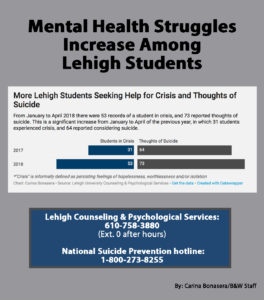
Birky said his data show 31 students reported they were “in crisis” between January and April 2017. But for those same four months in 2018, 53 students reported they were “in crisis.”
Reports of suicide considerations rose from 64 in January-April 2017 to 73 in January-April 2018.
Though the size of Birky’s staff has remained constant, the Counseling Center saw 537 clients between January and April 2017 and 630 between January and April 2018.
Despite the circumstances, Birky has managed to find a sense of relief.
He said it has been 20 years since a Lehigh student committed suicide while enrolled in classes and living on campus. Based on national averages and the university population, he said a suicide “should” statistically happen every two to three years.
“We’ve had some major attempts and only by the grace of God did they not die,” Birky said. “The biggest fear is suicide. It’s so devastating when that happens, it just tears campuses apart.”
With the current student population, Birky believes there should be three more therapists on staff to avoid burnout and meet demand. He said there are not enough therapists to see all students who seek help within a week.

“We are pushed to the limit,” Birky said. “I’ve messaged that to the administration. There are plans to increase the student body by 1,500, we definitely need more therapists. There’s no doubt. They know that.”
A recent study conducted by Cigna, a health insurance company, found that 48 percent of college-aged U.S. adults reported feelings of loneliness. Birky said the increase in connectivity via social media doesn’t necessarily come with deeper intimate connections and might be a factor contributing to loneliness.
This loneliness reaches a swath of the student population — Birky estimates that up to 20 to 40 percent of students occasionally struggle with a level of anxiety or depression so painful it takes their breath away, makes it difficult to feel happy and makes it difficult to leave their rooms to study or go to class.
Christopher Mulvihill, the associate dean of students, said his biggest concern is when students turn to hard alcohol to cope with mental health problems. Birky said in his experience, it is hard to find a Lehigh student who doesn’t consume alcohol. And Stoller said she believes there is a high rate of substance abuse on campus.
Mulvihill said he sometimes sees students’ mental health issues manifested in conduct issues, which is when he intervenes.
“Students are more aware of their own mental health issues,” Mulvihill said. “We have students here who need help. When the help is there and the student is not utilizing it, that’s when problems occur.”
Mulvihill said Lehigh’s large engineering and business schools, high participation in Greek life and the socioeconomic status of the typical student make students more susceptible to issues with alcohol compared to students at other universities.
However, he said only 10 to 12 percent of Lehigh students interact with the conduct office, which falls in line with college averages on a national scale.
Birky believes the image-conscious campus culture relates to student mental health in that students constantly feel they need to be connected and in control.
“The problem lies in when people feel reluctant or hesitant to talk about the dark side of their experience — where their pain is at, where they’re not so confident, where they’re worried,” Birky said. “That imbalance is what gives rise to mental health problems.”
Alex Hannaby, ‘19, the president of Lehigh’s chapter of the National Alliance on Mental Illness, has dedicated herself to combating the stigma associated with mental health issues, which she said often prevents students from seeking help.
“It can be hard at times with the stigma to talk about mental health, especially at a school that’s very academically focused,” Hannaby said. “It’s easier to push it away. But it’s OK to not be OK, and we need to make an effort as a campus to be accepting of those around us and be able to talk about these tough issues with our peers.”
If you or someone you know is struggling, make an appointment with Lehigh’s Counseling and Psychological Services or review Student Affairs’ list of crisis options and emergency contacts.
3 Comments
I wonder how much of the “loneliness” is a result of the way students were raised as children. If persons are happy within themselves I don’t see loneliness as a big problem, especially at a university. Do statistics exist for many previous years at Lehigh. I feel statistics will show more students with problems today. The problem existed during my undergrad days (I recall Cornell as the poster child with it’s on campus suicide lure); the solution was probably “tough it out” or equivalent. The 1965 Epitome shows Health Services with 3 doctors and a physiotherapist; there must have been some nurses also; seems like nobody for mental health.
Life at Lehigh mirrors life in America where the symptoms are treated but not the causes. As counseling and psychological services tries to expand to meet its clients needs, the conservative administration recommends working smarter and doing more with the same inadequate resources. More and more students with mental health issues will be enrolling.
Lehigh didn’t cause this problem but I hope its graduates will do much to solve it as citizens, professionals and parents. Do a better job than my generation. In America, the baby boomers got rid of the hypocritical silent majority and replaced it with what you see now.
I recently encountered mention of a book written by Professor David Graeber of the London School of Economics. The title is: Bullshit Jobs: A Theory.
It has received an enormous amount of media attention since it was published last May.
https://www.amazon.com/exec/obidos/ASIN/150114331X/
I’ve long considered many psychologists and therapists as being self serving leaches who prey on people with too much time and money on their hands. This cartoon illustrates the breed:
https://comicskingdom.com/pardon-my-planet/2018-08-25
One of the few competent therapists I know remarked to me that she was amazed in her undergraduate days of studying psychology at how many classmates it that curriculum were themselves “screwed up”. Her theory about them was that they recognized they had some problems and entered the curriculum to try and figure themselves out.
I vividly remember an anecdote discussing a statement by the head of the Langley Porter Psychiatric Institute in San Francisco.
He remarked that psychiatrists and psychologists make as many people worse as they make better.
The bottom line being that they are a “zero sum” game and on average provide no benefit at all.
=====
I suspect that yes, there probably have been a few students that have indeed needed some serious help. I recall one such student from when I was at Lehigh.
If students are indeed “suffering” from the anxieties that Birky claims, it is probably due to the myriad of utterly useless requirements and demands placed upon them by Lehigh’s myriad of petty bureaucrats and administrators.
For example, the Office of Fraternity and Sorority Affairs (OFSA) requires fraternity and sorority members to attend no end of brainwashing meetings and workshops. Furthermore they insist the students produce no end of silly documents and presentations ranging from New Member Education Plans, Risk Assessment Plans, to Accreditation Presentations.
One would think that these petty bureaucrats feel the students have nothing better to do with their time. They fail to recognize that the reason the students are at Lehigh is “in theory” to attend classes, study, do reading and homework assignments, take and pass exams, etc.
======
Dwelling back on the beginning of this comment and the subject of Bullshit Jobs” .
Nothing exemplifies them more that Lehigh’s Office of Diversity, Inclusion and Equity bureaucracy shown on page 4 of Lehigh’s organization chart:
https://www.lehigh.edu/~pres/orgchart/luorgchart.pdf
Lehigh would do well to eliminate everything and every one shown in that chart
It is all phony nonsense that breeds hate, division, and discontent rather than unity.
Every one of the organizations and people shown in that organization chart page are a classic example of that what Professor Graeber is talking about in his book.
They are bullshit jobs that are useless and counterproductive.
The comments here are so grotesque that I actually went and had a look around at Lafayette’s paper, Bucknell’s, and a bunch of others. None of those schools have collections of men writing “I despise myself, so I’m going to take it out on others in the most bigoted and meanspirited way possible” comments all over their student papers.
Are Lehigh alumni just especially awful, or what is it? If it were one or two weirdos, I’d shrug about it, but there seems to be a pretty good supply. If I were school-shopping and I saw all this stuff, that noise you’d hear would be me scratching the place off my list. These are not people I’d want to spend $200K to be associated with, or for my kid to be associated with.
Comment Policy
Comments posted to The Brown and White website are reviewed by a moderator before being approved. Incendiary speech or harassing language, including comments targeted at individuals, may be deemed unacceptable and not published. Spam and other soliciting will also be declined.
The Brown and White also reserves the right to refuse the publication of entirely anonymous comments.