



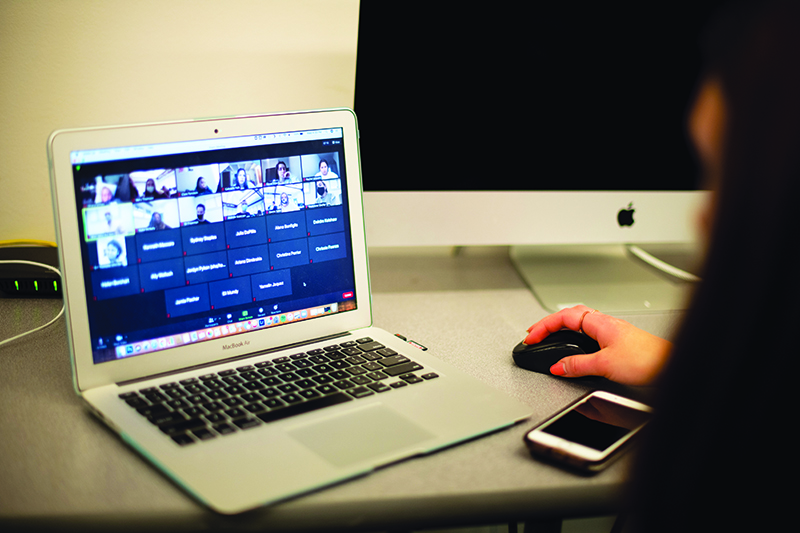
Motivation eludes you as you tumble out of bed and into some oversized sweater and stain-covered sweatpants — after all, no one will be seeing your waist down. Your dread morphs into panic as you notice the patch of hair awkwardly sticking out and the night light you left on behind you — no one can know you’re still scared of the dark.
Once you’re logged in and your professor introduces today’s subject matter, you can’t help but over analyze yourself in the corner of the screen or compare your room or angle to someone else’s. Your heart pounds at the thought of being talked over, ignored or having technical difficulties.
These and many other feelings brought on by the onslaught of video calls are a phenomenon being coined “Zoom anxiety,” and it’s becoming increasingly prevalent as the COVID-19 pandemic alters students’ daily educational lives.
In a survey completed by U.K.-based visual presentation design agency Buffalo 7 in late 2020, of over 2,000 home workers surveyed, more than seven in 10 experienced some form of video call anxiety. Additionally, in the U.K., there was a 180 percent increase in Google searches for “Zoom anxiety” between March and November.
“You know everybody experiences Zoom fatigue—we’re all exhausted at the end of the day—but the anxiety piece is quite different,” said Farah Vallera, a professor of practice in the College of Education.
Vallera emphasized the significance of the little video boxes everyone is subjected to through Zoom calls. She said the constant live videos generate anxiety by disallowing students and staff to act as they normally would.
“Think about when you’re at the grocery store,” Vallera said. “You have a stage, you know your roles and your lines, so when you get up to check out, you’re going to make small talk with the cashier, you’re likely going to put your phone in the pocket so that you’re not perceived as rude.”
She said a lot of mental work must go on all at once on Zoom, but it is more than there would be if students and faculty were in person. This is due to fewer social, physical and verbal cues to read and to react to.
Therefore, the work people put into socializing differs drastically between in-person and Zoom classes, Vallera said. For example, she typically uses her hands frequently when lecturing in front of a class, but does so less frequently on Zoom calls, where she feels like another version of herself.
“We are just shoulders and heads, right?” Vallera said. “We’re not taking in the nonverbal communication and things that we would be able to use to read other people.”
To Michelle Seagull, ‘23, it’s harder to gauge the proper etiquette for something so seemingly awkward. She said looking directly into the camera feels less personal but necessary to mimic professional eye contact.
It makes sense to Vallera, then, that this new normal would foster the growth of anxiety among students using these video call applications so often.
Not only are people looking directly at the camera or others, but they are also spending a copious amount of time feeling hyper-aware of their looks.
“Seeing my face all of the time makes me really aware of all the problems and imperfections that I tend to stay away from,” said Kai Davison, ‘22. “I’ll just spend more time than I need looking.”
In the Buffalo 7 survey, nearly half of those who said they experienced Zoom anxiety attributed it to being unable to prepare an appropriate appearance.
“You might feel that way a little bit in person, but it’s not literally staring you right back in the face,” Seagull said.
Now imagine if your background is more personal: a messy room, leak in the ceiling, parents seen fighting in the background or even three kids sharing one small room, all of which may be aspects of your life you didn’t want to broadcast.
With the social norm being that cameras remain on, it creates a “Catch-22,” as Vallera calls it, that can cause a lot of stress for both students and staff. To her and Elena Cucco, a staff psychologist in the Counseling Center, students miss out on valuable connections and learning when their cameras are off, but it can be depressing or anxiety-provoking to expose their personal spaces on camera.
According to Vallera, much of this Zoom anxiety is instigated by students being deprived of social interaction. Vallera said students are used to leaning over and asking a question during class to make friends, reading body language and nonverbal cues and moving about the classroom to show off a new sweatshirt or pair of earrings.
This lack of “chemical reward” has led educational specialists and psychologists like Vallera and Cucco, respectively, to try and determine what can be done to help students through this seemingly new mental health struggle.
They agree that more small group interactions through breakout rooms, ice breakers or designated check-in spaces are crucial to building a safer learning and living environment for students.
“It allows them to connect with humans, talk about your day, or what’s going on,” Vallera said. “They need time to talk about me and complain about my projects—to be with one another.”
They know this is no simple task for educators, but it is also not being discussed enough, whether some faculty are simply unaware or are still learning how to handle the switch to distanced learning.
Vallera has faith that faculty will “level up,” stating that they will acknowledge the surge of Zoom anxiety and figure out empathetic means to manage it for their students.
Seagull, however, hopes vaccine roll-out is efficient enough to get fellow students back in the classroom and out of their own heads.
1 Comment
Another great article by Sam Barney-Gibbs. Always thoughtful, insightful and eloquent. A really talented student-writer!
Comment Policy
Comments posted to The Brown and White website are reviewed by a moderator before being approved. Incendiary speech or harassing language, including comments targeted at individuals, may be deemed unacceptable and not published. Spam and other soliciting will also be declined.
The Brown and White also reserves the right to refuse the publication of entirely anonymous comments.